

International development consultant jobs are specialized roles where experts provide technical assistance to organizations like the World Bank and UN on a contract basis. These assignments range from short-term policy analysis to multi-year project implementation and demand deep expertise in fields like public health, economics, or environmental science.
The Reality of International Development Consulting
Let’s be direct: landing a consulting gig with a Multilateral Development Bank (MDB) or a UN agency is a tough game. It takes more than a good CV.
You need to understand the specific needs of these institutions and position yourself as the go-to expert who can solve their exact problem. These organizations don’t hire generalists. They bring in specialists to fill critical knowledge gaps on their teams.
This isn’t a permanent staff position with a predictable career ladder. It’s a series of high-impact assignments. Your job is to deliver a specific output, a detailed feasibility study, a national policy framework, a training program for government officials. Once the work is done, you move on to the next contract.
Core Roles and Contract Types
Consultants are the flexible workforce of the development world. They’re brought in for two main reasons: expertise and capacity. A project team might need a water sanitation engineer for a six-month infrastructure assessment or a gender specialist for a three-year program.
These engagements generally fall into a few key categories:
Short-Term Consultant (STC): These assignments typically last less than 150 days in a year. They are laser-focused on a specific task, like writing a report, evaluating a project, or facilitating a workshop.
Long-Term Consultant (LTC): These contracts can run for one to three years and often involve embedding you within a project team. You might serve as a technical advisor or a project manager for one piece of a larger loan or grant.
Framework Agreements: Some consultants get pre-vetted and placed on a roster. When a need pops up, the agency can contract them quickly without going through a long, drawn-out procurement process.
This process flow shows the core pillars you need to master to succeed.
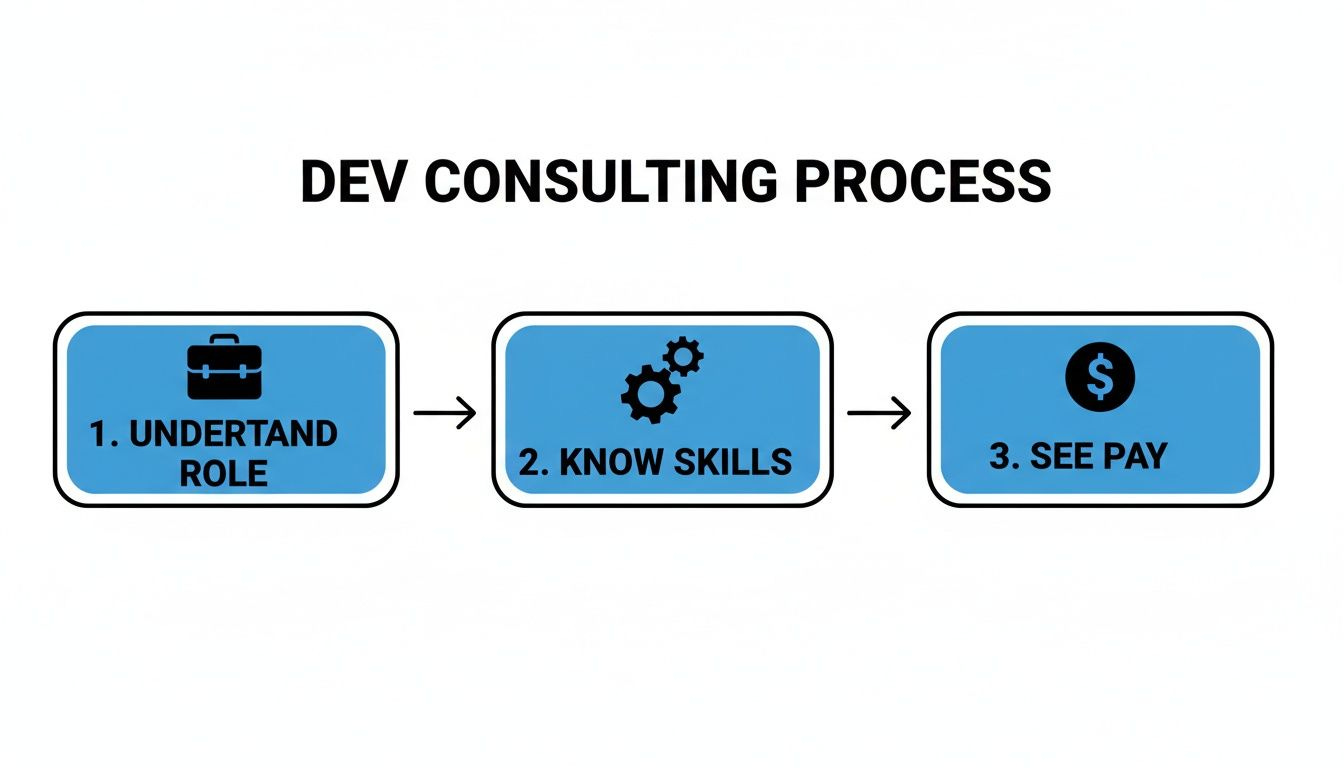
The visualization breaks the journey into its essential components: understanding the different roles, mastering the required skills, and knowing the market for compensation.
Market Dynamics and Opportunities
The market for development consultants is huge and always shifting. In 2023 alone, major development aid platforms featured over 86,000 job postings as part of a much larger pool of 163,000 total vacancies. That gives you a sense of the scale and demand out there.
Hiring was diverse, with nearly 1,000 openings in macroeconomics and public finance, over 600 in health, and almost 500 in the environment sector. You can read the full analysis of 2023 hiring trends to see exactly where the demand is highest.
The key takeaway is this: success as a consultant hinges on your ability to align your specific skillset with the documented needs of a project. Your value is directly tied to the problem you can solve for the client.
Where to Find the Best Consultant Opportunities
Scrolling through generic job boards is looking in the wrong place. The best international development consulting gigs live on specialized procurement portals and niche platforms where organizations like the World Bank, UN agencies, and major implementing partners hunt for top-tier experts.
Knowing exactly where to look is your first real advantage. Wasting time on sites like Indeed or Monster is a dead end for this line of work. High-value contracts are advertised through official channels, and each requires a specific approach. Your search has to be focused and strategic.
Navigating MDB Procurement Portals
Multilateral Development Banks are bureaucratic beasts, and their hiring systems are no different. Each has its own portal for individual consultants, and you must be registered and active on them. These aren’t “apply and forget” sites. They’re databases where project managers go to find talent directly.
The two big ones you have to master are:
World Bank eConsultant2: This is the Bank’s central hub for individual consulting opportunities. The trick here is creating a detailed profile that mirrors the language and skills you see in their project documents. Your profile is your primary marketing tool.
ADB Consultant Management System (CMS): The Asian Development Bank’s portal functions in a similar way. Success on CMS means meticulously tagging your expertise and experience, as the whole system relies heavily on keyword matching for its search algorithms.
These portals are where Expressions of Interest (EOIs) are formally posted. They are the official starting line for most MDB consulting gigs.
UN and NGO Platforms
The United Nations system has its own massive ecosystem of opportunities. It can feel overwhelming but is manageable if you know the main entry points.
The primary gateway is the UN Global Marketplace (UNGM). It’s the procurement portal for 29 UN agencies. If you want to work with organizations like UNDP, UNICEF, or WFP, registering here is non-negotiable. You’ll find everything from short-term data analysis gigs to long-term advisory roles. For a deeper dive, check out our guide on the best places to find UNDP job opportunities.
Beyond UNGM, niche boards are incredibly valuable. Devex is the industry standard for jobs, news, and networking in global development. It requires a subscription but often aggregates high-quality listings you won’t easily find scattered elsewhere.
The rule is simple: be where the clients are looking. If a project manager can’t find you on the platform they use every day, you don’t exist. An optimized profile on the right portal is more valuable than a hundred cold emails.
The Role of Consulting Firms
A massive amount of MDB and bilateral donor funding like USAID or FCDO is funneled through large consulting firms. Companies like DAI, Chemonics, and Abt Associates constantly bid on multi-million dollar projects and need to build teams of experts to deliver them.
These firms post opportunities directly on their websites under sections like “Careers” or “Work With Us.” They often look for consultants to fill specific roles on proposals they’re preparing. Getting on their radar means you could be included in a winning bid for a long-term project.
To help you keep track, here’s a quick breakdown of where you should be focusing your energy.
Top Platforms for Development Consulting Jobs
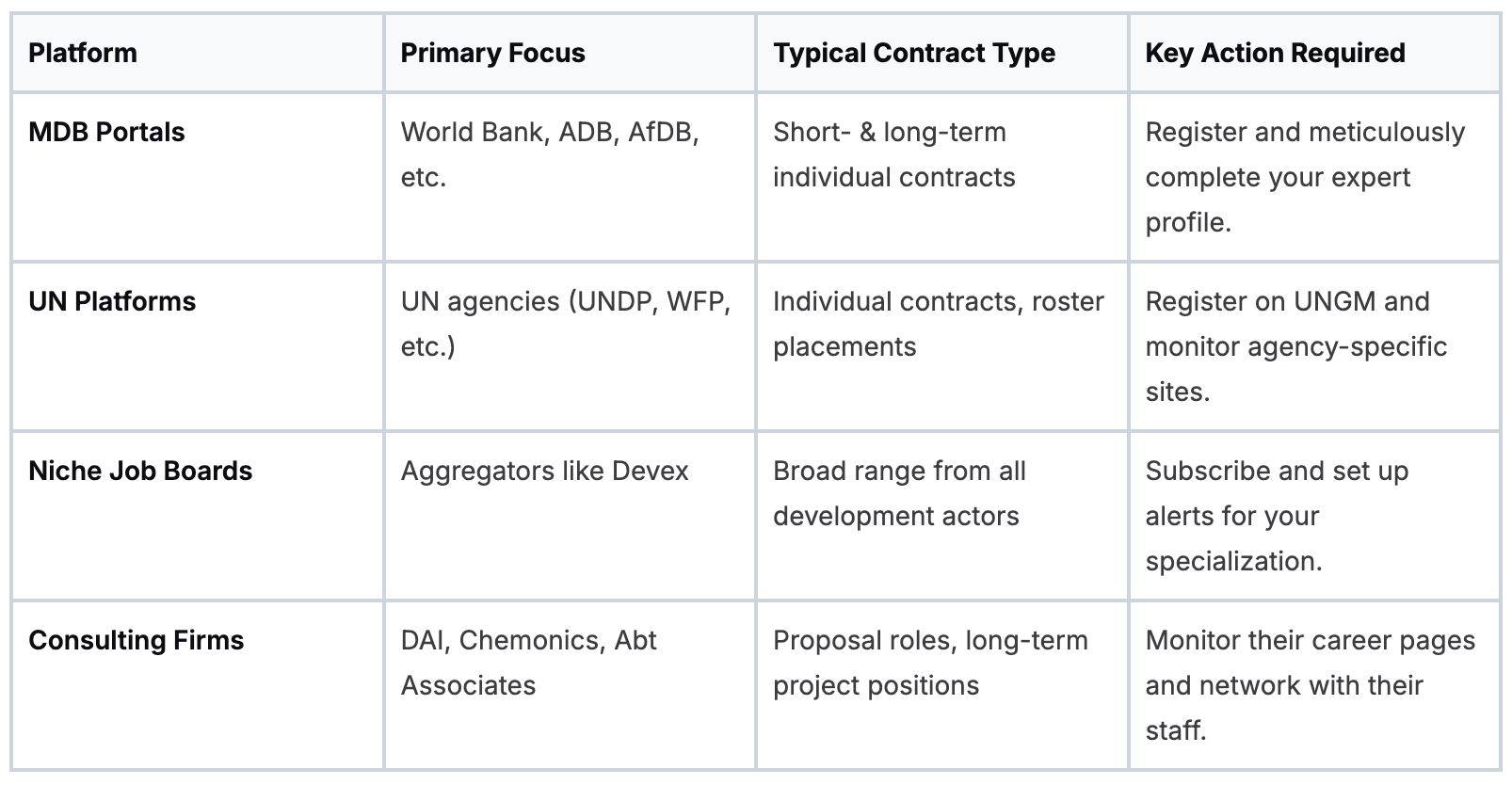
Your strategy must be multi-pronged. Dedicate time each week to scan the MDB and UN portals for direct opportunities while also keeping an eye on the major firms for project-based roles. This ensures you’re covering all the primary channels where the best international development consultant jobs are found.
Your CV and Profile: Getting Past the First Filter
Let’s be blunt: your standard corporate resume is useless here. In the world of international development consulting, it will get your application tossed in the virtual bin before a human even reads it.
Procurement officers and project managers aren’t hiring a “team player with great communication skills.” They’re looking for a specific expert to solve a specific problem. Your CV is a sales pitch. It’s your primary evidence that you are the solution outlined in the Terms of Reference (TOR). If you don’t make that connection crystal clear from the first sentence, you’re out.
Speak Their Language—Literally
Multilateral Development Banks (MDBs) and UN agencies are creatures of habit. They are deeply bureaucratic and expect documents to look a certain way. Ignoring their preferred formats is a classic rookie mistake. It instantly signals that you don’t understand their world. Using the right template shows you’re an insider who knows the rules of the game.
Get these two formats down cold, as they are non-negotiable in this field:
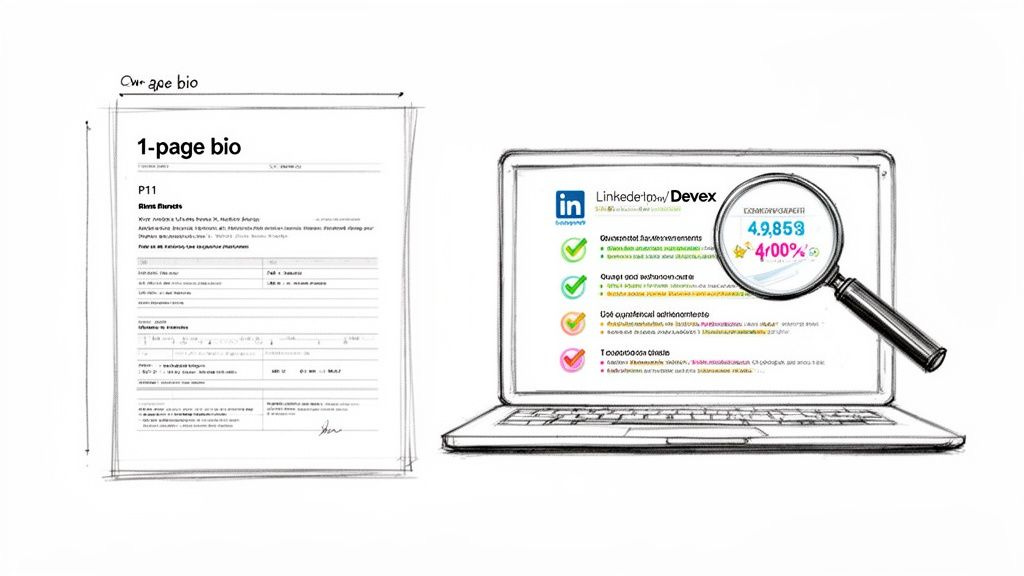
The UN P11 Form: This is the mothership of personal history forms for the entire UN system. It’s exhaustive, asking for everything from your language proficiency scores to the contact details of past supervisors. The trick is to fill it out meticulously once, then tailor it for each specific application.
The World Bank One-Page Bio: The Bank often wants a brutally concise, one-page summary of your expertise. This isn’t just a summary; it’s a test. It forces you to cut the fluff and highlight only the most critical experience for the assignment. It proves you can communicate value quickly and effectively.
Beyond the format, your content must be a mirror to the TOR. This means you need to lift the exact language and keywords from the project description and embed them in your CV. If the TOR is searching for an expert in “climate-resilient agricultural value chains,” your CV better feature that exact phrase, tied to a concrete accomplishment.
Quantify Everything. No Exceptions.
Vague statements like “managed a large project” are completely meaningless to an evaluator. They read it as “this person has nothing concrete to show.” You have to replace these fluffy phrases with hard numbers and specific, measurable outcomes. This is how you build credibility and immediately stand out.
Your entire mindset needs to shift from describing your responsibilities to showcasing your results.
Instead of this:
Responsible for project monitoring and evaluation.
Do this:
Designed and implemented an M&E framework for a $15 million health systems project, tracking 35 key performance indicators across 4 countries.
See the difference? That level of detail provides undeniable proof of your capabilities and shows you understand the metrics that matter in development work.
The most effective consultant CVs are built on a foundation of quantifiable achievements. Every bullet point should answer the question, “So what?” with specific data, figures, or tangible outcomes that prove your impact.
Make Sure Your Online Brand Backs You Up
Your formal application is just one piece of the puzzle. Project managers and recruiters constantly hunt for talent on professional networks. Your profiles on platforms like Devex and LinkedIn are your 24/7 digital sales force. They must be consistent with your CV and reinforce your brand as a specialist.
An unoptimized, generic profile is a massive missed opportunity. Here’s what you need to do:
Write a Specialist Headline: Ditch “Consultant.” Be specific. “Public Financial Management Specialist | Post-Conflict States” or “WASH Program Design & Evaluation Expert.” This instantly tells recruiters what you do and makes you searchable.
Pack Your Summary with Keywords: Your “About” section should read like a glossary of technical terms for your niche. Think like a recruiter plugging terms into a search bar. What words would they use to find you? Use them.
Detail Your Project Experience: Don’t just list job titles and dates. Under each role, add bullet points detailing your most significant projects, mirroring the quantified, results-oriented achievements from your CV.
Get Your Skills Endorsed: It might seem trivial, but a profile with 50+ endorsements for “Project Cycle Management” looks far more credible than one with zero. It’s social proof that backs up your claims.
Mastering your CV and online profiles is about creating a powerful, coherent story. It’s the story of who you are, the problems you solve, and the value you deliver. Get this right, and you’ll find yourself on the shortlist for the best international development consultant jobs far more often.
Writing a Winning Technical Proposal
Your CV gets you on the longlist. The technical proposal is what gets you the contract.
This is where you prove you understood the client’s underlying problem and have a credible, structured plan to solve it. A weak proposal is the fastest way to get cut, no matter how good your qualifications are. Your proposal is your core intellectual offering. It’s how you go from being another qualified candidate to the only logical choice for the job.
Deconstruct the Terms of Reference
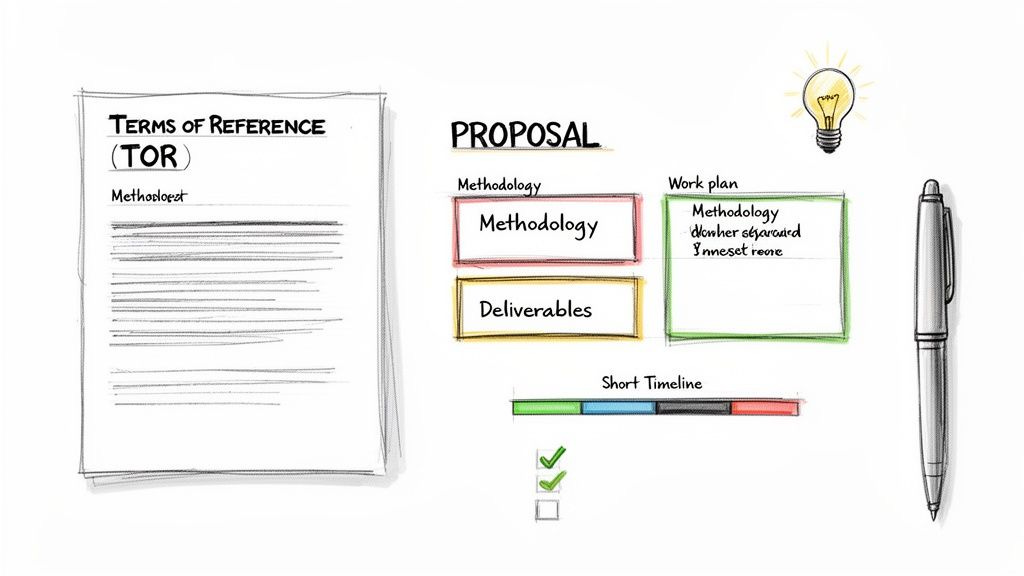
Before you write a single word, you need to tear the TOR apart. Don’t just skim it. Print it out, grab a highlighter, and become a detective. Your goal is to pinpoint the client’s explicit requirements and their implicit anxieties.
Look for these key elements:
Problem Statement: What’s the real issue they’re trying to solve? This is often buried in the background section.
Key Objectives: What specific goals must be achieved? These are usually listed plainly as bullet points.
Scope of Work: This section outlines the specific tasks and activities you’ll be expected to perform.
Deliverables: These are the tangible outputs you have to produce: reports, workshops, policy briefs, you name it.
Evaluation Criteria: This is pure gold. The TOR will often state exactly how they will score proposals, sometimes even with percentage weights. Pay close attention here.
Once you’ve mapped these out, you can build your entire proposal as a direct response. Each section of your proposal should clearly address a specific part of the TOR, using the client’s own language to show you’re on the same page.
Structure Your Proposal for Impact
A winning proposal isn’t a long, rambling essay. It’s a clear, logical, and persuasive argument that guides the reader through your thinking and builds their confidence in you. While the exact format can vary, a strong proposal always contains a few core sections.
Start with a concise Understanding of the Assignment. This opening section shows you get it. Briefly re-state the problem in your own words to demonstrate a deep comprehension of the context and challenges. This immediately builds trust with the evaluator.
Next, detail your Proposed Methodology. This is the heart of your proposal. Explain how you will do the work. Get specific about your analytical frameworks, data collection methods like key informant interviews, desk reviews, or surveys, and the sequence of your activities. This is your chance to showcase your technical depth.
Your methodology is your unique value proposition. It’s where you demonstrate not just what you will do, but the thoughtful, expert process you will use to get there. It’s the difference between a generic plan and a tailored solution.
Finally, lay out a clear Work Plan and Deliverables. This section makes your proposal tangible. Use a simple table or timeline to show the sequence of activities and when each deliverable will be completed. It proves your plan is realistic and well-managed, which is a major concern for any project manager. For a deeper look into what evaluation panelists are thinking, reading an interview with an MDB panellist can give you a critical edge.
Avoid Common Proposal Pitfalls
I’ve seen excellent consultants write mediocre proposals and lose jobs they were perfectly qualified for. They usually fall into a few common traps that you can easily sidestep.
Misinterpreting the Scope: Don’t promise to solve world hunger when they asked for a market analysis of three specific crops. Stick strictly to the scope outlined in the TOR. Overpromising is a red flag that signals you either didn’t read the document carefully or don’t have a realistic grasp of the work.
Being Too Generic: Your proposal must feel like it was written for this job and this job alone. If it reads like a template you could submit for any similar assignment, it will fail. Reference the specific country, the project, and the institution. Show you’ve done your homework.
Ignoring the “Why”: Don’t just list a bunch of activities. Explain why your chosen methodology is the best approach for this specific problem. Justify your choices and connect them directly back to the client’s objectives.
A great technical proposal is a masterpiece of persuasion. It convinces the client that you are a low-risk, high-reward partner who can deliver exactly what they need, no questions asked.
Pricing Your Services and Negotiating Contracts
Figuring out what to charge is one of the most stressful parts of going independent. It’s a constant balancing act. Go too high, and you might price yourself out of a great project. Go too low, and you leave money on the table and undervalue your expertise.
The trick is to land in that sweet spot where you’re competitive but also fairly paid for your value. This isn’t a guess. It’s a calculated decision based on your years in the field, the complexity of the work, the client’s likely budget, and what the market is paying. A consultant with five years of experience won’t command the same rate as a seasoned pro with two decades, and that’s how it should be.
Calculating a Competitive Daily Rate
Your daily rate is the financial engine of your consulting business. The best way to figure it out is to work backward. Start with the annual income you want to make, then add all the costs of being your own boss.
I’m talking about health insurance, retirement contributions which you now fund 100%, self-employment taxes, and any money you’ll spend on professional development. Crucially, you also have to account for unpaid time: the days you spend hunting for contracts, writing proposals, and dealing with admin. A good rule of thumb is to assume you’ll only be billable for about 180-200 days a year, not the 260 days in a typical full-time job.
This is why consultant rates look so high compared to staff salaries. To get a real sense of the numbers, check out our deep dive on MDB salaries and consultant rates for some concrete benchmarks.
All-Inclusive Versus Plus Expenses
When a contract lands in your inbox, zero in on the payment structure. It will specify whether your rate is “all-inclusive” or if expenses are covered separately. This detail has a massive impact on your bottom line for any international development consultant jobs you take on.
All-Inclusive Rate: This means you get a single, fixed daily fee that has to cover everything: your professional time plus all your costs like flights, hotels, and per diems. It puts all the financial risk squarely on your shoulders, so you better be good at budgeting.
Rate Plus Expenses: Here, the client pays your professional fee and reimburses your travel and living costs separately, usually up to a pre-approved limit. This is the much safer and preferred arrangement for most consultants.
Getting this right is critical. An all-inclusive rate for a project in a high-cost country demands a much higher daily fee than a remote gig where your biggest expense is your internet bill. Don’t learn this lesson the hard way.
Navigating the Contract and Financial Realities
Once you have a draft contract, read every single line. Seriously. Pay obsessive attention to the payment schedule, the exact scope of work, and the termination clauses. The payment terms are especially important for managing your cash flow, as MDBs and UN agencies can take anywhere from 30-90 days to process an invoice.
Remember, you’re running a business now. That means you need to plan for these income gaps. I always advise people to build up a financial cushion to cover at least three to six months of living and business expenses. This safety net gives you the freedom to choose the right projects, rather than grabbing the first thing that comes along because you’re desperate.
The market for these roles is stable, but rates fluctuate. For context, in the United States, the average annual salary for international development consultant jobs hovers around $78,627, which works out to about $37.80 an hour. Within that, about 14% of positions fall in the $87,500 to $93,499 range, which shows the earning potential that comes with experience. You can discover more insights about consultant salary trends to arm yourself for rate negotiations. Being financially savvy is essential for building a consulting practice that lasts.
Your Top Questions, Answered
Even seasoned pros have questions when they first break into MDB and UN consulting. It’s a unique ecosystem with its own unwritten rules. Let’s tackle some of the most common queries to save you time and get you focused on what matters.
How Much Experience Do I Actually Need?
There’s no magic number, but let’s be realistic: most successful independent consultants have at least 5-7 years of solid, deep professional experience. MDBs and UN agencies aren’t hiring for potential. They’re paying a premium for proven expertise. They have a specific problem and need someone who has solved a similar one before.
If you’re earlier in your career, your best bet is to get on a project team with a larger consulting firm that bids on these contracts. This is the fastest way to get that coveted MDB or UN project experience on your CV, which is the only currency that matters here. Another great route is to find roles on smaller NGO projects to build up your specific technical track record.
Is a Master’s Degree or PhD a Must-Have?
For most roles, yes. An advanced degree is often the price of entry. A Master’s is typically the bare minimum for any serious policy, research, or technical advisory gig advertised by the big institutions. The Terms of Reference (TOR) will almost always spell this out.
A PhD becomes a game-changer for highly specialized roles: think complex econometric modeling, niche research, or serving as the lead technical guru on a project. While not always mandatory, it gives you a massive competitive edge. That said, extensive and highly relevant field experience, say 15+ years, can substitute for an advanced degree, especially for roles focused on hands-on project implementation and management.
The rule of thumb is simple: your education has to match the intellectual firepower required for the assignment. The more specialized the work, the more an advanced degree is essential for credibility.
What Does the Application Timeline Look Like?
Patience is a required, though unstated, skill for any aspiring consultant. The time from hitting “submit” to actually starting work can vary wildly and depends on the client’s urgency and their internal procurement hoops.
Urgent, Short-Term Needs: For a quick analysis or a report that was needed yesterday, things can move surprisingly fast. We’re talking as little as 2-4 weeks.
Standard Competitive Contracts: For most advertised roles, prepare for a much longer runway. The timeline from the Expression of Interest (EOI) deadline to getting a final contract signed is often somewhere between 3 to 6 months.
Because these timelines are so long and unpredictable, you must keep multiple opportunities in your pipeline at different stages. Relying on a single application is a recipe for long, unpaid gaps between contracts.
How Important Is My Network?
It’s everything. While every application has to go through formal procurement portals for compliance reasons, many opportunities are shaped, discussed, and informally shared within trusted professional circles long before a TOR is ever finalized and posted publicly.
Project managers often have a mental shortlist of go-to consultants when they first identify a need. Getting on that list comes from one thing: building a reputation for doing excellent work and staying connected with former colleagues and clients. Attending industry events and keeping a sharp, updated LinkedIn profile aren’t just optional fluff; they are fundamental to staying visible and hearing about international development consultant jobs before the rest of the world does.
At Multilateral Development Bank Jobs, we cut through the noise to bring the best opportunities directly to you. Get curated lists of staff and consultant roles from over 30 MDBs and UN agencies sent to your inbox every week, along with deep-dive career guides just like this one. Subscribe today at
https://mdbjobs.com
.