

Landing a job at the European Bank for Reconstruction and Development isn’t about blasting out résumés and hoping one sticks. This is a specialized institution that requires a focused strategy. Forget generic career advice. Succeeding here means understanding the Bank’s unique mission and showing them exactly how you fit.
This guide is your direct path, cutting the fluff to give you a practical roadmap.
Your Roadmap to a Career at the EBRD
So, what does it actually take to land one of these roles? You have to understand what the EBRD is. It’s a major force in international development with a specific mandate: helping countries transition to open, market-oriented economies.
Your application, your CV, and your interview answers all need to tie back to that mission.
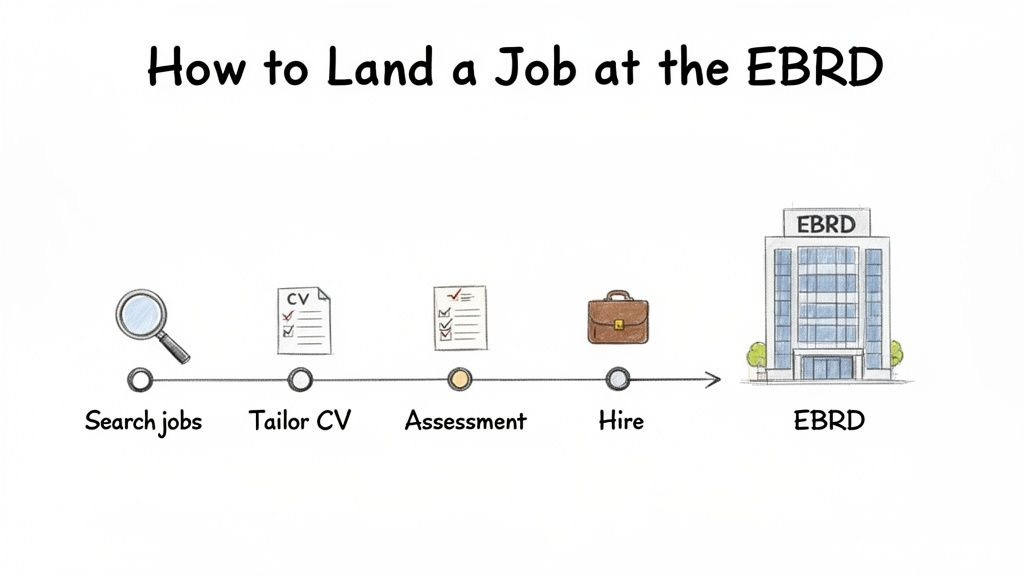
Founded in 1991, the EBRD has grown into a powerhouse multilateral development bank. Today, it employs around 3,000 people and operates in 36 countries from Central Europe to Central Asia and the Southern and Eastern Mediterranean. If you want a deeper dive into its origins, DevelopmentAid has a great piece on its rapid creation.
Know the Landscape: Where Do You Fit?
Before you polish your CV, you need to know the terrain. The EBRD isn’t a monolith. It offers a few distinct career paths, and picking the right one from the start is the most important first step you can take.
Here’s a quick summary of the main ways in.
EBRD Career Paths at a Glance
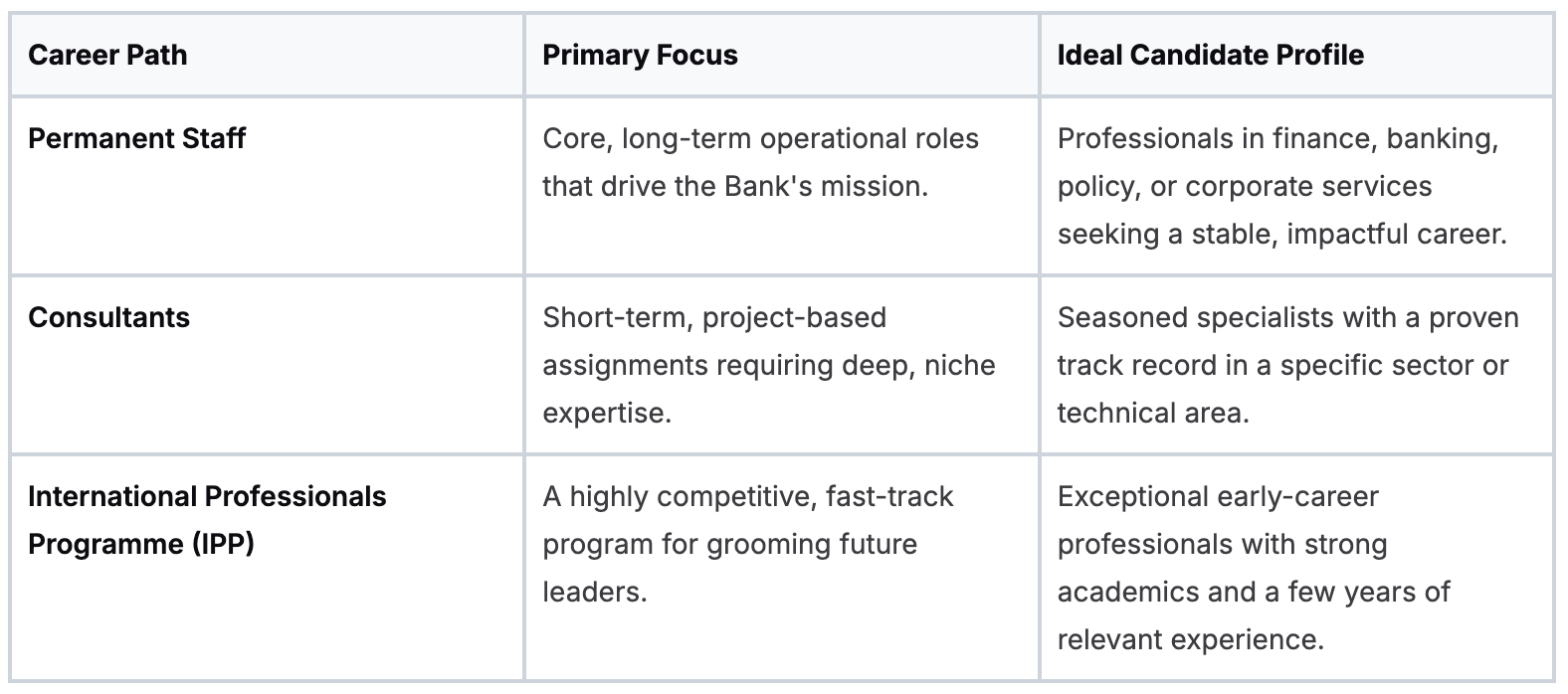
Understanding these pathways is crucial. Applying for a staff role with a consultant’s mindset is a quick rejection. Each path has its own logic and demands a tailored approach.
Why a Specialized Approach Is Non-Negotiable
A generic application you could send to any investment bank will fail at the EBRD. They can spot it a mile away. The Bank looks for people genuinely committed to its mission of fostering market economies in complex places.
Your application has to show you get it. Your experience, skills, and motivation must align with the Bank’s operational and geographical focus.
Success comes from showing you understand the EBRD’s distinct role in the world. It’s an engine for economic change. Your application needs to prove you are ready to contribute to that mission from day one.
This guide gives you that insider perspective. We’ll break down each career path, clarify the often-confusing eligibility rules, and give you actionable advice for every stage of the process. Think of it as your step-by-step plan for a rewarding career at the EBRD.
Understanding EBRD Roles and Eligibility Rules
First things first: not all jobs at the EBRD are the same. Before you think about your CV, you need to understand the three main ways people work for the Bank. Each is designed for a different purpose and demands a different approach from you as a candidate.
The most common route in is as permanent staff. These are the core operational roles that keep the projects moving. Think of the bankers, analysts, economists, and lawyers who are the engine of the EBRD’s mission every day. These are long-term gigs, usually based at the London HQ or in a country office.
Then you have consultant roles. These are for seasoned experts with deep, niche knowledge. Consultants are brought in on a fixed-term basis to crack a specific problem, offer technical advice, or plug a temporary skills gap. If you’re a specialist who loves short, high-impact projects, this is your lane.
Finally, there’s the International Professionals Programme (IPP). This is the Bank’s super-competitive, two-year rotational program built to find and groom its next generation of leaders. It’s a fast-track opportunity for outstanding early-career professionals, giving them a tour of different departments and business areas.
The Critical Issue of Nationality
Here is a rule that is absolutely non-negotiable: nationality matters. The EBRD is an international financial institution, owned by its member countries. Because of this structure, most staff jobs and every IPP spot are strictly limited to nationals of these shareholder countries.
Applying for a staff role when you’re not a citizen of a member country is a guaranteed rejection. It’s the first filter the hiring team applies, and there are zero exceptions.
Before you spend a single second on your resume, check your eligibility. The list of EBRD shareholder countries is public information on their website. This one simple check saves you from wasting hours on an application that is dead on arrival.
Consultant roles can sometimes offer more wiggle room, but even these are often tied to specific donor funds with their own nationality strings attached. Always check the “eligibility” section of the job description. For a wider view, check our detailed guide on which MDBs you’re eligible for.
Decoding the EBRD Grading Structure
You’ve confirmed you’re eligible and picked a career path. The next step is understanding the professional pecking order. The EBRD uses a grading system to classify roles based on responsibility, experience, and seniority, giving everyone a clear career ladder.
While exact job titles shift between departments, the grades follow a logical progression.
Analyst Level: This is the entry point for professionals. You’ll need a Master’s degree and a couple of years of relevant experience. Analysts are in the trenches, handling research, financial modeling, and supporting senior team members.
Associate Level: At this stage, you’re taking on more ownership. Associates manage transactions and client relationships. This typically requires several years of direct industry experience.
Principal Level: These are the senior experts and team leaders. They’re responsible for originating and executing complex projects from start to finish. To land a Principal role, you need a serious track record of success.
Director Level: This is the senior leadership tier, overseeing entire sectors, regions, or departments. Directors set the strategy and manage large teams to execute it.
Getting this structure is key. It helps you figure out where you fit, so you can apply for positions where you’re a credible candidate. Firing off an application for a Principal role with an Analyst’s CV just shows you haven’t done your homework. Pitch your application at the right level.
Breaking Down the EBRD Application and Assessment Process
You’ve submitted your application to the European Bank for Reconstruction and Development. That’s the easy part. What comes next is a structured, multi-stage marathon designed to filter out everyone but the best-fit candidates. Going in blind is a huge disadvantage.
This isn’t a quick hire. The EBRD process tests your technical skills, professional behaviors, and patience. Let’s walk through each phase so you know what to expect and how to prepare.
The First Hurdle: Initial Application Screening
Your CV and cover letter are your entry ticket. The first look at your application is a quick screen by HR to tick the basic boxes: nationality, years of experience, and other must-haves. A real person will spend no more than 30 seconds on your file at this point.
Your documents need to scream “I’m a perfect match” at first glance. Use the exact keywords from the job description. If a role asks for “private sector development in Central Asia,” that phrase better be front and center.
Your goal here is to be brutally clear, not creative. Recruiters are scanning for reasons to put you in the ‘no’ pile. Don’t give them one. Make it impossible for them to miss how well your background lines up with their needs.
If you clear this first check, your application lands with the hiring manager for a closer look.
The Stages of EBRD Recruitment
Once you’re shortlisted, you’re in the game. The EBRD’s assessment process has several phases, and each one is an elimination round. While the exact steps might change depending on the job, the overall structure is consistent.
Each stage tests a different part of your professional toolkit.
The image below lays out the main entry points into the Bank. Whether you’re coming in as staff, a consultant, or through a specialized program, you’ll be funneled into this rigorous evaluation.
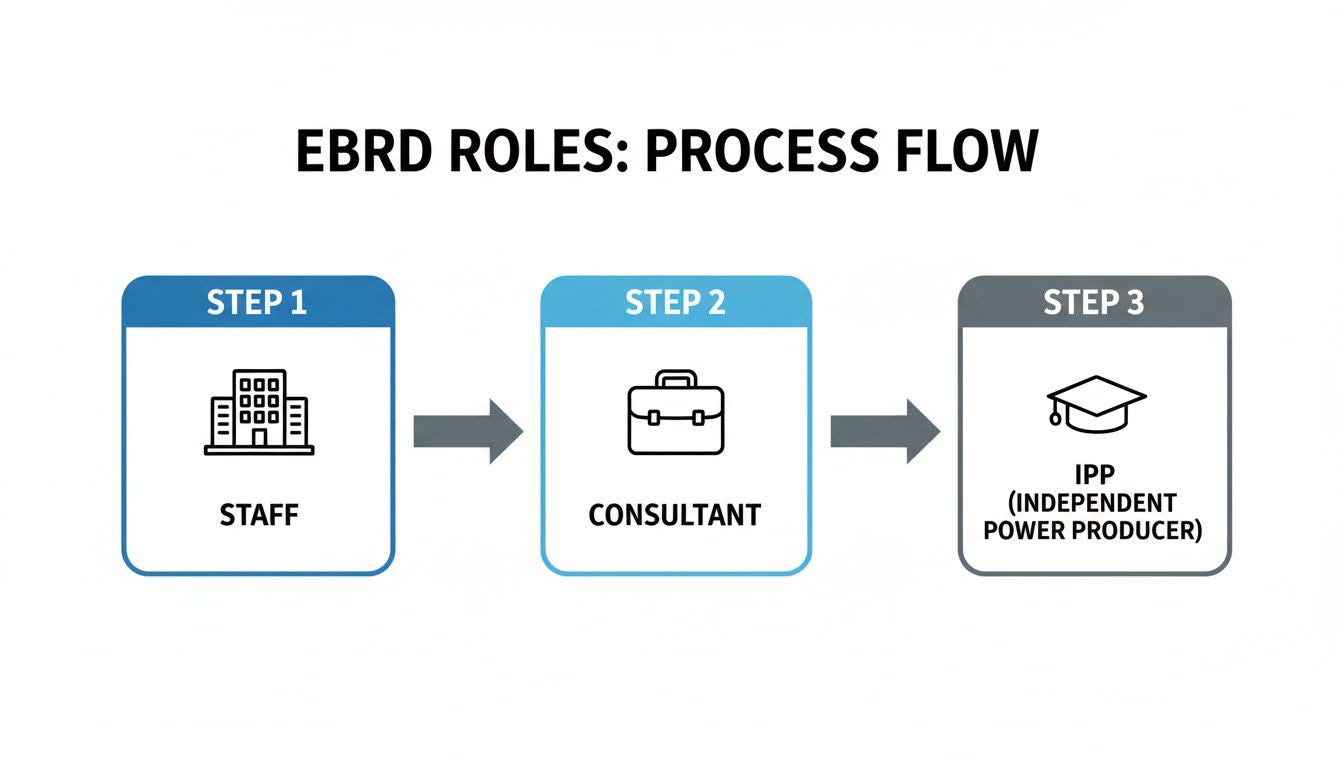
As you can see, you have to prove you have what it takes, no matter the door you enter.
Demystifying the Assessment Center
For many roles, especially at the analyst and associate levels, you’ll face an assessment center. This is an intense half-day or full-day event with exercises designed to see how you perform under pressure. It’s about demonstrating how you think and collaborate.
Here’s a taste of what to expect:
Case Study: You’ll get a packet of information on a fictional EBRD project. Your job is to analyze it, spot the risks and opportunities, and present your recommendations. They’re testing your analytical horsepower and business instincts.
Group Exercise: You and other candidates get a problem to solve as a team. Assessors watch everything: your communication style, how you influence others, and whether you’re a constructive team player.
Competency-Based Interview: This is a classic “tell me about a time when...” interview. You need specific examples from your past that prove you have key competencies like teamwork, integrity, and a focus on results.
A word of warning: these processes can drag on. The entire cycle, from application to offer, often takes three to six months. Patience is a required, if unstated, competency. You can see similar multi-stage hoops in our guide on how to apply for World Bank jobs.
The Final Panel Interview
If you make it through the assessments, you’ve reached the final boss: the panel interview. You’ll face the hiring manager, a few department heads, and someone from HR. The questions will be a mix of deep technical dives and high-level strategic questions about your grasp of the EBRD’s mandate.
They aren’t just confirming you have the skills. They’re trying to figure out if you fit the institution’s culture and mission. This is where your homework on the EBRD pays off.
You need to show you understand their world. For example, knowing that the 2008 financial crisis caused massive labor market disruptions that hit youth employment especially hard across Europe and Central Asia shows you get the context. Mentioning the varied recovery patterns in these regions demonstrates your awareness of the challenges the EBRD was built to address.
Bringing this kind of insight proves you’re not just looking for any job. It shows you understand the EBRD’s world and are ready to be a part of it.
Crafting Your Application to Stand Out
A generic CV is a losing one when you’re trying to get a job at the European Bank for Reconstruction and Development. Your application is your first chance to make your case, and to get noticed, it has to speak the EBRD’s language. You need to go beyond listing your past duties.
You have to frame your experience in a way that clicks with their mission. A one-size-fits-all approach won’t cut it. Recruiters are sifting through applications looking for proof that you understand the challenges of development finance, project management, and policy reform in their countries of operation. They want to see your impact, not your job title.
Frame Your Achievements with the STAR Method
The best way to show your value is by using the STAR method. It’s a simple framework that forces you to build a story around your accomplishments, making them concrete. Vague statements like “managed a portfolio of projects” are meaningless to a recruiter. You need to show them the results.
The STAR method breaks your experience into four parts:
Situation: Briefly set the scene. What was the project or challenge?
Task: What was your specific goal or responsibility?
Action: What concrete steps did you personally take? Use strong, active verbs.
Result: What was the outcome? This is where you bring in the numbers. Quantify your impact with figures, percentages, or a clear statement of achievement.
Think about a project you were on. Instead of saying, “worked on a due diligence team,” frame it like this:
Situation: A mid-sized manufacturing firm in Poland sought a €15 million loan to upgrade its energy efficiency, but its financial reporting was a mess. Task: My job was to dig through three years of their financial statements to build a reliable credit risk model. Action: I spotted major inconsistencies in their cash flow reporting. I worked directly with their CFO to restructure their data, which allowed me to build a new projection model. Result: The model I built clearly showed the project’s viability, leading to the loan’s approval and a projected 20% cut in the company’s energy costs.
See the difference? This structure gives them hard proof of your skills in action. It’s the difference between telling them you can do the job and showing them you’ve already done it.
Your Cover Letter Is Not a CV Summary
Don’t use the cover letter to repeat your CV. That’s a massive waste of real estate. Its purpose is to build a compelling story that connects your drive and background to the EBRD’s mission. This is where you answer the “why” question.
Why the EBRD? Why this role? What in your background makes you a believer in fostering market-oriented economies? This is your shot to prove you have a deep understanding of what the institution does.
It also helps to show you’re clued into the complex economic environments where the bank works. For example, understanding how wage dynamics shifted in the euro area during past crises, where wage shares went up during recessions due to labor hoarding, shows you grasp the real-world economic pressures relevant to the EBRD’s work. You can read more about these European Central Bank findings on labor compensation to get a sense of this.
Pre-Submission Application Checklist
Before you hit “submit,” run your application through this final check. These are the classic mistakes that get applications tossed.
Is It Tailored? Have you woven keywords from the job description throughout your CV and cover letter?
Is It Quantified? Are your biggest achievements backed up with numbers, percentages, or specific outcomes?
Is Nationality Confirmed? For staff roles, have you double-checked that you’re a national of an EBRD member country? Don’t skip this.
Is the “Why” Clear? Does your cover letter make a powerful case for why you want to work at the EBRD?
Is It Flawless? Have you proofread for every spelling and grammar error? A single typo signals a lack of attention to detail, a killer in this field.
Treat your application like your first work sample for the EBRD. It needs to be analytical, precise, and professional.
How to Succeed in the EBRD Interview
If you’ve landed an interview at the European Bank for Reconstruction and Development, congratulations. They think you’re smart. Now, they want to see how you think.
The interview process goes deep. It will probe your technical skills, professional competencies, and whether you genuinely get what the bank is about. They will grill you on financial modeling and throw you curveballs on tricky policy issues. Showing up unprepared is a non-starter.
Know the Institution Inside and Out
Walking into an EBRD interview with surface-level knowledge is a fatal mistake. Your interviewers live this work, and they expect you to have done your homework. This is your chance to show you want this job, not just any job.
Your research needs to hit three core areas:
Recent Projects: Go beyond press releases. Dig up a few recent investments in the specific region or sector you’re applying for. Get to grips with the project’s goals, its financing structure, and the challenges they faced.
Country Strategies: Every country the EBRD operates in has its own strategy document. Find the relevant one and read it. Know its key priorities, whether that’s a green energy transition, SME development, or infrastructure modernization.
Key Initiatives and Controversies: Understand the bank’s big-picture goals, like its Green Economy Transition approach. You also need to be aware of the complexities and criticisms. For example, knowing about challenges like the bank’s financing of controversial clients, as detailed in reports from organizations like Bankwatch, shows you have a realistic, nuanced view of its operations.
This level of detail separates a generic applicant from a potential colleague.
Master Competency-Based Questions
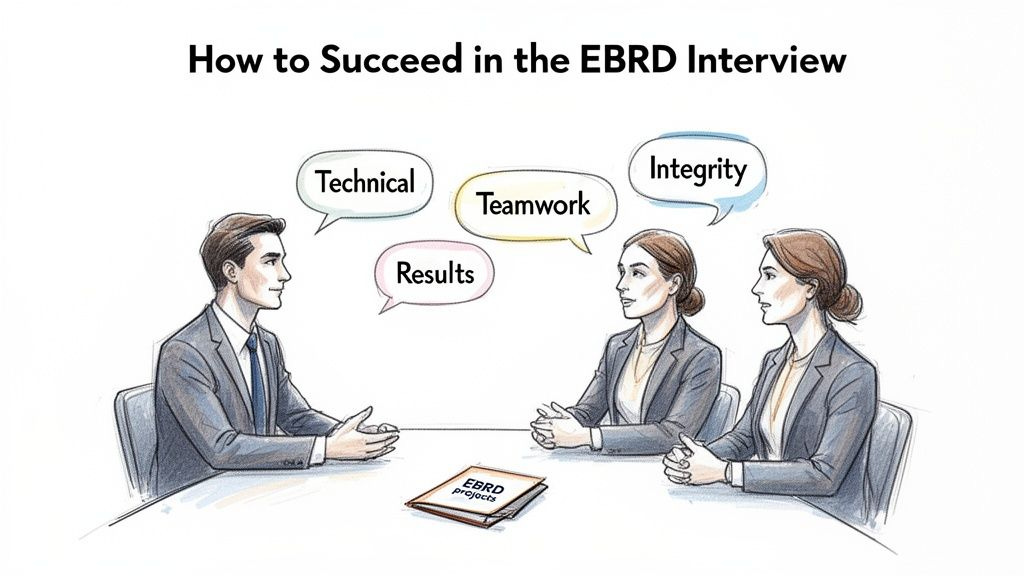
The EBRD leans heavily on competency-based questions. These are the “Tell me about a time when...” scenarios designed to see how you’ve behaved in past professional situations. They’re looking for hard evidence that you embody their core values.
You need specific, well-structured stories ready to go.
The goal is to prove your skills with evidence, not adjectives. Instead of saying you’re a “great team player,” tell a story about a time you navigated a difficult team dynamic to deliver a complex project ahead of schedule. Your past actions are the only proof they care about.
Have at least two solid examples prepared for each of these core areas:
Results Orientation: A time you drove a project to completion despite major roadblocks.
Teamwork: An instance where you collaborated to solve a problem you couldn’t have cracked alone.
Integrity: A situation where you had to make a tough ethical call or uphold a standard when it was easier not to.
Technical Expertise: A specific project that puts your core professional skills on full display.
Structure your answers using the STAR method: Situation, Task, Action, Result. It’s a simple framework that keeps your answers focused and powerful.
Ask Questions That Show You Think Strategically
Near the end of the interview, they’ll ask if you have questions. This isn’t a formality; it’s your final test.
Asking generic questions about salary signals you’re only thinking about what’s in it for you. Asking smart, strategic questions shows you’re already thinking like a member of the team. Your questions should show genuine curiosity and a strategic mind. Do not ask something you could have found on their website in five minutes.
Weak Questions:
“What are the benefits like?”
“What’s the day-to-day work like?”
Strong Questions:
“I saw the recent country strategy for Jordan emphasizes private sector engagement. On a practical level, how does this specific role contribute to that priority?”
“Given the bank’s deep commitment to the Green Economy Transition, how is the team measuring the impact of its renewable energy projects beyond standard financial returns?”
These kinds of questions prove you’ve done the work and are already thinking about how you can contribute. It’s the perfect way to end the interview and leave a lasting impression.
Keeping an Eye on Job Openings
Waiting for the perfect EBRD job to appear is a losing game. The best roles are often snapped up by candidates who are already watching the pipeline. If you want to get ahead, you need a system that brings opportunities to you.
Passively browsing won’t cut it. You have to build a proactive monitoring system that tells you the second a relevant role opens up. This gives you a critical head start on your application, a massive advantage when things are this competitive.
Setting Up Smart Job Alerts
First, automate the search. Go to the source and set up targeted alerts on the EBRD’s careers portal. Get specific with your keywords, otherwise you’ll just get an inbox full of irrelevant emails.
Don’t stop at the official site. You need to cast a wider net. Professional platforms and niche job boards are crucial for tracking vacancies at Multilateral Development Banks (MDBs). To get a handle on the best options, check our guide on the top sources for development job offers in Geneva and other major hubs.
EBRD Careers Portal: Set up different alerts for various job functions. Create one for “Principal Banker, Infrastructure“ and another for “Analyst, Financial Institutions“.
Third-Party Sites: Use specialized MDB job aggregators that pull listings from multiple institutions.
LinkedIn Jobs: Create alerts for “EBRD“ combined with your target job titles.
This multi-channel approach means you won’t miss an opportunity because you were looking in the wrong place.
Using LinkedIn for Market Intelligence
Job alerts are reactive. Being proactive means spotting opportunities before they even hit the job boards. This is where LinkedIn becomes your secret weapon for intelligence gathering.
An official job posting is the final step in a long process. The real work of identifying a need, getting budget approval, and drafting a job description happens months earlier. Following the right people and projects on LinkedIn gives you a window into that process.
Your goal is to follow the signals. New project announcements, major investments, or senior staff moves often signal a hiring push is on the horizon.
Start by identifying and following key people and departments within the EBRD on LinkedIn. Zero in on Managing Directors, team leads, and HR business partners in the sectors you’re interested in. Pay attention to what they post about, the projects they highlight, and the skills they mention. This isn’t about spamming them with connection requests; it’s about listening to the conversation to figure out what the bank needs next.
This simple intelligence work will put you miles ahead of everyone else.
Frequently Asked Questions About EBRD Careers
Thinking about a career at the European Bank for Reconstruction and Development? Let’s clear up some common questions.
Do I Need a Finance Degree to Work at the EBRD?
No. While you need a strong finance background for banking and investment roles, the EBRD is a huge institution with a wide range of needs. It’s a development institution.
The Bank constantly looks for experts in economics, law, policy advisory, risk management, HR, and communications. The degree on your diploma matters less than your expertise. The real key is showing a clear line between what you can do and how it supports the EBRD’s mission to build market economies.
How Long Does the Recruitment Process Take?
Play the long game. Like most Multilateral Development Banks, the EBRD hiring timeline is a marathon, not a sprint. From submitting your application to getting a final offer, you should expect the process to take three to six months.
It’s a deliberate and thorough process involving multiple interviews, panel assessments, and internal approvals. A few weeks of radio silence doesn’t mean you’re out of the running. Patience is a virtue here.
What Is the Official Language of the EBRD?
The working language of the EBRD is English. All internal meetings, reports, and day-to-day business happen in English.
Fluency in another language spoken in the EBRD’s countries of operation, like Russian, French, or Arabic, can be a massive plus, especially for field roles. Professional fluency in English is non-negotiable. Your CV, cover letter, and every interview will be in English.
Is It Possible to Move Between Departments?
Yes. Internal mobility is a fundamental part of how the EBRD develops its people. The Bank encourages staff to get experience across different sectors and regions. After you’ve been in a role for a couple of years, you’ll see plenty of opportunities for an internal move.
This is how the Bank builds well-rounded leaders who understand the institution from different angles. Many senior staff have built their careers by working in several different departments over the years.
Finding the right opportunity is the first step. Multilateral Development Bank Jobs simplifies your search by delivering curated job lists directly to your inbox every week, covering staff and consultant roles from over 30 top institutions. Subscribe at
https://mdbjobs.com
to stop searching and start applying.