
MDB jobs disappear fast. Are you tracking the latest openings?
Subscribe to the Premium Plan and never miss an opportunity:
• Get Staff roles on Mondays
• Get Consultant roles on Fridays
Grab a free trial here to see what you’ve been missing (no payment required).
The 1st of July is an exciting day for you, if you work for the World Bank. It’s the start of the new fiscal year.
But what this actually means is that you get a pay rise. And what it also means is that the Bank releases updated information on the salary scales for the coming year.
Trying to wrap your head around the nuances of the World Bank’s salary system can be a nightmare. It depends on whether you’re recruited from overseas or not, which country you’re based in, and what grade you have.
So I’m going to do my best to break it all down for you here, so that even your grandpa can understand it.
Let’s go.
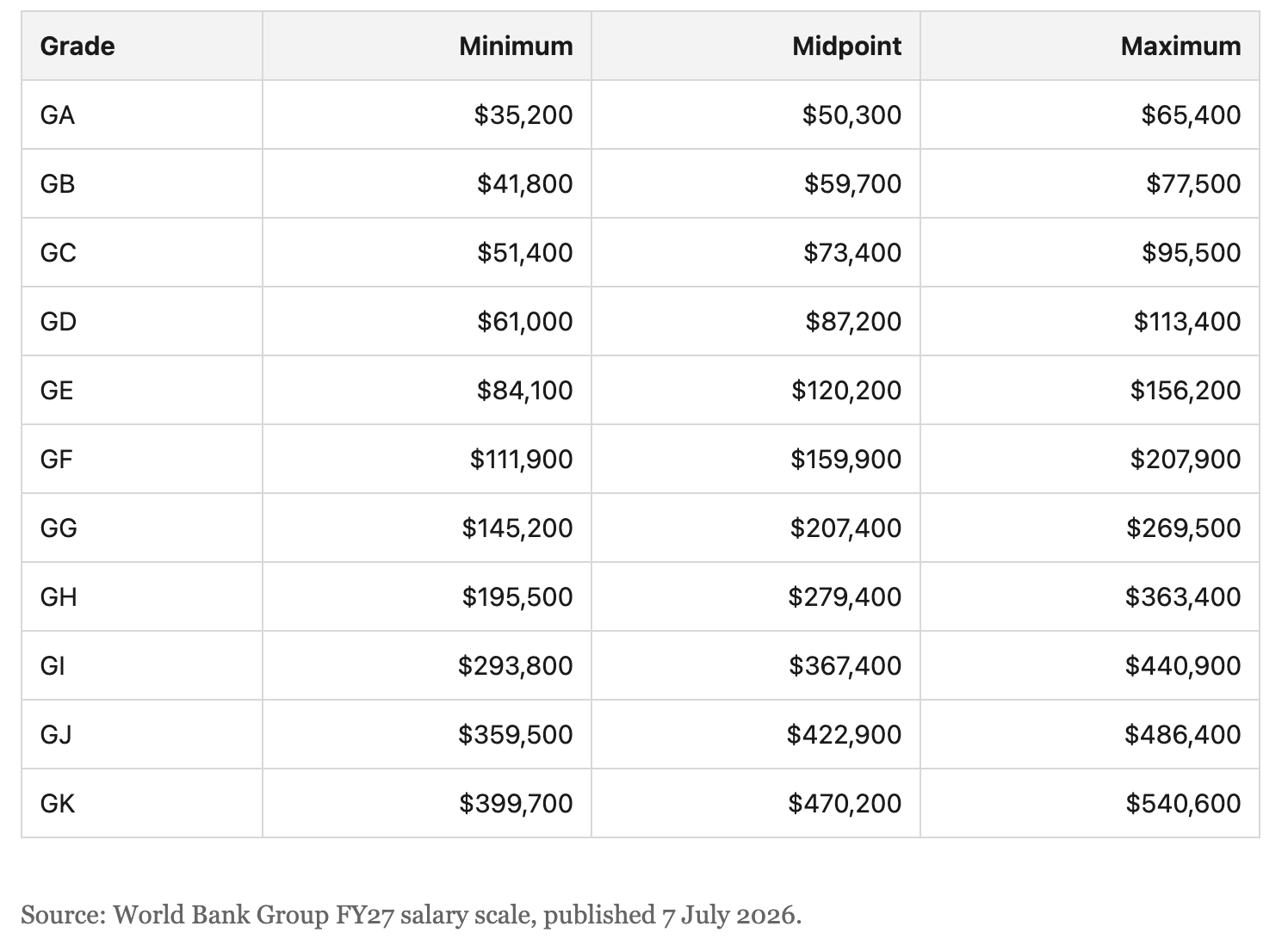
What changed this year? The HQ minimums, midpoints and maximums rose by roughly 2.6% to 2.8% from the FY2026 table. The current salary PDF runs through GK at headquarters. That is worth flagging because the Bank's careers FAQ still describes the familiar GA to GJ structure.
The new headquarters salary scale
Alright, so here are the annual net salary ranges in U.S. dollars for the World Bank Group’s United States headquarters salary plan (you can find more info on it here).
What the grades mean
The grades can be pretty confusing, I know. The World Bank essentially groups jobs into three broad streams:
Administrative roles sit at GA to GD and include team assistants and programme assistants.
Technical jobs run from GE to GJ (economists, investment officers and technical specialists generally sit in this part of the ladder).
Managerial jobs overlap with the professional stream at GH to GJ.
Administrative roles
Across GA to GD, the FY2027 headquarters scale runs from $35,200 at the bottom of GA to $113,400 at the top of GD. The Bank says GA to GD recruitment usually requires a bachelor’s degree. For country-office vacancies at these grades, it gives preference to nationals or legal residents of the duty station and to people who already have the right to work there.
Analysts, specialists and Young Professionals
Professional grades begin at GE, with a headquarters range of $84,100 to $156,200. GF runs from $111,900 to $207,900. This is the grade to watch if you are applying to the Young Professionals Program as successful candidates typically receive a GF-level term appointment.
Annoyingly, the Bank doesn’t publish a single YP salary, and the old figure of $105,275 shouldn’t be carried forward as a current average. A YP offer is set using preset criteria, cannot be negotiated and will fall under the relevant GF salary plan. The 2026 YPP page says the programme starts with a two-year appointment, followed by a five-year contract for those who complete it successfully.
At GG, the headquarters range is $145,200 to $269,500. GH stretches from $195,500 to $363,400. These are obviously some pretty wide bands, which is why guessing someone’s salary from the grade alone is tough.
Directors and the top bands
GI now runs from $293,800 to $440,900, while GJ runs from $359,500 to $486,400. The FY2027 table adds GK at $399,700 to $540,600. The public careers FAQ has not yet explained how GK fits into its ten-grade description, so I wouldn’t attach a specific title to it without seeing the vacancy or offer letter.
International and local salaries are different systems
The ongoing issue at the World Bank (and pretty much all MDBs) is the difference between salaries for international staff and local staff.
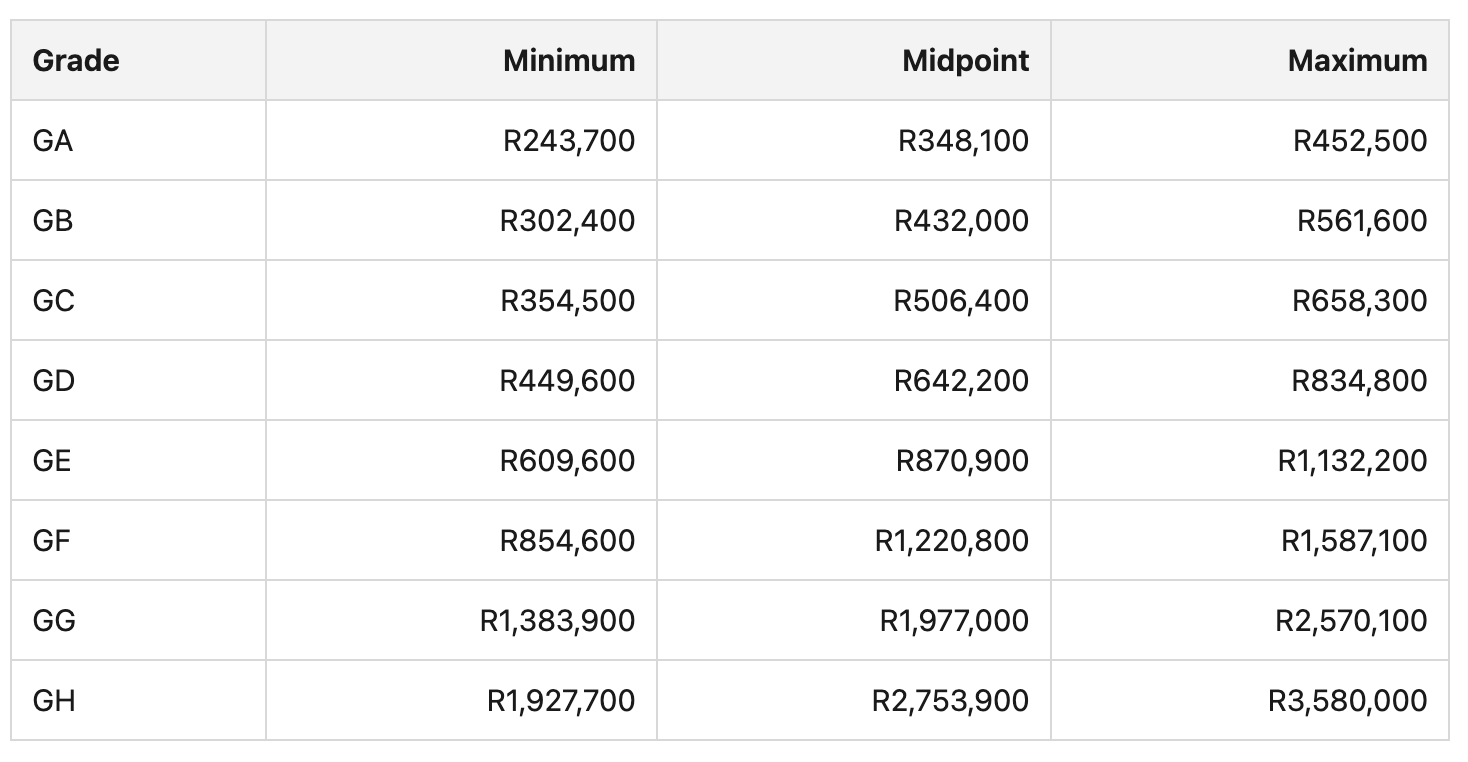
Internationally recruited staff are paid in U.S. dollars and are hired for global expertise and mobility, while locally recruited staff are paid in local currency. A local salary is not the headquarters number converted at today’s exchange rate. It actually comes from a separate country salary plan, reviewed against that labour market.
Here’s the latest South Africa scale (my home-country comparison). The official table stops at GH for South Africa:
The benefits that sit on top of salary
Not all benefits that World Bank staff get are publicly available. But based on the public records, I can confirm that new staff receive 26 days of annual leave and 15 days of sick leave each year. Primary caregivers receive 100 days of parental leave and secondary caregivers receive 50. Staff have access to a pension plan with employee contributions and a Bank match, as well as medical, dental, life, accident and disability cover under the relevant plan.
Internationally recruited staff may also receive relocation and eventual resettlement support. Mobility premiums and other global-mobility benefits apply to certain staff, not to every international hire.
For staff covered by the country-office Medical Benefits Plan, the 2026 premium table says the Bank pays 75% of the premium and the staff member pays 25%. The staff share ranges from 1.10% of monthly net salary for individual cover to 2.80% for a staff member with five or more eligible family members.
The tax question
This is where people can get themselves into a spot of trouble. The headquarters table is a net salary scale. Under the Bank’s tax system, non-U.S. citizens working for the Bank in the United States generally do not pay U.S. income tax on Bank salary. U.S. citizens do owe U.S. taxes. Eligible staff paid on the net system receive a tax allowance intended to put their after-tax income on a comparable footing with colleagues who are exempt. The Bank’s employment-verification guidance distinguishes these net salaries from the notional gross figures sometimes used for lending or tax records.
That doesn’t make every World Bank engagement tax-free. Staff tax-allowance rules are not a safe template for consultants, and country-office or home-country rules can differ. The Bank itself tells employees to contact their respective Tax Office and directs other filers to a tax professional for individual advice.
So please don’t take a salary from this table, multiply it by 1.4 and call that your private-sector equivalent. Your real comparison should use after-tax cash, pension contributions, medical costs, leave, relocation support and the length of the appointment. Then ask HR to confirm the tax treatment in writing before you sign.
What you should take from the numbers
If you’re looking at a headquarters vacancy, the advertised grade gives you the outside limits. It does not tell you where the offer will land. The Bank says salaries are based on education and professional experience, and it reviews the structure every year against public- and private-sector comparators. Individual pay rises also depend on performance.
For a Young Professional, the useful number is the FY2027 GF range of $111,900 to $207,900. For a mid-career specialist, GG and GH now span $145,200 to $363,400. Senior HQ grades begin at $293,800, while the newly published GK band tops out at $540,600.
And for a local role, you should ignore the headquarters table. Find the country row in the FY2027 PDF and work in the published local currency. It’s a bit less glamorous than a viral “tax-free salary” calculation, but it’s the number you can actually use.
Make sure you subscribe to MDB Jobs to get the latest vacancies delivered straight to your inbox each Monday, and consultant positions each Friday.