


You’re probably looking at inter american development bank jobs for one of three reasons. You want mission-driven work with real regional impact. You already work around development finance and want a stronger platform. Or you’ve seen IDB roles before, applied once or twice, and realized the process is much less transparent than the job pages suggest.
That instinct is right.
The IDB is the kind of institution where smart candidates lose because they misread the hiring game. They target the wrong contract type. They underestimate nationality filters. They send a polished but generic CV. Then they wonder why nothing moves.
The bank matters because its work sits close to the core economic pressures in Latin America and the Caribbean. The IDB’s Better Jobs Index, developed by its Labor Markets Division, tracks employment conditions in a region where 70% of the working-age population depends exclusively on labor income, and in 2022 the job quality score reached 41.2 while the quantity score stood at 74.1, according to the Inter-American Development Bank’s Better Jobs Index publication. If you land a role there, you’re not joining a generic international employer. You’re joining an institution that shapes policy, financing, and technical work across the region.
That’s the upside.
The catch is that IDB hiring runs on formal rules and informal filters at the same time. The candidates who get through usually understand both.
Your Guide to a Career at the IDB
Many applicants approach the IDB the wrong way. They treat it like a prestige employer first and a highly structured multilateral system second. That produces weak applications.
A stronger approach starts with a basic truth. The bank hires against operational need, internal constraints, and regional representation logic. You need to fit all three.
What the bank is really hiring for
The IDB values technical credibility, but it also values relevance to its mandate. That means your profile has to make sense in context.
A public finance specialist with direct sovereign advisory experience fits differently from a strong generalist. A digital systems expert who has worked in enterprise environments fits differently from a broad IT manager. The bank wants people who can solve a defined institutional problem.
Practical rule: If your application reads like “smart international professional,” it’s too vague. If it reads like “the exact person for this portfolio, team, and delivery problem,” you’re in the right zone.
Why the process feels opaque
It feels opaque because several screens operate at once:
Eligibility filters tied to nationality and language
Technical fit against the terms of reference
Contract logic that shapes who gets considered for what
Team preference for candidates who can work in a multilateral setting without a long learning curve
That last point matters more than people think. The IDB often prefers candidates who already understand donor environments, sovereign clients, internal review culture, and long decision chains.
You can learn those systems on the job. Hiring managers still prefer not to teach them if they have another option.
Decoding IDB Career Paths Staff vs Consultant
Your first strategic decision is simple. Decide whether you want access, stability, or both. At the IDB, those aren’t always the same thing.
A lot of candidates chase any opening they can find. That gets them into the pipeline, but it doesn’t always get them where they think they’re going.
The contract choice that shapes everything
The sharpest distinction is between staff roles and consultant roles. Internal data cited on the IDB jobs platform says only 25% to 35% of consultants transition to staff positions, and a 2026 hiring freeze on non-essential staff cut permanent roles by 10% while consultant roles grew 22%, according to the IDB jobs site. That tells you two things. Consultant hiring is active, and consultant work does not reliably convert into a staff career.
That doesn’t make consultancy a bad option. It makes it a different option.
Staff roles are career infrastructure. Consultant roles are market entry, specialist delivery, or short-cycle positioning.
What each path is good for
Here’s the clean comparison.
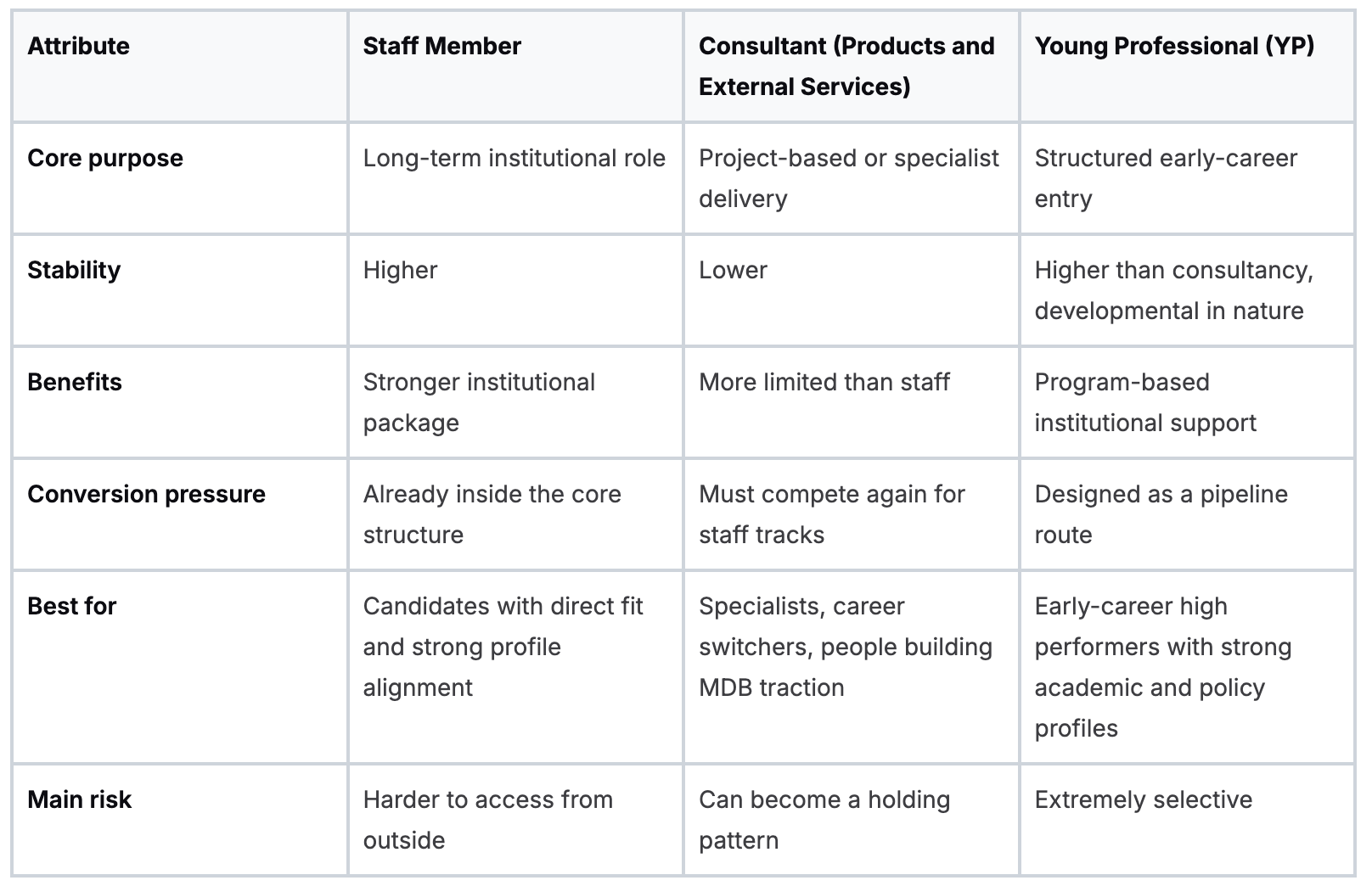
If you want a broader view of this distinction across multilateral employers, this guide on MDB consultant vs full-time employee is worth reading alongside IDB-specific postings.
Staff roles
Staff roles are what most applicants think they want. For good reason.
They offer institutional continuity, stronger internal mobility, and clearer long-term standing. If your goal is to build a durable career inside development banking, staff positions are the ultimate prize.
But staff hiring is slower, more competitive, and more conservative. Teams usually want a candidate who can land with minimal friction. That means direct subject-matter relevance, comfort with matrixed environments, and often stronger language expectations.
Consultant roles
Consultancies are where many candidates first get in. They can pay well, they move specific portfolios, and they often open practical doors.
They also expire.
If you take a consultant role, do it with intent. Use it to build internal references, sharpen a niche, and get exposure to IDB workflows. Don’t assume good performance alone will carry you into staff status. The conversion numbers tell you that belief is weak strategy.
Young Professionals and internships
The Young Professionals Program is one of the few true pipeline routes. It’s built for people with strong academic foundations, policy traction, and credible long-term multilateral potential. If you fit that profile, it’s worth serious attention.
Internships are different. They help with exposure, network, and institutional literacy. They don’t substitute for core experience. For many applicants, an internship is useful only if it sits inside a larger plan.
What actually works
Three patterns tend to work better than “apply everywhere”:
Target staff roles only when your fit is obvious: If you need several explanatory leaps to justify your candidacy, the hiring team will likely move on.
Use consultancy as a deliberate bridge: Pick terms of reference that place you near revenue, operations, lending, analytics, or visible advisory work.
Treat YP as a separate competition: It rewards a different profile from lateral hires. Don’t package yourself the same way.
A random application strategy creates random outcomes. The IDB rewards candidates who choose a lane.
Navigating Nationality Rules and Eligibility
Many strong applicants often find themselves blindsided.
Official eligibility language sounds broad. Real hiring patterns are narrower. If you ignore that, you’ll waste months applying into roles where your odds were weak from the start.

The rule on paper and the rule in practice
The IDB prioritizes nationals from its 48 member countries, with stronger emphasis on borrowing countries in Latin America and the Caribbean. Internal data indicates that over 70% of professional roles are filled by LAC nationals, and 2025-2026 trends show nationality quotas that could raise barriers for candidates from non-borrowing countries by 15% in some specialist hires, according to Indeed’s IDB employer page.
That doesn’t mean non-LAC candidates can’t get hired. It means they should stop pretending the field is level.
Who has the natural advantage
Borrowing-country nationals often align better with the bank’s mandate, regional staffing logic, and language environment. In many teams, that matters immediately.
A candidate from the region may bring:
Regional credibility: Familiarity with client institutions, policy context, and local administrative realities
Language readiness: Spanish or Portuguese that works in meetings, drafting, and stakeholder management
Representation fit: Alignment with the bank’s institutional preference structure
That combination is hard to beat with a generic international profile.
How non-borrowing country candidates stay competitive
You need a sharper strategy, not optimism.
Use these filters:
Go where scarcity matters more than representation. Highly technical roles can give you more room if your expertise is difficult to replace.
Lead with language, not just citizenship. Functional Spanish or Portuguese often matters more in practice than many applicants want to admit.
Use every lawful eligibility advantage you have. Dual citizenship, regional residency history, or deep LAC work experience should be made visible early.
Target units with wider hiring logic. Some parts of the broader IDB ecosystem can be more open than heavily country-facing roles.
If you’re unsure which multilateral institutions you can realistically target based on nationality, this eligibility overview is useful: which MDBs am I eligible to apply.
Your nationality may not disqualify you. It can still put you behind before the interview starts.
What doesn’t work
Two habits repeatedly sink applications.
First, candidates bury language weakness under broad international credentials. Hiring teams notice immediately when the role needs client-facing fluency.
Second, applicants from outside the region aim for policy-heavy or country-facing positions without proving regional substance. A passport from a member country helps. Real operating relevance helps more.
The right response isn’t frustration. It’s precision. Build a profile that answers the bank’s actual hiring constraints, not the version you hoped it had.
The IDB Hiring Process from Start to Finish
The process is orderly, but from the outside it often feels slow and silent. That’s normal.
What matters is knowing what each stage is trying to screen out. Once you understand that, you can prepare for the right battle at the right time.
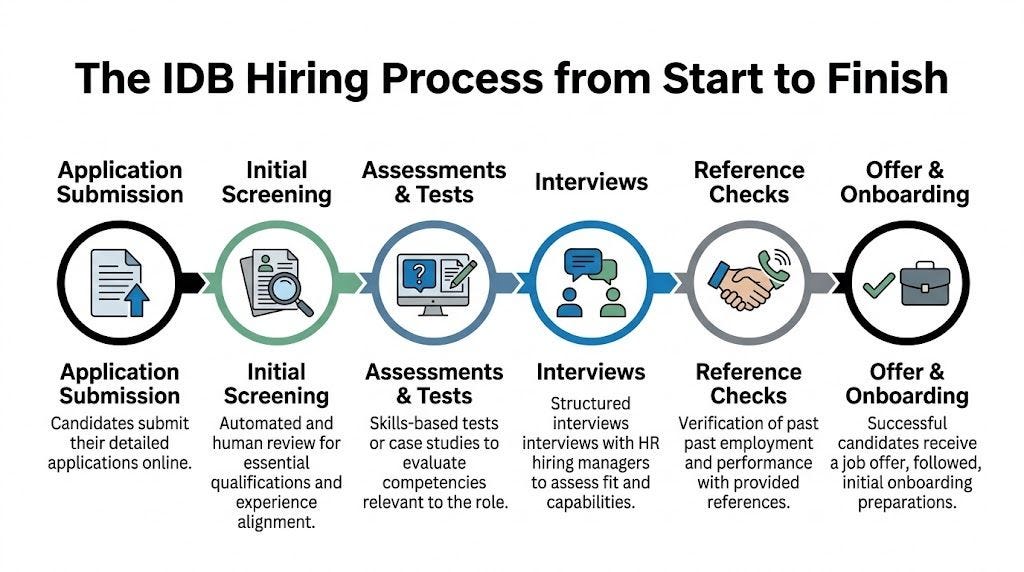
Step one and two
The first stage is the posting and application stage. You find the role, read the terms carefully, and submit through the online system.
This sounds routine. It isn’t.
At this point, many applicants fail because they haven’t mapped their background tightly to the role. If the posting asks for sovereign advisory experience, enterprise SAP architecture, green bond expertise, or multilingual drafting ability, the screening team expects to see that reflected directly in your CV and profile.
The next screen is initial review. HR and the hiring team look for essential qualification match, not general brilliance. If a mandatory criterion is weak, the file often dies early.
What happens in screening
Initial screening usually checks four things:
Eligibility compliance
Years and type of experience
Technical alignment with the stated terms
Clarity of evidence in the application
A common mistake is assuming your reputation or employer brand will fill in the blanks. It won’t. If the CV doesn’t make the fit obvious, reviewers won’t do investigative work on your behalf.
Assessments and technical exercises
For many roles, the next hurdle is some form of assessment. The exact format depends on the position.
You may see a written exercise, a technical test, a case memo, a slide-based presentation, or a practical assignment tied to the job. A finance role may test your judgment and structure. A digital role may test architecture thinking or delivery discipline. A policy role may test synthesis, writing, and recommendation quality.
Interview reality: The bank often uses assessments to find out whether you can already operate at level, not whether you could learn it later.
Interviews
The interview phase usually includes structured conversations with HR, the hiring manager, and often a panel. These are rarely casual.
Expect competency-based questions. Expect technical probing. Expect questions that test judgment in institutional settings, not just subject expertise.
Good candidates answer with specific situations, clear decisions, and concrete outcomes. Weak candidates stay abstract and sound polished but thin.
Reference checks and final review
Once you get late in the process, references matter. The bank wants confirmation that you work well in complex teams, deliver under structure, and can handle multilateral pace without losing quality.
Your references should be briefed. They should understand the role and know what parts of your performance to emphasize.
How to manage the process like a professional
Treat the process as a long campaign, not a quick transaction.
Keep a simple tracking system with:
Posting date and closing date
Role family and business unit
Your specific CV version
Likely technical themes for testing
Reference choices matched to the role
You can do that in a spreadsheet, Notion, Airtable, or any system you’ll regularly maintain.
What candidates misread most often
The biggest misconception is silence. People assume silence means rejection or, worse, that they should start nudging everyone they can find.
That usually hurts more than it helps.
Use targeted follow-up when appropriate, stay organized, and keep applying selectively. The strongest candidates build a pipeline of relevant applications instead of emotionally overinvesting in one vacancy.
Crafting a Winning IDB Application
A generic CV won’t survive serious review at the IDB. The bank hires against terms of reference, and those terms are usually precise.
Your job is to make the reviewer’s decision easy.

Read the posting like a hiring manager
Don’t skim. Break the posting into components.
Separate the role into these buckets:
Mandatory qualifications
Technical tools or frameworks
Delivery expectations
Stakeholder environment
Language and location constraints
Then rewrite your CV so those elements are visible in the same language family the posting uses.
That doesn’t mean copying text blindly. It means reflecting the actual hiring need.
Use proof, not adjectives
“Experienced,” “strategic,” and “results-oriented” don’t move IDB reviewers. Evidence does.
The role-specific examples make this obvious. For a SAP Technical Expert, the IDB requires 5+ years in SAP ABAP/Fiori and cloud integrations, and success is measured by 95% on-time project delivery and zero critical vulnerabilities post-deployment, while expert-led practices can reduce deployment failures by 30%, according to this IDB SAP Technical Expert posting summary on Impactpool. If you’ve done that kind of work, your CV should show architecture decisions, coding leadership, cloud integration scope, review responsibility, and security discipline.
For a Technical Expert in Green Bonds, the requirements include a Master’s degree, 5 years in green finance, and expertise in ICMA Green Bond Principles, and such experts have been shown to enable 20% higher capital mobilization rates for the bank, as noted in the same verified role summary above. That means your application should highlight issuance support, thematic bond frameworks, advisory outputs, and any direct work with public sector or financial institutions.
Build bullet points that sound like delivery
Weak bullet:
Managed finance projects and worked with stakeholders on green initiatives.
Better bullet:
Supported thematic bond advisory work for public sector and financial institution clients, including framework review, knowledge product inputs, and coordination across internal and external stakeholders.
Weak bullet:
Responsible for SAP development and maintenance.
Better bullet:
Led SAP ABAP/Fiori delivery decisions across enterprise workflows, including code review, architecture alignment, and cloud integration support for scalable deployment.
The bank hires people who can already describe their work in operational terms. If your CV reads like a job description, rewrite it.
What your application package should do
Your CV and any supporting note should answer four questions fast:
Why this role?
Why this team?
Why now?
Why you over the next plausible candidate?
That requires selectivity. Tailoring one strong application beats sending five loosely aligned ones.
Common application failures
These show up again and again:
Overbroad profiles: You’ve done many interesting things, but none of them are positioned as directly relevant.
Weak keyword alignment: The posting asks for specific systems, frameworks, or financial instruments and your CV hides them.
No regional framing: You’ve done strong technical work, but the application doesn’t connect it to Latin America and the Caribbean.
Duty-based writing: You list responsibilities instead of showing problem-solving and delivery.
If you fix those four, your odds improve materially even before the first conversation.
Compensation Benefits and Life at the Bank
Candidates often obsess over salary before they understand the work setting. That’s backward.
At the IDB, compensation matters, but your day-to-day experience depends just as much on contract type, duty station, and how much bureaucracy you can tolerate without losing momentum.
Staff life versus consultant life
The practical divide is less about prestige and more about how you live.
Staff roles usually come with stronger institutional footing, fuller benefits, and a clearer long-term path. Consultant roles can be attractive for experienced specialists who want focused assignments or a foothold in the system, but the trade-off is less stability and fewer long-range guarantees.
If you’re comparing options across institutions, this salary-focused overview of MDB salaries and compensation helps frame the broader market.
Headquarters and country office trade-offs
Washington, D.C. and country office life are very different professional experiences.
A headquarters role often gives you more exposure to internal decision-making, cross-department coordination, and institution-wide processes. It can be excellent for learning how the bank operates in practice.
A country office role usually places you closer to implementation, government counterparts, and actual project execution. That proximity can be career-defining if you want operational credibility.
Neither is automatically better. They build different strengths.
What daily work feels like
Expect a mission-driven environment with real expertise. Expect process discipline too.
The culture tends to reward people who can write clearly, coordinate calmly, and work through layered review without becoming difficult. Strong performers usually combine patience with decisiveness. They know when to push and when to document.
The bank values substance, but it also values people who can move substance through institutional machinery.
How to judge fit before you accept
Ask yourself a few blunt questions:
Do you want institutional permanence or portfolio flexibility?
Do you enjoy structured review environments?
Would you rather sit near strategy or near execution?
Can you work well across languages, time zones, and formal processes?
People thrive at the IDB when they like both the mission and the mechanics. If you love the mission but hate the mechanics, the shine fades quickly.
Your Long-Term Strategy for an IDB Career
Most successful IDB hires don’t stumble into the bank. They build toward it.
That usually means creating a profile with three layers. First, a clear technical specialty. Second, visible regional relevance. Third, enough institutional fluency that a hiring manager can picture you working inside a multilateral team without excessive ramp-up.
Build the right kind of experience
The strongest preparation is targeted experience, not just impressive experience.
Look for work that gives you some combination of these:
Client-facing problem solving with governments, public institutions, regulated sectors, or development actors
Technical depth in an area the bank routinely hires for
Cross-border or multicultural work that proves you can operate in regional settings
Writing and synthesis because weak drafting limits your ceiling fast in MDB environments
Early-career candidates often overfocus on credentials. Mid-career candidates often overfocus on title. The bank pays closer attention to usable substance.
Network like a serious professional
Good networking here is narrow and informed.
Talk to people who understand the unit, role family, or workflow you want. Ask better questions than “how do I get in?” Ask what the team struggles to hire for. Ask what separates candidates who interview well from candidates who stall. Ask what language level really matters in practice.
Then keep in touch without becoming a burden.
Stay close to the market
IDB hiring shifts with operational priorities, budget cycles, and internal staffing patterns. If you only look when you urgently want a job, you’ll always be reacting late.
Track role families. Save terms of reference. Notice repeated qualifications. Watch where consultant volume is rising and where staff hiring appears more selective. That gives you a much stronger read on timing and fit.
One practical option is Multilateral Development Bank Jobs, which tracks openings across MDBs, including IDB roles, and also publishes guides on topics like consultant hiring, YPPs, and eligibility. Used well, that kind of resource helps you spot patterns instead of just vacancies.
The candidates who last in this space are deliberate. They build a reputation, sharpen a niche, and keep showing up with stronger evidence each cycle.
If you want a simpler way to monitor inter american development bank jobs alongside roles at other MDBs, Multilateral Development Bank Jobs is a practical resource to keep on your radar. It publishes curated full-time listings, consultant opportunities, and market-specific guides that can help you track openings and understand how these institutions hire.