MDB jobs disappear fast. Are you tracking the latest openings?
Subscribe to the Premium Plan and never miss an opportunity:
• Get Staff roles on Mondays
• Get Consultant roles on Fridays
Grab a free trial here to see what you’ve been missing (no payment required).
On 17 September the World Bank Group announced that it had mobilised more private capital in a single year than at any point in its history. The figure had tripled in four years. Behind it sits a rebuilt guarantee business, a Japanese banker hired from Mizuho, and a president who says in public that his institution cannot lend its way to the goal. Here is how the number was built and who gets hired to keep it growing.
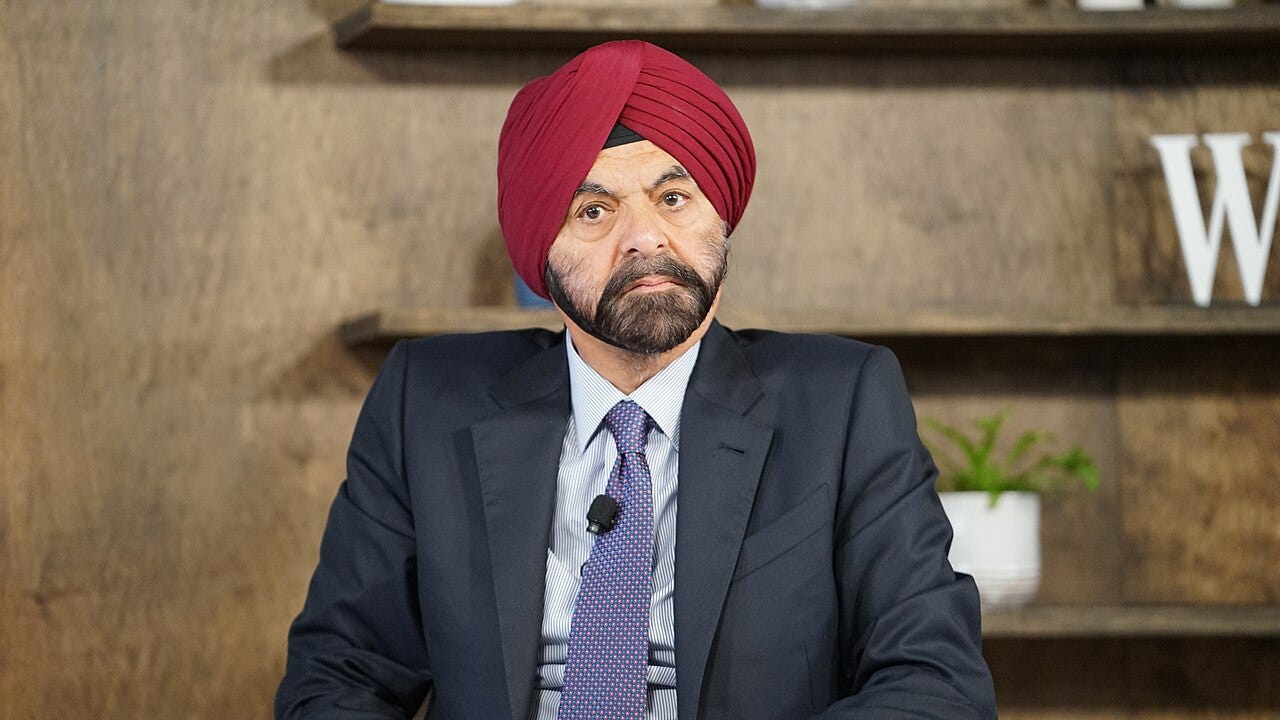
We can’t be lending $200 billion a year,” Ajay Banga told AFP on 17 September. “We don’t have it.”
It was a strange thing for the president of the World Bank Group to say on the day he announced a record. But those dozen words are the argument he has been making since he took the job in June 2023, and the press release his staff put out that morning was the first hard evidence that the argument might be working. In the fiscal year that ended on 30 June 2026, the Group said, it mobilised $112 billion of private capital for developing countries. Four years earlier the figure was $35 billion. The year before it was $69 billion, which means the number rose by more than 60 percent in twelve months. Add the Group’s own financing and the total that reached developing economies was, in the Bank’s words, well over $200 billion. AFP noticed the detail that matters most. Other people’s money is now almost level with the Bank’s own.
“We changed how we work to do that, faster, simpler, and as one World Bank Group,” Banga said in the release. “The result is $112 billion mobilized this year, more than three times where we started.”
Private capital mobilisation is a clumsy phrase for a simple idea. It is money that belongs to somebody else, a commercial bank or a pension fund or a bond investor, that goes into a project because the World Bank Group arranged the deal, lent alongside, or promised to cover part of the loss if things went wrong. AFP’s report carried a tidy example. The International Finance Corporation, the Group’s private sector arm, put together an $850 million financing package for Banco Industrial in Guatemala. Of that, $750 million was raised from international capital markets. The Bank’s own cheque was the small part of the deal, and that was the point of doing it.
The road to that structure began a few weeks after Banga, the former Mastercard chief executive, walked into the building on H Street. In June 2023 he set up something called the Private Sector Investment Lab and filled it with people who ran large pools of money. Mark Carney, then the UN’s special envoy on climate action and finance, and Shriti Vadera, the chair of Prudential, were the co-chairs. Noel Quinn of HSBC sat on it. The Lab’s job was to answer a question the Bank had been asking itself for a decade without much result. Why don’t institutional investors put money into developing countries, even when the returns look good on paper?
The investors came back with five answers. Rules change without warning. Political risk insurance exists but is hard to buy. Currencies collapse. Nobody wants to hold the riskiest slice of a deal. And there is no standard product, nothing a pension fund can buy off the shelf the way it buys a corporate bond. The Lab turned each complaint into a workstream, and the one that moved first was guarantees.
A guarantee is the Bank acting as a co-signer with a triple-A credit rating. A commercial lender finances a power plant or a trade line, and the Bank promises to pay if certain named things go wrong, such as a government tearing up a contract or a borrower being unable to convert local currency into dollars. The lender gets comfort and the country gets a loan it would not otherwise have been offered. The Bank, for its part, has tied up far less of its own capital than a loan would need. The trouble in 2023 was that the World Bank Group sold guarantees through 20 different products scattered across its institutions, each with its own rules, staff and paperwork. On 28 February 2024 Banga announced that all 20 would be folded into one marketplace, which opened on 1 July 2024, and he set a target of tripling annual issuance to $20 billion by 2030. “By consolidating our offerings, simplifying processes, and boosting accessibility we are delivering faster, easier access to guarantees for businesses,” he said. Vadera was blunter about why it mattered. “Guarantees are one of the most established and effective ways to mobilise private finance for climate and development.”
The single marketplace issued $12.3 billion of guarantees in its first full fiscal year, up 19 percent. Then Banga changed the person running it. Hiroshi Matano, who had led the Multilateral Investment Guarantee Agency for six years, stepped down, and on 31 July 2025 the Bank named Tsutomu Yamamoto as MIGA’s managing director. Yamamoto had spent more than 30 years at Mizuho and its predecessor, Dai-Ichi Kangyo Bank, which he joined in 1991. He ran Mizuho’s global transaction banking unit, had worked in the Americas, Asia and Europe, and held a Stanford MBA. He was a commercial banker, in other words, hired to run a development agency like a business line. Banga more or less said so. Yamamoto’s experience, the announcement quoted him as saying, was wanted “for growing our guarantee business”. He started in early December 2025.
By then the instruments had started to combine in ways they never had. In September 2025 the Group stacked a MIGA political risk policy on top of a World Bank policy-based guarantee for the first time, backing a €433.3 million sustainability-linked loan to Côte d’Ivoire. Saudi Arabia’s Public Investment Fund signed memorandums worth up to $9.5 billion this year, $6 billion with IFC and $3.5 billion with MIGA. And when the fiscal year closed in June 2026, guarantee issuance had passed $25 billion. The 2030 target was beaten four years early.
The breakdown of the $112 billion is where the story gets less comfortable. Upper-middle-income countries took $50 billion, up from $12 billion in fiscal 2022. Lower-middle-income countries took $37 billion, up from $14 billion. Africa went from about $9 billion to $22 billion. Low-income countries got roughly $3 billion, and the Bank’s own release describes that figure as maintained, which is a polite way of saying it has not moved. Private money goes where private money is comfortable. The poorest borrowers, the ones the Bank exists for, are still mostly financed the old way.
There are also questions about the counting. The Bank’s Independent Evaluation Group has pointed out that the World Bank records mobilisation when its board approves a project, before the private financiers have committed, which tends to overstate the total when deals are cancelled later, and that nobody routinely goes back to check what turned up. The development banks are reviewing their joint methodology. And three days before the announcement, Álvaro González of the Center for Global Development published a piece noting that the Bank has merged its private sector policy teams with IFC’s investment staff five times since 1999. “Each new arrangement was billed as a fundamental rethink of how the bank supports firms and markets,” he wrote, “yet none lasted a decade.”
Banga, to be fair, did not oversell it. “You can’t force countries to take private capital,” he told AFP. “It’s going to have to be a mutually acceptable system.” Then came a line that will follow him around. “This is wet paint, and as the paint dries, you get a little more result.”
For anyone trying to get hired, the wet paint is the good news. The Bank says 55 percent of its financing now goes to five sectors it considers rich in jobs, namely infrastructure and energy, agribusiness, healthcare, tourism and value-added manufacturing. Its reasoning is that 1.2 billion young people will reach working age in developing economies over the next 10 to 15 years, that only around 420 million jobs are projected for them, and that the private sector creates nine of every ten. Whatever you think of the forecast, it has decided where the budget goes.
It has also changed who the Bank wants. The growth is in MIGA and the guarantee platform, in IFC’s syndications and treasury teams, and in the units that package loans for sale to outside investors. Those teams need people who have underwritten credit, priced political risk, placed reinsurance, run a syndication desk or structured a securitisation. They need people who can explain a deal to a rating agency. IFC already commits a third of its long-term financing in local currency and wants 40 percent by 2030, which makes foreign exchange hedging and local bond market experience worth more than they were. Yamamoto’s appointment tells you how far up that preference goes. A development economics master’s and two years at a think tank is a weaker hand for these roles than four years on a bank’s project finance desk, and it’s better to hear that now than after the third rejection.
The old workaround is going too. Short-term consultancies, the side door through which thousands of people entered the Bank, end in January 2027. So the practical routes are a staff vacancy in one of these teams, the Group’s Young Professionals Program, or a mid-career move from a commercial bank, an insurer or a development finance institution. If you are early in your career and can choose, choose the job that puts you on transactions.
And there is real work left for people who want the hard version. That flat $3 billion for low-income countries is the Bank’s biggest unanswered question, and nobody inside has cracked it. Someone who knows how to get a pension fund comfortable with a solar project in Malawi or a trade line in Niger has a skill the institution cannot buy at the moment.
Make sure you subscribe to MDB Jobs to get the latest vacancies delivered straight to your inbox each Monday, and consultant positions each Friday.