MDB jobs disappear fast. Are you tracking the latest openings?
Subscribe to the Premium Plan and never miss an opportunity:
• Get Staff roles on Mondays
• Get Consultant roles on Fridays
Grab a free trial here to see what you’ve been missing (no payment required).
While the World Bank cuts consultants and the UN cuts posts, the Asian Development Bank is doing the opposite. A plan to grow lending by half by 2034, a charter amendment, a new human resources framework and a president who wants staff out of headquarters have combined into a hiring surge with no equal in the development world. This is the story of how it happened and what the bank is looking for.
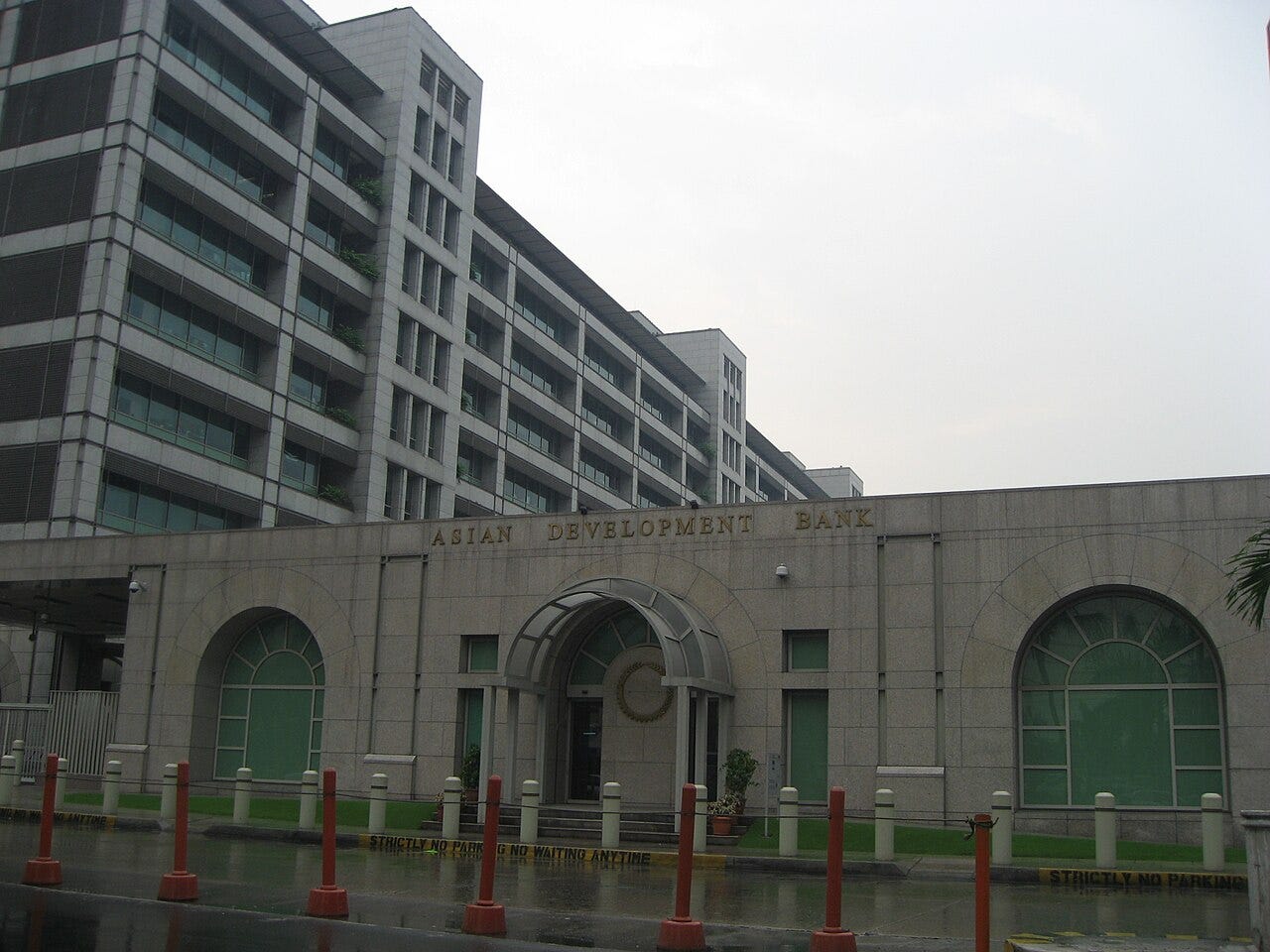
The address is 6 ADB Avenue, Mandaluyong City, Metro Manila, and for most of the Asian Development Bank’s sixty years it was a place that hired carefully. A hundred people in a good year. Two hundred in a very good one. The bank grew, from roughly 2,600 staff in 2009 to about 4,300 in 2025, but it grew the way institutions grow, a department at a time, and the systems that ran it were designed for something smaller.
Then, in 2025, the gate opened. The bank advertised what its director of talent management, Niny Khor, called a “record high” of more than 800 positions. It posted more jobs on Devex’s board than any other development employer that year. And when Devex asked her early in 2026 what came next, the answer was 700 more. “Now is an excellent time to apply,” she said, which is not a sentence development bank HR directors say very often.
To understand why, you have to go back to a board decision taken before the current president had even arrived. On 18 February 2025 the ADB approved its Capital Utilization Plan. The name is dull and the content is not. The plan laid out a path from $24 billion of annual financing commitments in 2024 to more than $36 billion by 2034, an expansion of 50 percent, without any new money from shareholders. It could do that because of capital management reforms in 2023 that had loosened the bank’s own rules on how much it could lend against the capital it already had. Masatsugu Asakawa, then in his final days as president, called it “a dynamic plan” that “enables us to make strategic investments to address complex challenges”. Buried in the announcement was the line that matters for this story. The plan “envisions a sharp increase in ADB’s lending commitments over the next two to three years, supported by an expansion in staff and technical assistance resources”. Private sector operations, the part of the bank that lends to companies rather than governments, were to rise from 20 percent of commitments to 27 percent over the decade.
Six days later Masato Kanda walked in.
Kanda, Japan’s former vice minister of finance for international affairs and for years its top currency diplomat, had been elected by the Board of Governors on 28 November 2024 and took office on 24 February 2025 to serve out the remainder of Asakawa’s term. He inherited a bank that had just promised to grow by half, and he treated the promise as a floor. In his first year the bank committed $29.3 billion from its own resources, 20 percent more than in 2024, with partners adding $14.7 billion for a total of $44 billion. The bank announced $10 billion for the ASEAN Power Grid and more than $10 billion for the CAREC programme across Central Asia, and delivered $14 billion of a $40 billion food systems pledge. It rewrote its energy policy to allow nuclear power for the first time, launched a new environmental and social framework, and signed a first-of-its-kind agreement with the World Bank Group under which each institution relies entirely on the other’s systems when they co-finance a sovereign project. And the governors agreed the first amendment to the bank’s charter in its history, the legal step that turned the 50 percent expansion from a plan into a permission.
None of that happens without people, and the bank’s own budget documents had already said so. The 2025 to 2027 work programme and budget framework identified 390 additional positions, which the bank described as the largest staffing increase in more than a decade. That is how 390 new posts turn into 800 advertisements: the new positions plus the normal churn of an institution of 4,300. The 700 of 2026 are the second tranche.

What Kanda added was a view about where those people should sit. “I am radically empowering country directors on the ground, giving them greater authority over approvals, human resource management and technical assistance funds,” he said in May 2026, describing the changes as “quite dramatic” and confirming that more staff were being moved from headquarters to the field. The bank has opened or upgraded offices in the Solomon Islands, Fiji, Papua New Guinea, Laos, Georgia and Uzbekistan. In July 2026 it approved a resident mission in Türkiye, and on 2 July it announced a North Pacific Subregional Office in Pohnpei, in the Federated States of Micronesia, to be led by a regional director and operational by the end of the year, covering Micronesia, the Marshall Islands and Palau. Emma Veve, the bank’s director general for the Pacific, said the office would “help to unlock more public and private financing for development” in a part of the world where the bank had committed $841 million cumulatively by March 2026. The appointments keep coming: a new country director for Mongolia on 10 August, another for Timor-Leste on 17 August, with Bangladesh and Azerbaijan earlier in the year.
The second thing Kanda added was a rulebook for how the bank treats the people it hires. On 30 January 2026 the board endorsed a Strategic Human Resource Framework, organised around seven stages of what the bank calls the staff journey, from workforce planning and recruitment through to departure. “From the moment a candidate considers joining us and throughout the whole employment lifecycle, we are committed to providing care and support, given our people are ADB’s most important institutional asset,” Kanda said. The aim, he said, was a workplace “highly attractive to the best global talent”. The framework commits the bank to track recruitment timeliness, learning access and staff experience, and it explicitly promotes mobility between headquarters and field offices. The Budget, People, and Management Systems Department is running the rollout. If you have ever waited five months for an ADB recruitment to conclude, recruitment timeliness becoming a tracked indicator is the most practical sentence in the document.
Then, on 22 April 2026, Kanda announced he would stand for a full term. “In this time of radical transformation where the development landscape is threatened by multiple, compounding shocks, the Asian Development Bank provides an anchor of stability for our developing member countries,” he said. Nominations ran from 1 June to 1 July. He was the only name put forward. The governors voted between 2 July and 31 August on giving him five years from 24 November 2026, and the bank has continued at full speed through the voting period: a five-year deal with a group of global insurers on 31 July to free up $2.5 billion of lending capacity for small businesses and affordable housing, and $800 million on 11 August for the Philippines and the Maldives as the Middle East conflict hit their budgets.
So what, exactly, is the bank hiring? Khor’s answer to Devex was specific in one respect. The bank wants digital fluency across every profession, “engineers who are digitally savvy and lawyers who understand AI”, rather than a separate tribe of technologists. Beyond that, the shape of the demand follows the shape of the plan. Private sector operations growing from a fifth to more than a quarter of a much larger book means investment officers, credit and risk analysts, and people who have closed transactions with financial institutions, because the insurer deal and the master framework it expands are built around lending through banks to borrowers the bank cannot reach directly. The power grid and connectivity initiatives mean energy economists, transmission engineers and regional cooperation specialists. The food systems commitment means agriculture and water. The decentralisation means that a meaningful share of the 700 are not in Manila at all but in Pohnpei, Tashkent, Tbilisi and Port Moresby, where the bank is short of the country economists, project officers and procurement and safeguards specialists that a country director needs in order to use the authority he or she has just been handed.
Most of the roles, Khor said, will still be in Manila, and that is where the mechanics matter. ADB recruits through its own portal, the ADB Career and Employment System, and the honest advice is to set up alerts and apply early, because with 700 openings in a year the bank is reading applications continuously rather than in seasons. The Young Professionals Program is the structured entry route: a three-year fixed-term appointment at headquarters or another duty station, open to candidates under 32 with at least three years of relevant experience, including internships, recruited through an online assessment, a recorded video interview and then panel interviews in the first quarter of the year. The appointment can be extended once or converted to a regular position at the bank’s discretion. Below that is the internship programme for master’s and PhD students enrolled at a school in an ADB member country, which for the 2026 cohort closed in mid-March.
There is a catch, and Kanda knows it. A bank that has advertised 1,500 positions in two years on a base of 4,300 is a bank where a large share of the staff are new to the institution, its culture and its systems, at the very moment it is pushing authority out to country offices and asking the whole machine to lend half as much again. The human resources framework exists because the board could see that risk. Whether care and support survive contact with 700 onboardings is an open question.
But for a job seeker the arithmetic is simple. The World Bank is ending 22,000 short-term consultancies and the UN is cutting thousands of posts, while the ADB is hiring 700 people and has told you in public that now is a good time to ask. Six ADB Avenue has not been this open in sixty years.
Make sure you subscribe to MDB Jobs to get the latest vacancies delivered straight to your inbox each Monday, and consultant positions each Friday.