MDB jobs disappear fast. Are you tracking the latest openings?
Subscribe to the Premium Plan and never miss an opportunity:
• Get Staff roles on Mondays
• Get Consultant roles on Fridays
Grab a free trial here to see what you’ve been missing (no payment required).
Three years ago the Central American Bank for Economic Integration was being called the bank of dictators, and US lawmakers were asking its founders to rein it in. Since then it has elected its first woman president, sued its last one in a Washington court, collected nine positive rating actions and voted itself $3 billion of new capital. Most job seekers in the region have never looked at it. They should.
Three billion dollars in Oviedo
On 26 June the Central American Bank for Economic Integration held its Board of Governors meeting a long way from Central America, in Oviedo, in the north of Spain. Spain is one of the bank’s shareholders, though few people outside the region would guess it. The governors, finance ministers and central bankers from the member countries, approved what the bank called its Ninth Capital Increase. Authorised capital went from $7 billion to $10 billion.
Authorised capital is a ceiling, the maximum value of shares a bank is allowed to issue. Members still have to subscribe for the new shares and pay in their part. But raising the ceiling is the decision that comes first, and it is the one a bank’s rating agencies watch, because more capital behind the same loans means a safer lender.
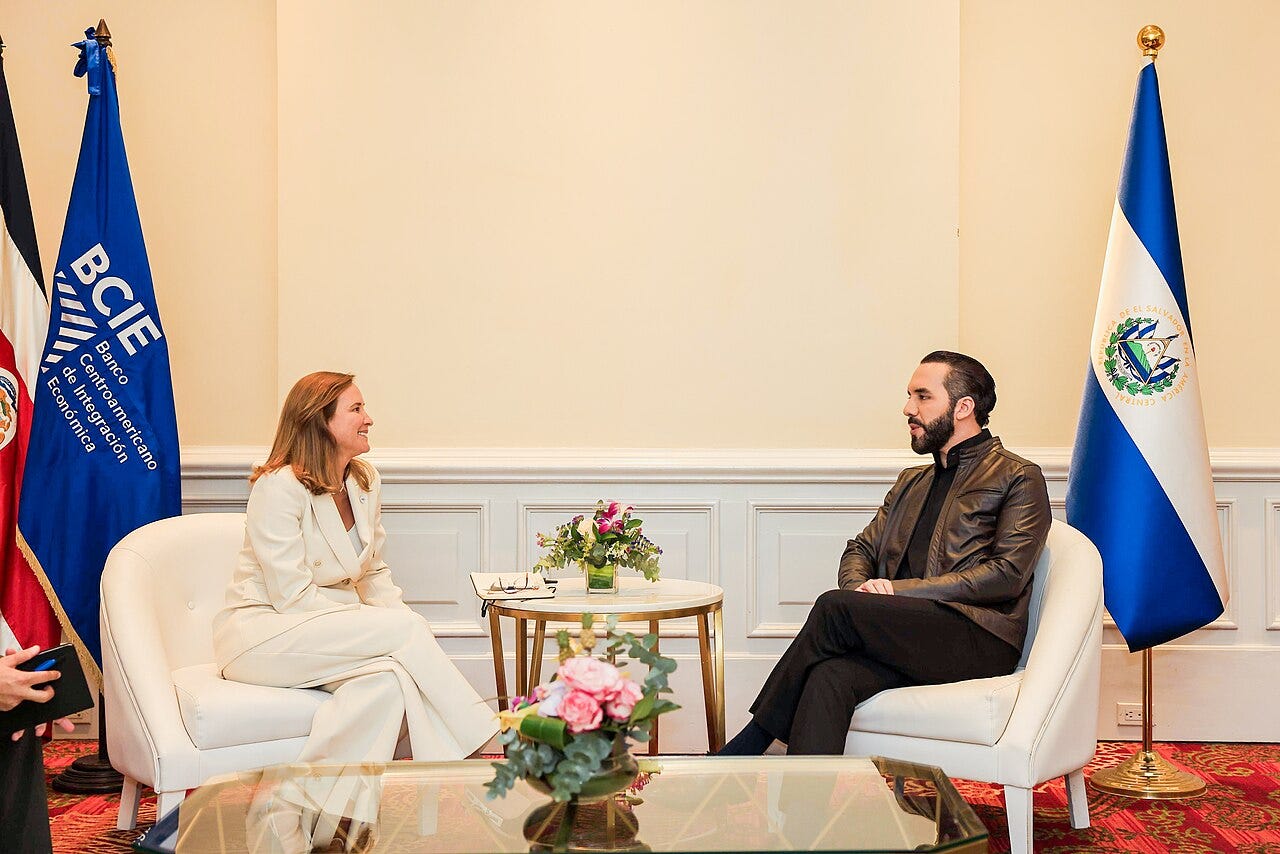
The governors also amended the Constitutive Agreement, the bank’s founding treaty. Panama and the Dominican Republic, both Central American neighbours that had sat in a separate class of shareholder, were moved into Series A alongside the five founders. Gisela Sánchez, the Costa Rican who has run the bank since December 2023, said the decisions “lay the foundations of the CABEI of the next 20 or 30 years”. In the same speech she called for an institution that is “transparente, rigurosa técnicamente, eficiente en el uso de los recursos”: transparent, technically rigorous, efficient with its money.
That last phrase would be boilerplate at most development banks. At this one it’s a pointed remark about the man who ran it before her.
From Managua to the bank of dictators
The bank, known in Spanish as BCIE and in English as CABEI, is older than most of its peers. It grew out of the General Treaty on Central American Economic Integration, signed in Managua on 13 December 1960, the same project that produced the Central American Common Market. Guatemala, Honduras, El Salvador and Nicaragua signed first and Costa Rica followed. The bank opened in Tegucigalpa, Honduras, in 1961 and has been there ever since. Over time it brought in Panama and the Dominican Republic from the neighbourhood, Belize as a borrower, and then a list of outside shareholders that reads like a diplomatic puzzle: Mexico, Colombia, Argentina, Cuba, Spain, South Korea and Taiwan. The bank says that over the last 20 years its projects have accounted for about half of all development bank money channelled to Central America.
Its reputation, until recently, was a different matter. Dante Mossi, a Honduran economist who had spent 15 years at the World Bank, became executive president on 1 December 2018. Nicaragua was months past the 2018 crackdown in which, according to UN and Inter-American Commission experts, more than 300 people were killed. Lending to Daniel Ortega’s government grew anyway. CABEI’s financing went from 21.39 percent of Nicaragua’s public investment programme in 2017 to 39.14 percent in 2022, according to figures reported by Bloomberg Línea. On 17 March 2023 Senator Bob Menéndez and Representative Michael McCaul wrote to the presidents of Costa Rica, El Salvador, Guatemala and Honduras, saying the bank had approved nearly $3.5 billion over five years for projects run under the Ortega and Murillo regime, and asking the founders to use their votes to suspend it. Manuel Orozco of the Inter-American Dialogue, who had himself been stripped of his Nicaraguan nationality that February, called the lending “complete complicity with a dictatorship that represses, kills, exiles, imprisons.”
Mossi rejected the label. He told the Honduran outlet Expediente Público in September 2024 that he really resented the title of banker of dictators. “I arrived in December 2018, the hard crisis in Nicaragua had already passed.” Inside the bank, though, the alarm had been sounding for a while. In late 2021 nine of its directors wrote a letter warning about a worsening financial position and raising transparency concerns. In October 2023 the Organized Crime and Corruption Reporting Project published an investigation that linked several Mossi-era projects to later scandals.
A clean break
By then the governors were already choosing his successor. The headhunters Heidrick & Struggles sifted 243 applications down to six names and then to a shortlist of three. On Friday 17 November 2023 the governors elected Ana Gisela Sánchez Maroto, an industrial engineer with an MBA who had been regional director of strategy at BAC, regional director of corporate relations at Florida Ice & Farm Company, and an executive at the entrepreneurs’ network Endeavor. It wasn’t unanimous. Guatemala and Taiwan voted for the bank’s executive vice president, Jaime Díaz Palacios, and Honduras and Cuba abstained after a Honduran candidate, Hugo Noé Pino, was left off the shortlist. Sánchez took office on 1 December 2023 for a five-year term ending in November 2028. She was the first woman to lead the bank in 63 years.
The break with the past was not polite. On 5 September 2024 CABEI sued Mossi in the federal district court in Washington, DC, hiring Gibson, Dunn & Crutcher and alleging breach of fiduciary duty, market manipulation and violations of the US RICO Act, the racketeering statute, over what it called an “illegal scheme structured by Mr. Mossi”. Mossi went to the Central American Court of Justice in Managua over $6,000 of benefits the bank had withheld, accused it of “terrible opacity” under Sánchez, and said he had no wish to be “part of a bank that is closing.” Nobody comes out of that exchange looking good. But it told investors which way the institution was facing.
The road to AAA
The rating agencies noticed. Moody’s upgraded the bank to Aa2 with a positive outlook in July. Fitch, which had last rated it A+ in 2019, came back on 20 October with AA and a positive outlook, two notches higher. S&P has it at AA+ and so does Japan Credit Rating Agency. On 29 October Sánchez told the Spanish news agency EFE that the bank had now received nine positive rating actions. The bank counts 21 upgrades since 2002 and no downgrades. It also wants more. “Under our institutional and financial strategy, we have a clear purpose of becoming a AAA-rated institution,” its chief financial officer, Humberto Rodríguez, told LatinFinance in August. “I think we have a good shot of making it.”
Ratings matter here in a very direct way. CABEI raises its money in bond markets, and a better rating means cheaper money, which the bank passes on. It says its lending rates have come down by 80 to 95 basis points over three years, worth about $690 million in savings for borrowing governments over five years. It earned a record $277.9 million in 2025 and had $19.8 billion of assets at year end. Sánchez also told EFE that operating expenses had grown by more than 80 percent and that the bank had since cut them by about 18 percent while the loan book kept growing. (Running a leaner shop is one way to please a rating agency. It’s less fun for the people in it.)
Spreading the risk
The obstacle to AAA is concentration. A development bank owned by a handful of neighbouring countries ends up lending mostly to those same countries, so its fortunes rise and fall with theirs. Under Mossi, by Sánchez’s own late-2023 figures, a quarter of the portfolio was in El Salvador and 22 percent in Nicaragua. The Oviedo reforms attack this from several directions at once. The bank merged its three classes of members into two. Series A members now face an exposure limit of 23 percent, a cap on how much of the loan book can go to any one country, and the bank says that frees about $2 billion of lending room for Panama and the Dominican Republic. Roughly 11 percent of authorised capital is unsubscribed and open to new, highly rated members. Sánchez compared the reform to 1992, when the bank first let in shareholders from outside the region.
There’s a second tool, less visible and very clever. CABEI has signed four exposure exchange agreements worth more than $2.1 billion with other development banks, including CAF and FONPLATA. Two lenders that are each too heavily exposed to their own neighbourhoods swap slices of risk, a bit like two farmers each insuring the other’s harvest. Fitch says the share of the bank’s five largest exposures fell from 75 percent at the end of 2024 to 61 percent. Lending outside the founding five rose from 19 percent of the book in 2023 to 27 percent in 2025, and that includes a $500 million loan to Mexico’s state power company CFE and a newly approved $100 million loan to Colombia.
Who CABEI will need
So what does a $10 billion CABEI need that a $7 billion one didn’t? Mostly people who can do what the bank has spent three years learning to do. It funds itself in 30 currencies and 26 markets. It runs a $15 billion medium-term note programme. It negotiates risk swaps with other multilaterals and argues its case with four rating agencies at once. Treasury, credit risk and capital management are the obvious beneficiaries. So is anyone who can structure a deal in Mexico or Colombia, where the bank is new and the borrowers are large.
The entry routes are small and specific. The bank is headquartered in Tegucigalpa, with offices in Guatemala, El Salvador, Nicaragua, Costa Rica and Panama. Its Young Professionals Program lasts two years, requires at least a master’s degree, and is open only to citizens of the 15 member countries who are under 32 when they join. Fluent English is required. A posting that closed on 22 May 2026 was for the Private Sector and Financial Institutions Department in Guatemala City and asked for two years in banking, corporate finance, project finance or development finance. Another, which closed on 28 July, was for information security and listed ISO 27001, SIEM tools and CISSP-type certifications, with Spanish among its languages. There is also an unpaid professional internship of about three months for students near the end of their degrees, with applications accepted all year and a letter required from the university.
Compare that with the Inter-American Development Bank, which most people in the region think of first. The IDB has 48 member countries, sits in Washington, and its own two-year Young Professionals programme draws from that whole hemisphere and beyond. CABEI’s pool is a fraction of the size. If you hold a Honduran, Salvadoran, Panamanian or Dominican passport, you are competing with a much smaller field. If you’re Spanish, Korean, Mexican or Taiwanese, you may not know you’re eligible at all, and neither do most of your rivals.
The caveats
The caveats are real. This is a bank still in litigation with its former president, with a rating story that depends on new members who haven’t signed up yet, and a cost-cutting drive whose effect on staff numbers it hasn’t spelled out. Sánchez has about two years left in her term. She says she wants to spend them working with the finance ministers and presidents of the eight SICA countries on a regional plan for 2040. The governors have given her the capital to try.
Make sure you subscribe to MDB Jobs to get the latest vacancies delivered straight to your inbox each Monday, and consultant positions each Friday.