

Trying to land a job at the World Bank isn’t about sending a generic CV into the void. It’s a game of strategy. Your entire approach hinges on understanding the Bank’s distinct career tracks, from permanent staff roles to specialized consulting gigs. Each one has its own playbook, expectations, and ideal candidate profile.
Understanding Your Path into The World Bank
Getting a role at the Bank requires a clear strategy based on where you are in your career. There are four main ways in, each built for a different type of candidate. Applying for a staff role with a consultant’s profile is a fast track to the “no” pile.
The four main pathways are: staff appointments, consultant contracts, the prestigious Young Professionals Program (YPP), and internships.
Staff roles are the most stable and fiercely competitive, designed for established experts. Consultant positions offer more flexibility and are often project-based, a classic way to get your foot in the door and prove your worth from the inside.
For high-achieving early-career professionals, the YPP is the premier track for grooming future leaders. For students, internships offer an invaluable, real-world taste of global development work.
Figuring out where you fit is the first and most critical step.
Choose Your Entry Point
Your current career stage is the single biggest factor in this decision. An experienced professional with a decade of sector-specific work plays a completely different game than a recent Ph.D. graduate. A huge, common mistake I see is people misjudging their fit and wasting months on applications that were never going to fly.
You have to be realistic and align your experience level with the right entry point.
This decision tree helps visualize how your current status maps directly to the available opportunities.
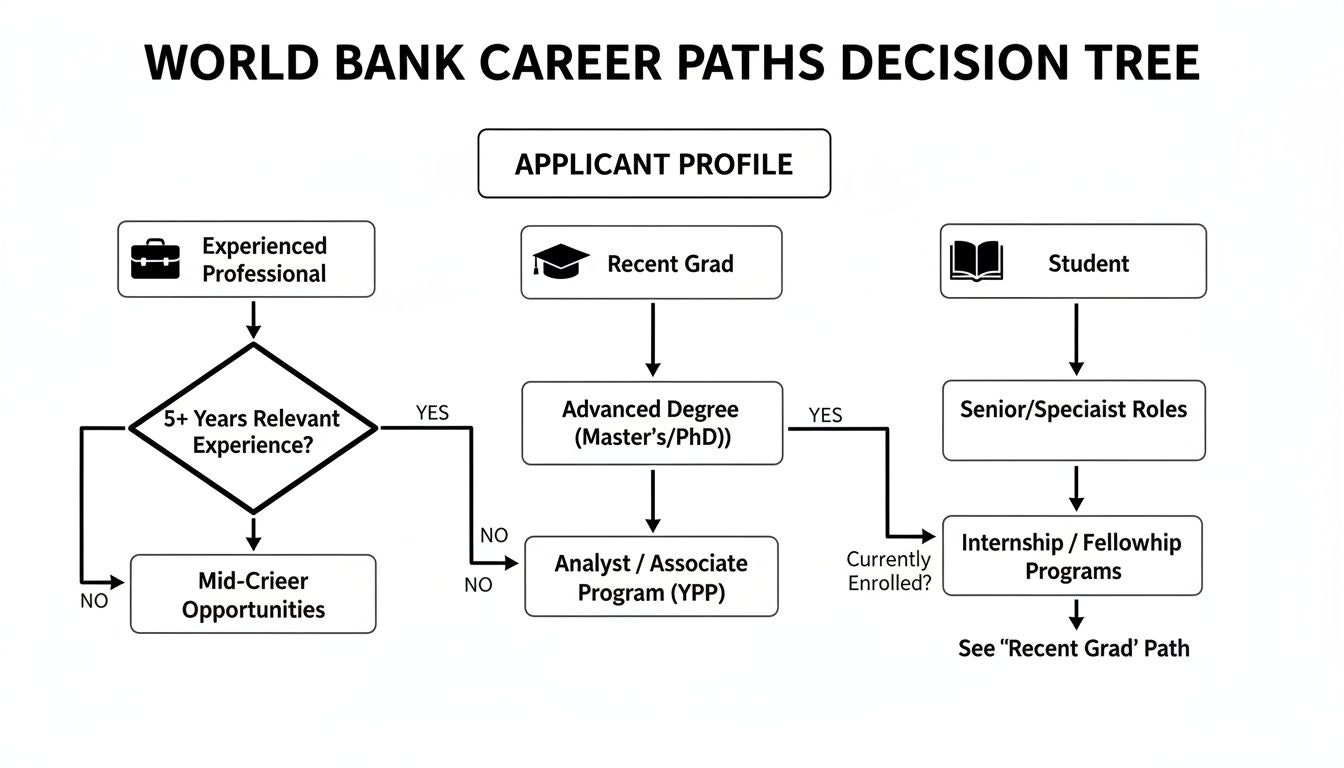
Whether you’re a student, a recent grad, or a seasoned pro, there’s a specific door for you. These pathways are fundamentally different contracts, cultures, and career trajectories.
Here’s a quick summary of the different employment types at the Bank.
World Bank Career Paths at a Glance
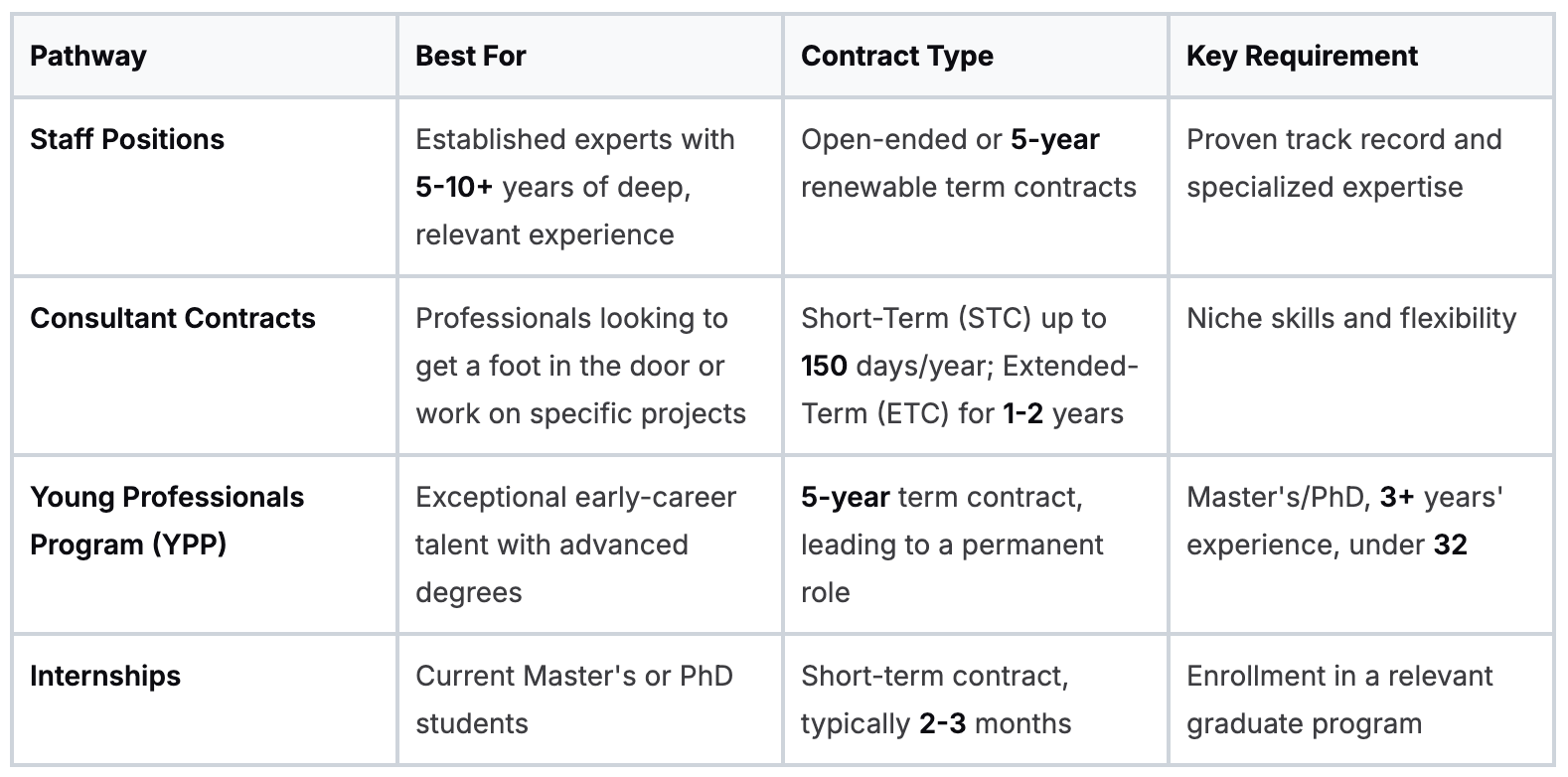
Each path serves a different purpose for both the Bank and the individual. Understanding which one aligns with your profile is the foundation of a successful job search strategy.
Let’s break down the essentials for each track:
Staff Positions: These are the core, permanent roles graded from GA to GK. They demand deep expertise and a significant professional history. They are the Bank’s institutional backbone.
Consultant Contracts: Known as Short-Term Consultants (STCs) or Extended-Term Consultants (ETCs), these roles are tied to specific projects with fixed end dates. They are an excellent way to build an internal network and a track record of delivering good work.
Young Professionals Program (YPP): This is a hyper-competitive, five-year leadership development program. It’s the main pipeline for exceptional young talent with advanced degrees and a few years of solid experience.
Internships: Designed for students currently enrolled in a Master’s or Ph.D. program, these offer a chance to contribute to real projects and get a feel for the Bank’s work.
Getting in often means starting as a consultant. Many successful staff members I know began with short-term contracts, proved their value on a project, and then successfully competed for a permanent position when one opened up.
Finding Openings and Decoding Eligibility Rules
To have a shot at a World Bank role, you need to know where to look. Most people make the rookie mistake of starting and ending their search on the official World Bank Group Careers portal. While that’s the main source, it’s not the only one, especially if you’re targeting less-visible consultant gigs.
Think of your job search as an intelligence-gathering mission. The best candidates don’t just set up an alert on the main portal and wait. They actively scan niche development job boards and monitor LinkedIn posts from team leads who are quietly sourcing talent for upcoming projects. You have to hunt for the role.
Where to Actually Find World Bank Jobs
The official portal is your baseline, but relying on it alone means you’re competing with thousands of others doing the exact same thing. To get a real edge, you have to cast a wider net.
Here are the channels you must monitor:
The Official WBG Careers Website: This is non-negotiable. It’s the central hub for all staff positions, the Young Professionals Program (YPP), and formal internships. Get comfortable with its search filters and terminology.
Devex and DevNetJobs: These are the industry-standard job boards for anyone serious about a career in global development. The Bank often cross-posts consultant roles here to tap into a more specialized pool of candidates.
LinkedIn: This is the insider’s channel. Follow World Bank practice managers, directors, and lead specialists in your field. They often post about upcoming projects or signal a need for specific skills long before a formal Terms of Reference (TOR) is published.
The real game is finding opportunities before they become hyper-competitive. I’ve seen consultants land gigs because they responded to a manager’s post on LinkedIn about needing a “health financing expert for a short-term assignment in Southeast Asia.” The official job posting came much later.
Decode Eligibility the Right Way
Finding a promising opening is step one. The next, more important step is figuring out if you’re actually eligible. The World Bank has strict, non-negotiable rules that sideline countless unprepared applicants every year. Wasting days on an application for a role you can’t legally hold is a classic rookie error.
The single most critical factor is nationality. For many staff positions, especially at the D.C. headquarters, the Bank uses a nationality quota system to maintain a staff that reflects its diverse member countries. If your country is over-represented, you’re facing a much steeper climb for a staff role.
But this rule isn’t a blanket ban.
Consultant Roles (STC/ETC): Nationality restrictions are far less of an issue for consultant contracts. The main focus is simple: finding the right expert for a specific project, regardless of their passport.
Country Office Positions: Jobs based in one of the Bank’s many country offices are almost always open to nationals of that country. Depending on the role, they are often open to international candidates as well.
The YPP Program: The Young Professionals Program has its own specific nationality requirements, which explicitly favor candidates from under-represented member countries.
To get a handle on the full process, check out our deep dive into the World Bank hiring playbook and its timelines. It gives you a realistic picture of how long each of these steps can take.
Read Between the Lines of a Job Description
World Bank job descriptions, or Terms of Reference (TORs), are notoriously dense and loaded with specific jargon and acronyms. Your job is to translate this bureaucratic language into what the hiring manager actually needs.
First, distinguish between the absolute must-haves and the nice-to-haves. Look for definitive language like, “A Master’s degree in X with a minimum of 8 years of relevant experience is required.” That’s a hard filter. If you don’t meet it, move on. Don’t waste your time or theirs.
Phrases like “Experience with Z is an asset” or “Familiarity with Y is desirable” are signals for preferred, but not essential, skills. Lacking one of these won’t kill your application if your core profile is a great match.
As a rule of thumb, if you meet 100% of the mandatory criteria and about 70-80% of the total requirements, you should apply. The “perfect” candidate who ticks every single box is a myth. Don’t self-select out of a great opportunity.
Crafting an Application That Gets Past the Screeners
Your application is your opening move. It has one critical job: to survive the initial cut.
Before a human hiring manager sees your CV, it has to get past a sophisticated applicant tracking system (ATS). I’ve seen countless qualified people get rejected at this stage because they submitted a standard corporate resume. That’s the fastest way to get screened out.
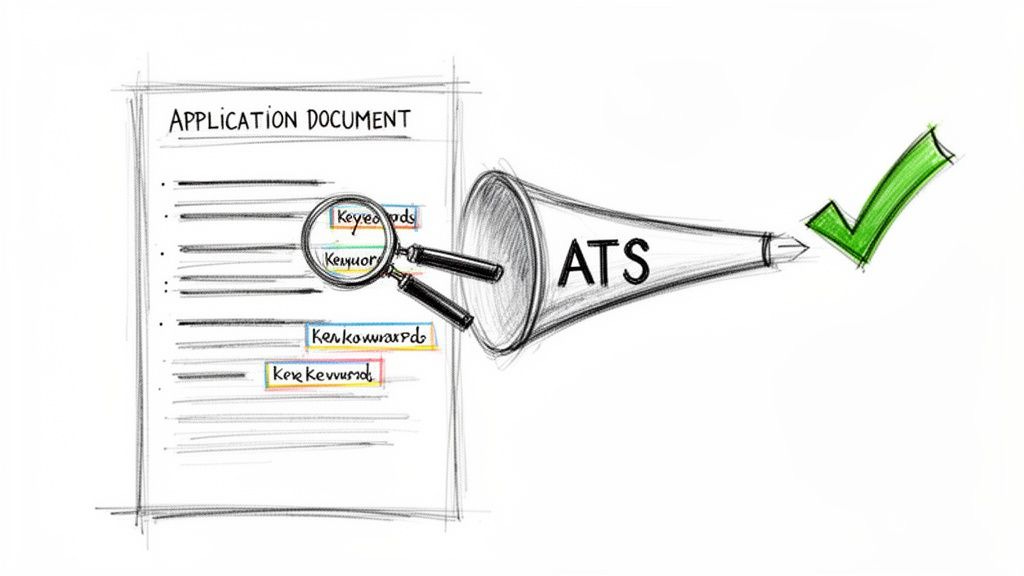
The Bank’s system is programmed to hunt for specific keywords, project types, and quantifiable results that align with its core mission. It doesn’t care about flashy designs or clever personal statements. It’s a machine scanning for data points.
This means your first task is a translation job. You must convert your experience into the language the World Bank understands and demonstrate development impact, not just corporate success.
Frame Your Experience in Development Terms
The biggest mistake candidates make is describing their achievements using private-sector jargon. Phrases like “increased market share” or “boosted quarterly profits” mean little to a development economist or a project manager focused on poverty reduction.
You have to reframe your work. Your CV needs to speak the language of results-based financing, stakeholder engagement, and country-level diagnostics.
Think about your work through a development lens. A project manager from a tech company, for instance, should emphasize skills in managing complex multi-stakeholder initiatives and delivering results on tight budgets. Did you manage a project that improved efficiency for low-income customers? That is “enhancing service delivery for vulnerable populations,” not just “process optimization.”
This quick translation guide shows how to shift the narrative of your career to align with the institution’s values and operational language.
CV Keyword Translation for World Bank Applications
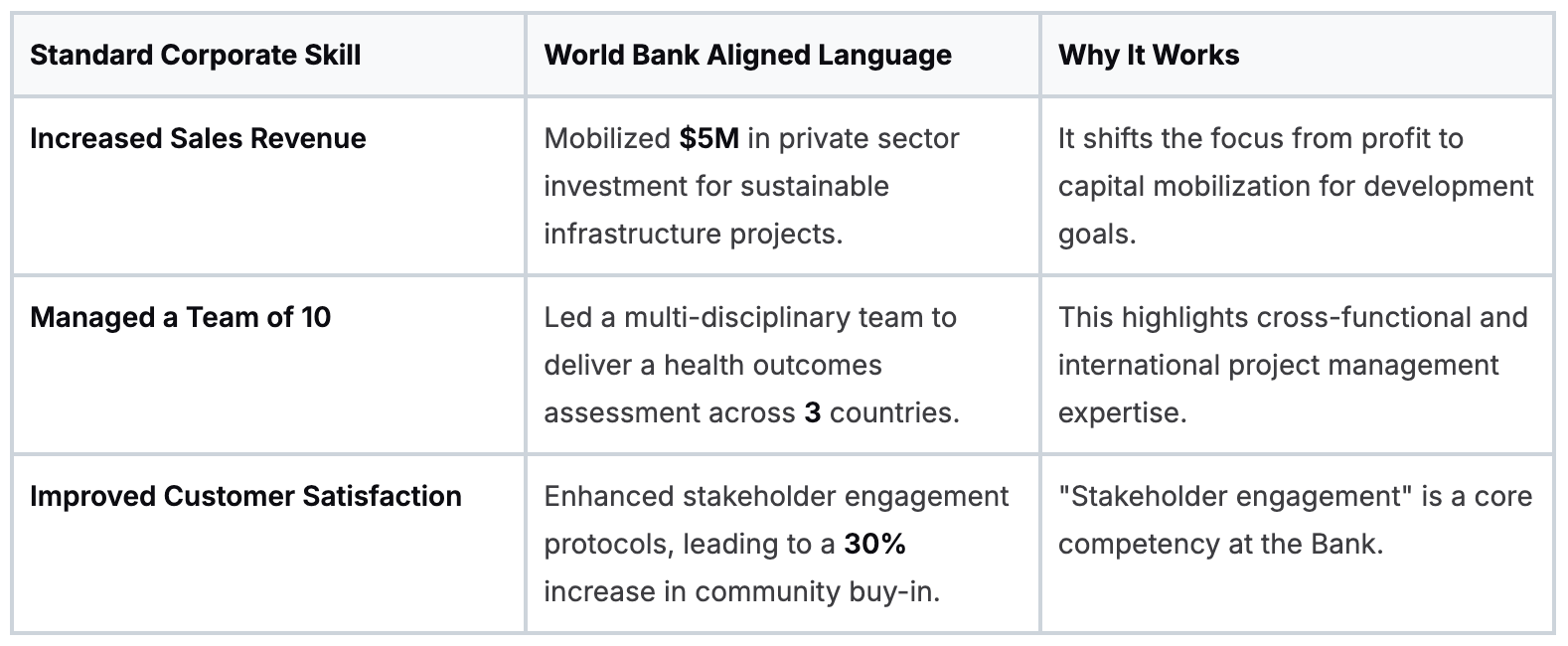
This is about fundamentally changing how you present your professional story. Learning to do this well is a game-changer. Our complete guide on how to apply for World Bank jobs dives much deeper into this reframing process with more real-world examples.
Quantify Your Impact, Not Just Your Responsibilities
Your CV should read like a highlight reel of your accomplishments, not a laundry list of your duties. Every bullet point has to answer the question, “So what?”
Avoid generic statements like “Responsible for data analysis.” That tells the screener nothing.
A much better version is: “Analyzed household survey data for 10,000 respondents to identify key drivers of youth unemployment, informing the $50M project design.” This is specific, measurable, and directly relevant to the Bank’s work.
The screeners are looking for evidence that you can deliver results in a development context. Numbers are the most powerful way to provide that evidence. A CV without metrics is a CV that gets ignored.
This focus on measurable outcomes is critical when your experience touches on major institutional priorities. Take youth employment, one of the most pressing challenges in global development. Over the next decade, a staggering 1.2 billion young people will enter the workforce in developing countries. Demonstrating how your work aligns with solving such massive, well-documented problems will make your application stand out immediately.
Tailor Your Cover Letter to The Specific Role
A generic cover letter is a waste of everyone’s time. Your cover letter has to prove you understand two things: the World Bank’s broader mission and the specific requirements of the role you’re targeting.
Don’t rehash your resume. Use the cover letter to connect the dots for the hiring manager. Pick two or three of your most relevant accomplishments and explain exactly how that experience prepares you to tackle the challenges outlined in the job description.
Your letter must also show you’ve done your homework. Mention a specific World Bank report, project, or initiative related to the team you’re applying to join. This signals genuine interest and proves you aren’t just spamming applications.
Here’s a simple structure that works:
Opening: State the exact position you’re applying for. Express clear enthusiasm for the team’s specific mandate (e.g., climate finance, education reform in South Asia).
Body Paragraphs: Connect your top 2-3 achievements directly to the job’s core requirements. Use the same language you see in the Terms of Reference (TOR).
Closing: Reiterate your strong interest and your understanding of how this specific role contributes to the Bank’s overall mission.
This focused approach respects the hiring manager’s time and makes it easy for them to see you as a serious, well-prepared candidate.
Mastering The World Bank Interview Process
Alright, your application made it through the initial cut. Congratulations. Now comes the real test: the World Bank interview gauntlet.
This is a methodical, multi-stage evaluation designed to vet your technical skills, behavioral competencies, and whether you genuinely align with the Bank’s mission. Knowing what’s coming is half the battle.
The process almost always follows a predictable path: a quick screening call, a formal panel interview, and, for many roles, a technical assessment or presentation. Each step has a purpose.
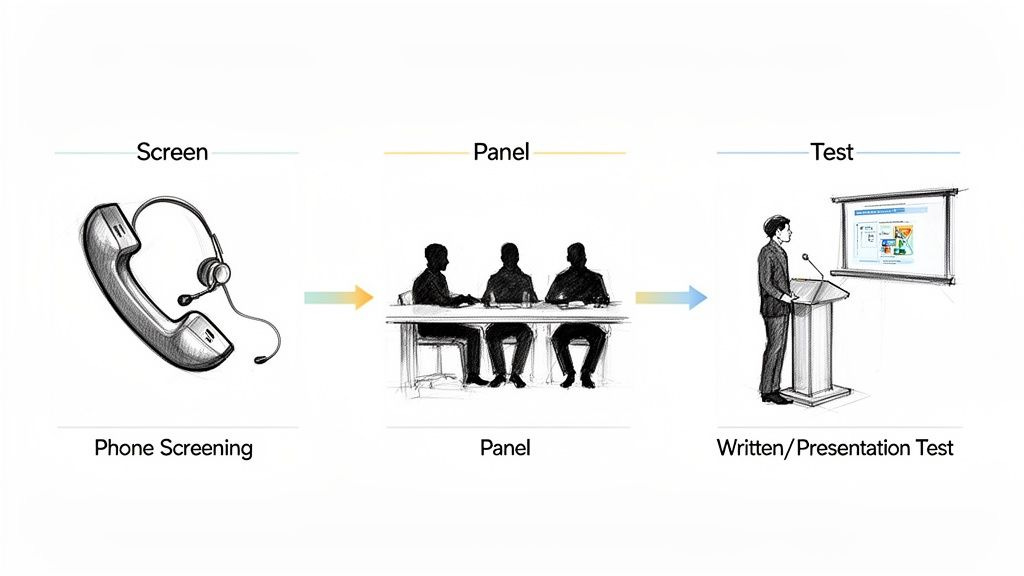
This process is about showing them how you think, proving your expertise under pressure, and communicating complex ideas with absolute clarity.
The Stages of The Interview
First up is the screening interview. This is usually a short call with an HR representative or a junior team member. Their goal is simple: verify what’s on your CV and make sure you tick the basic boxes.
Don’t underestimate it. Be ready with a crisp, two-minute pitch about who you are and why you want this specific job at the Bank.
If you pass that screen, you move to the main event: the panel interview. This is the most critical stage. You’ll likely face three to five interviewers: the hiring manager, technical experts, and maybe someone from a partner unit.
They’ll hit you with a mix of behavioral and technical questions. To get inside the heads of the people on the other side of the table, check out this insightful interview with a multilateral development bank panellist.
Finally, for many roles, there’s a technical assessment. This could be a timed writing test, a data analysis exercise in Stata or Excel, or a request to prepare and deliver a presentation. They want a raw, unfiltered look at your practical skills.
Answering Competency-Based Questions
The World Bank lives and breathes competency-based, or behavioral, questions. They believe your past performance is the best predictor of your future performance.
These questions almost always start with phrases like:
“Tell me about a time when you had to manage conflicting stakeholder interests.”
“Describe a situation where you delivered a complex project with limited resources.”
“Give an example of when you had to adapt your communication style for a different culture.”
Your secret weapon here is the STAR method. It gives you a clear, logical structure for your answers, ensuring you hit all the key points without rambling.
The STAR method is your framework for turning past experiences into compelling evidence of your capabilities. It stands for Situation, Task, Action, and Result. Master this, and you’ll handle any behavioral question they throw at you.
Here’s how you break it down:
Situation: Briefly set the scene. What was the context? Which project were you on?
Task: What was your specific job? What goal were you trying to hit?
Action: Describe the specific steps you took. Focus on your contribution, even if it was a team effort. Use “I,” not “we.”
Result: What happened? Quantify the outcome whenever you can. What did you learn from it?
This approach forces you to be specific and results-focused, which is exactly what the panel wants to see.
The Technical Assessment and Presentation
The technical assessment is where you prove you can do the work.
What they ask for varies wildly by role. An economist might get a dataset and be asked to run a regression analysis. A communications specialist might have to draft a press release on a sensitive topic. Your job is to go back to the job description, identify the core technical skills, and practice them. If it says “financial modeling,” build one. If it says “policy analysis,” be ready to write a sharp, concise brief.
For presentations, you’ll typically be given a case study and 48-72 hours to prepare a short PowerPoint deck. They’re testing several things at once:
Can you quickly grasp a complex problem?
Are your analytical skills sharp?
Can you communicate your ideas clearly and persuasively?
Structure it logically. Start with a clear summary of the problem, outline your proposed solution with data to back it up, and finish with a few key recommendations. Keep it tight, professional, and focused. This is your chance to show the panel exactly how you think and work.
The Inside Track on Networking and Informational Interviews
Let’s get one thing straight. A perfect application might get your CV past the initial screen, but a strong internal network is what actually gets you hired at the World Bank.
Applying “cold” is the lowest-probability path you can take. Networking here is a core part of any winning strategy.
This is about targeted intelligence gathering. The whole point is to build genuine connections with people who are already doing the work you want to do. Your goal is to understand a team’s priorities, its challenges, and what it needs before a job is ever posted publicly.
Find and Connect with The Right People
First, you need to identify current staff and consultants in your specific field. Your primary tool here is LinkedIn. Get surgical with your searches. Instead of just “World Bank,” try something like “Economist World Bank Education” or “Project Manager World Bank Water Global Practice.” You’re looking for people one or two levels above the role you’re targeting.
When you find someone promising, send a connection request, but always add a personalized note. Keep it short, specific, and respectful of their time.
Bad Request: “Hi, I want to work for World Bank. Can we connect?” (This is lazy and gets deleted almost instantly.)
Good Request: “Hi [Name], I’ve been following the Bank’s work on digital agriculture in West Africa and was impressed by your team’s recent project. As a specialist in this area, I’d appreciate the chance to connect and learn more about your work.”
The difference is night and day. The second one shows you’ve done your homework and have a genuine, professional interest. It’s focused on their expertise, not your job search.
How to Run an Effective Informational Interview
Once someone accepts your request, the next move is to ask for a brief informational interview. A 15-20 minute virtual coffee chat is all you need.
In your message, be explicit that you are not asking for a job. You’re seeking advice and insight. The best way to do this is by framing the request around their experience. Something like, “Would you be open to a brief 15-minute call in the coming weeks? I’m hoping to better understand the career path that led you to your current role at the Bank.”
During the call, your job is to listen more than you talk. Come prepared with smart, thoughtful questions that prove you understand the institution.
Your questions should focus on the team’s work, not on your own chances of getting hired. You’re gathering information that will make your future application incredibly specific and relevant.
Here are a few questions that work well:
“What are the biggest strategic priorities for your team over the next year?”
“What are some of the key challenges the team is currently working to solve?”
“What skills or expertise does the team find most valuable when tackling these issues?”
This approach gives you invaluable intel into the team’s pain points and where they’re headed. The global labor market is always shifting, and understanding these internal priorities is everything. The World Bank’s own research highlights a massive employment transformation, with structural changes affecting 22% of all jobs. You can read the full Future of Jobs research to see how these trends influence the Bank’s own focus areas.
After the call, send a thank-you email within 24 hours. Reference a specific piece of advice you found helpful. It’s a simple act of professional courtesy that keeps the door open for future contact.
Got Questions About a World Bank Career?
Even with the best game plan, you’re bound to have questions. The World Bank is a sprawling, complex place, and its hiring process can feel like a black box from the outside. Here are straight answers to the questions I hear most often.
What are the salary and benefits like at the World Bank?
Let’s cut to the chase: World Bank staff salaries are designed to be globally competitive. Your pay is determined by a formal grade level system, running from GA up to GJ. The real kicker? For most staff in most member countries, that salary is net of local income taxes. This is a massive financial advantage.
The benefits package for full-time staff is top-tier. It includes robust global health insurance, a very generous pension plan, and significant relocation support for internationally recruited staff and their families. It’s a package designed to attract and retain global talent.
Consultant pay is a completely different beast. It’s usually a daily rate you negotiate based on your experience and what the project budget can handle. Crucially, this rate does not include the staff benefits package. That’s a critical difference to remember when you’re weighing a contract offer.
How long does the hiring process usually take?
You’re going to need patience. The World Bank hiring process is notoriously slow, often taking anywhere from three to nine months, and I’ve seen it go even longer.
A few things cause this. First, the sheer number of applications for any single opening is staggering. Second, the internal approval process for every new hire involves multiple layers of bureaucracy.
It’s completely normal to apply and then hear nothing for weeks or even months. This doesn’t mean you’re out of the running. My best advice? Keep pursuing other opportunities. Never put your job search on hold for a single World Bank application.
The long wait is a feature, not a bug, of the system. The best candidates understand this and manage their expectations accordingly. A lack of communication is just part of the process, not a definitive “no.”
Can I move from a consultant to a staff role?
Yes. This is the most common and effective way people build a long-term career at the Bank. A huge percentage of successful staff members started with Short-Term Consultant (STC) or Extended-Term Consultant (ETC) contracts.
Working as a consultant is the ultimate “foot in the door” strategy. It lets you prove yourself on real projects, build a solid track record, and—most importantly—develop a critical internal network. When staff positions open up, an internal candidate with a history of delivering quality work has a massive advantage.
The transition isn’t automatic. You still have to apply for staff jobs through the same competitive process as everyone else. The difference is that your internal experience, glowing references from Bank managers, and deep understanding of how the institution actually works will make your application incredibly compelling.
What are the most common mistakes applicants make?
Over the years, I’ve seen the same handful of mistakes sink countless otherwise-qualified candidates. If you can avoid these, you’re already ahead of the competition.
Here are the biggest errors I see time and again:
Submitting a Generic Resume: Using a standard corporate CV that isn’t tailored for the development world is the number one mistake. It’s an immediate red flag that you haven’t done your homework.
Failing to Quantify Achievements: Many people just list their job duties. Your CV needs to show results. Show them what you accomplished with measurable impact.
Misunderstanding the Mission: The Bank is a mission-driven organization focused on poverty reduction. If your application doesn’t reflect a clear understanding of that mission, it will get tossed aside quickly.
Neglecting to Network: Applying “cold” with zero internal context or connections is a low-probability strategy. A single informational interview can give you insights that completely reframe your application and make it stand out.
Another classic blunder is applying for the wrong level. When someone with three years of experience applies for a Grade GF Lead Specialist role, it shows they don’t understand the system. Matching your profile to the right kind of opportunity is the first step toward getting noticed.
Ready to stop applying into the void and start getting noticed? The Multilateral Development Bank Jobs newsletter delivers curated staff and consultant openings from over 30 MDBs directly to your inbox every week, along with insider guides to help you master the application process. Subscribe today at https://mdbjobs.com.