

Working at the World Bank or the United Nations isn’t your average 9-to-5. These are mission-driven careers. The job is tackling the biggest, messiest global problems like poverty, climate change, or economic meltdowns. It’s a world away from a typical corporate gig.
So, What Does a Career in a Global Organization Actually Look Like?
Let’s get straight to the point. A job at an international organization means you’re signing up to work on the world’s most stubborn challenges. This is about contributing to projects that can affect millions of people, entire economies, and the planet itself. The work operates at a scale few other sectors can touch.
The mission is everything. Whether you’re an economist at the International Monetary Fund (IMF) trying to keep a country’s economy from collapsing, or a project manager at the World Bank overseeing clean water systems, the goal is always public good, not private profit. This shared purpose forges a unique and incredibly demanding professional culture.
The Day-to-Day Reality
Forget the stereotype of diplomats sipping champagne at embassy parties. The day-to-day is a grind. It’s a mix of deep analytical work, navigating complex relationships with governments and NGOs, and cutting through layers of bureaucracy. The pace can be relentless, and the problems never have easy answers.
An analyst might spend weeks modeling the economic fallout of a new climate policy for a developing nation. A field officer for a UN agency could be in a post-conflict zone, coordinating the delivery of humanitarian aid. The work is intellectually punishing and demands you adapt on the fly.
You are hired to find solutions for unbelievably complex development challenges. Your technical skills have to be razor-sharp. Your ability to navigate different cultures, political minefields, and institutional red tape is just as critical.
The Impact vs. The Hurdles
The real draw of jobs with international organizations is the chance to make a tangible impact. There’s immense satisfaction in seeing a project you managed bring electricity to a rural village, or watching a policy you helped shape stabilize a fragile economy. These are long-haul careers built on making a real difference.
This environment comes with its own set of headaches.
Bureaucratic Gridlock: These are massive, complex institutions. Progress can be painfully slow, and you’ll need patience and persistence to move a project from A to B.
Political Minefields: Your work is almost always tangled in the national politics of member countries. This demands serious diplomatic skill and knowing what to say and what not to say.
High Stakes: The decisions made here have massive consequences. This creates a high-pressure atmosphere where every detail matters and accountability is non-negotiable.
Understanding this landscape is the first step. This isn’t just a job; it’s a commitment to a specific way of working on a global stage. Deciding if this high-stakes path is for you starts with this honest picture.
The Three Main Entry Points to a Multilateral Career
There’s no secret handshake or single path to a career in a multilateral organization. You need to understand the distinct entry points and choose the one that lines up with your experience and goals.
Think of it like choosing the right trail up a mountain. Each one has a different starting point, difficulty, and view along the way.
We’re breaking down the three primary routes: permanent staff roles, consultant contracts, and the coveted Young Professional Programs. Getting this right is the difference between a targeted job search and sending applications into a black hole.
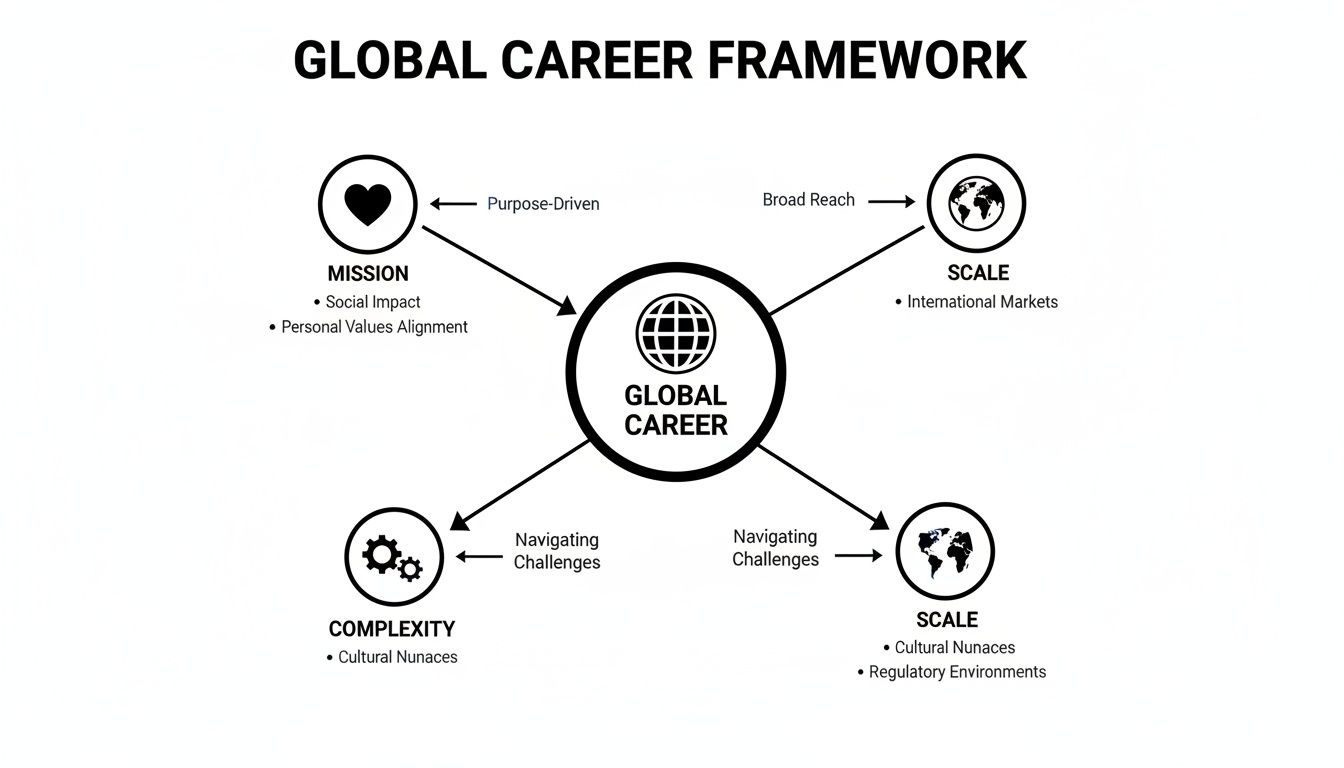
This diagram nails the core of it. The intense mission, massive global scale, and intricate complexity are the three pillars holding up these unique career paths.
To give you a clearer picture, let’s compare these pathways. Each route is designed for a different professional at a different career stage.
Career Pathways at International Organizations
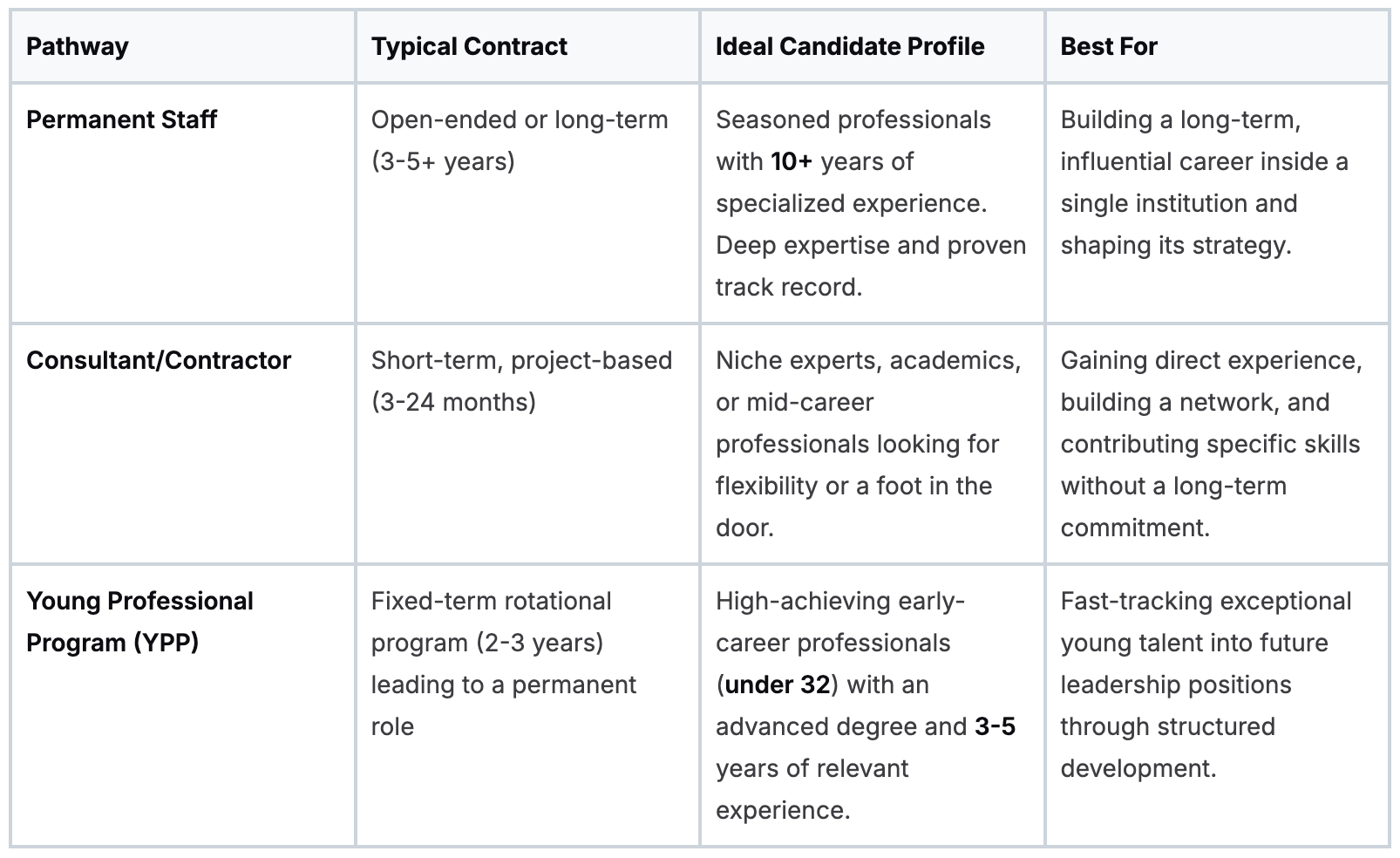
Understanding these distinctions is your first strategic step. Now, let’s dig into the details of each one.
Permanent Staff Positions
This is the most traditional path. A permanent staff position means you are a full-time, card-carrying employee of the organization. You get a long-term contract, benefits, and a clear place in the institutional structure. These roles are for seasoned professionals who bring specialized expertise and significant work experience to the table.
You’ll find these jobs at all levels, from mid-career specialists to senior directors. The hiring process is intense and competitive because the organization is making a long-term investment in you. Success here means you’re an expert in your field and you’re savvy enough to navigate the institution’s internal culture and politics.
Permanent staff are the backbone of the organization. They hold the institutional memory, drive long-term strategy, and are responsible for delivering on the organization’s mandate. It’s a route for those who want to build a deep, influential career inside one of these global giants.
Consultant and Contractor Roles
The consultant route offers a more flexible, project-based way in. Organizations hire consultants for specific tasks and a defined period, from a few months to a couple of years. This pathway is perfect for experts who want to contribute their skills without committing to a permanent role.
This is also a very common way to get your foot in the door. Many permanent staff members started as consultants, using these short-term contracts to prove their value and build an internal network. You’ll be expected to deliver high-quality work with minimal hand-holding, demonstrating your expertise from day one.
For a deeper look at the specific opportunities available, check out our practical guide to UN development careers.
Young Professional Programs
The Young Professional Program (YPP) is the premier entry point for the next generation of leaders. These are highly competitive, multi-year rotational programs designed to fast-track exceptional young talent into leadership roles. Organizations like the World Bank, IMF, and African Development Bank use YPPs to recruit and groom their future senior staff.
Candidates typically need an advanced degree, several years of relevant experience, and must be under a certain age, usually around 32. The selection process is famously rigorous. The World Bank Group employs over 15,000 staff from more than 180 countries. Their YPP is one of the main pipelines for new talent.
The IMF’s YPP is another great example. They select around 40 economists each year from thousands of applicants, which highlights the intense competition.
The First Cut: Understanding Eligibility and Nationality Rules
Before you polish your CV, you have to clear a huge, non-negotiable hurdle: nationality. For jobs at international organizations, especially the big Multilateral Development Banks (MDBs), this is the absolute first filter. Wasting time applying for a job where your passport makes you ineligible is the single biggest mistake you can make.
These institutions are owned and funded by their member countries. Because of this, they are required by their own charters to maintain a staff that reflects this global ownership. It is a core institutional policy to ensure geographic diversity.
Why Your Passport Is Your First Resume
Your citizenship directly dictates which organizations you can apply to. It’s that simple. If your country isn’t a shareholder in the African Development Bank, you cannot apply for a staff position there. It’s a hard rule with almost no wiggle room, except for some highly specialized, short-term consultant gigs.
This means your first step is a practical, mechanical check. You need to map your citizenship to the member country lists of the organizations you’re interested in.
Check the Member Lists: Every MDB and international organization publishes a list of its member countries on its website. This is your bible.
Target Strategically: Focus your time and energy only on the institutions where you are eligible. This check will save you countless hours.
Don’t see this as a barrier. See it as your first strategic advantage. It instantly narrows the field and lets you focus your efforts where they can actually pay off.
Beyond Citizenship: The Academic and Experience Bar
Once you confirm you have the right passport, the next filters kick in: your qualifications. The bar is high. The requirements are specific, and these organizations often have firm, non-negotiable educational benchmarks.
An advanced degree, a Master’s or a PhD, is the standard expectation for most professional-level roles. A bachelor’s degree alone is rarely enough to be competitive for a full-time staff position.
Think of the advanced degree as your ticket to the game. It proves you have the deep theoretical knowledge and analytical rigor needed to tackle complex global issues. Without it, your application will almost certainly be screened out by an algorithm before a human ever sees it.
The requirements for professional experience are just as strict. Vague claims on your CV are useless. You need to show a specific number of years of relevant, post-graduate experience. That “post-graduate” part is key. The work you did before or during your Master’s degree often doesn’t count toward this minimum.
The huge financial backing of MDBs allows them to maintain these high standards while also creating opportunities through nationality-balanced recruitment. The Multilateral Development Banks Comparison Report shows how this structure can favor candidates from underrepresented member countries. The highly competitive Young Professional Programs at the IMF and World Bank typically look for candidates with PhDs and 3-5 years of solid experience for their two-year rotational assignments.
By nailing down these baseline criteria—nationality, education, and experience—you immediately shift from being just another applicant to a credible candidate who’s actually in the running.
Finding Openings and Automating Your Job Search
You’re not going to find these high-level jobs on LinkedIn or Indeed. Knowing where to look is half the battle, and it’s a completely different game than a typical private sector search.
Forget casting a wide net on huge commercial job sites. Your search for roles at multilateral organizations has to be targeted and efficient. The absolute best source for any opening is always the organization itself.
Go Straight to the Source
Every major institution runs its own careers portal. This is ground zero. These sites are the only definitive source for staff jobs, consultant rosters, and special hiring programs like the Young Professional Programs.
Start by bookmarking the career pages of the big players:
The World Bank Group: The central hub for roles across all its branches.
International Monetary Fund (IMF): Where you’ll find opportunities for economists and financial sector experts.
United Nations (UN) Careers: The main gateway for jobs across the vast UN system.
Regional Development Banks: Don’t forget these, like the Asian Development Bank (ADB), African Development Bank (AfDB), and Inter-American Development Bank (IDB).
These portals have powerful filtering tools. Use them. Get granular and narrow your searches by job function, grade level, location, and closing date. This first step helps you get a feel for the landscape and what roles match your profile.

Automate Your Search with Targeted Alerts
Manually checking a dozen websites every day is a soul-crushing waste of your time. The real strategy is to build an automated system that brings the right jobs directly to you.
Every official careers portal allows you to create saved searches and email alerts. This is non-negotiable. You must set these up.
Create an alert for each of your target roles at each of your target organizations. Be specific with your keywords: “Health Economist,” “Project Management Consultant,” or “Water and Sanitation Specialist.” This transforms your job search from a frantic, manual chore into an efficient system that works for you while you sleep.
Use Specialized Aggregators and Newsletters
While direct portals are your primary weapon, a few specialized platforms and newsletters do an excellent job of curating these openings. They monitor the official sources and compile the listings, saving you hours of work. Think of these aggregators as your second line of offense.
Many hubs for global development professionals, like Geneva, have their own ecosystems of job boards and newsletters. It’s worth digging into these local networks. You can get a sense of how they work by exploring the best sources for job offers in Geneva to see just how localized these communities can be.
The goal is to create a workflow where opportunities find you. By combining direct alerts from the primary sources with curated lists from trusted aggregators, you can stop hunting and start crafting a perfect application.
How to Write a CV That Gets Noticed
Let’s get one thing straight: your standard, two-page corporate resume is going straight into the bin. Applying to the World Bank or UN requires a complete shift in how you present yourself. Forget buzzwords and flashy templates. These recruiters are looking for evidence.
Think of your CV as a policy brief about you. It needs to be sharp, data-driven, and answer one fundamental question: what impact have you had? A generic, one-size-fits-all CV is a sign of a lazy applicant and gets filtered out almost instantly. Your only goal is to make it past the initial screening and land on the hiring manager’s desk.
Stop Listing Responsibilities and Start Showing Results
This is the single biggest mistake people make. Nobody cares that you “managed a portfolio” or were “responsible for stakeholder engagement.” It means nothing. They want to know what happened as a result of your work. Did you save money? Did a project get completed on time? Did you improve a process?
Use the STAR method. It’s a simple framework that turns vague duties into compelling, evidence-based achievements.
Situation: Briefly set the scene. What was the project or challenge?
Task: What were you specifically trying to achieve?
Action: What concrete steps did you personally take to get it done?
Result: What was the measurable outcome? Use numbers, percentages, and tangible results.
This structure transforms a bland statement like “managed project budget” into something powerful: “Restructured a $5 million project budget (Action) to reallocate funds toward critical activities (Task), preventing a projected 15% cost overrun and ensuring the project was delivered on schedule (Result).” One is a duty, the other is an accomplishment.
Deconstruct the Job Description
The job description is a cheat sheet for your entire application. These organizations build their hiring process around core competencies, things like “client orientation,” “drive for results,” or “teamwork.” Your CV needs to prove, point by point, that you have them.
Here’s a practical approach: print out the job description and get a highlighter. Mark every required qualification, competency, and keyword. Then, go through your own experience and map your achievements, framed using the STAR method, directly to those highlighted terms. Use their language. If the JD asks for “procurement experience,” your CV must have the phrase “procurement experience,” backed up with a killer result.
Your CV should read like a direct answer to the job description. The recruiter should be able to go down their checklist and tick off every single requirement as they read your experience. This is strategic communication.
This methodical approach signals you’re a serious candidate who understands the institution. You’ve done your homework, and it shows.
Structure Your CV for Clarity and Impact
Recruiters spend seconds, not minutes, on each CV. Your formatting has to be clean, professional, and dead simple to scan. Forget fancy graphics, weird fonts, or dense paragraphs. Readability is everything.
A simple, effective structure for these applications looks like this:
Contact Information: Name, phone, email, city/country. That’s it.
Professional Summary: A tight, 3-4 line paragraph at the top summarizing your core expertise, years of experience, and key skills, tailored for the role.
Professional Experience: List jobs in reverse chronological order. For each role, use 3-5 bullet points written using the STAR method. Put your most impressive and relevant achievements first.
Education: Degrees, universities, and graduation dates.
Languages: List every language you speak and your proficiency level (e.g., Fluent, Professional Working Proficiency).
Skills: A short section for technical skills like statistical software (Stata, R), project management tools, or other relevant platforms.
This clean, logical flow makes it easy for a recruiter to find exactly what they’re looking for and move you to the next stage. You’re framing your experience in a way that speaks their language, making their decision to interview you a no-brainer.
Mastering the Multilateral Interview Process
Getting an interview offer is a huge win. You’ve made it past the brutal initial screening, which means the organization sees you as a credible candidate. Now the real test begins.
The interview process for jobs with international organizations is notoriously tough. It’s multi-staged and designed to test your technical chops and your diplomatic temperament. This isn’t a single, friendly chat.
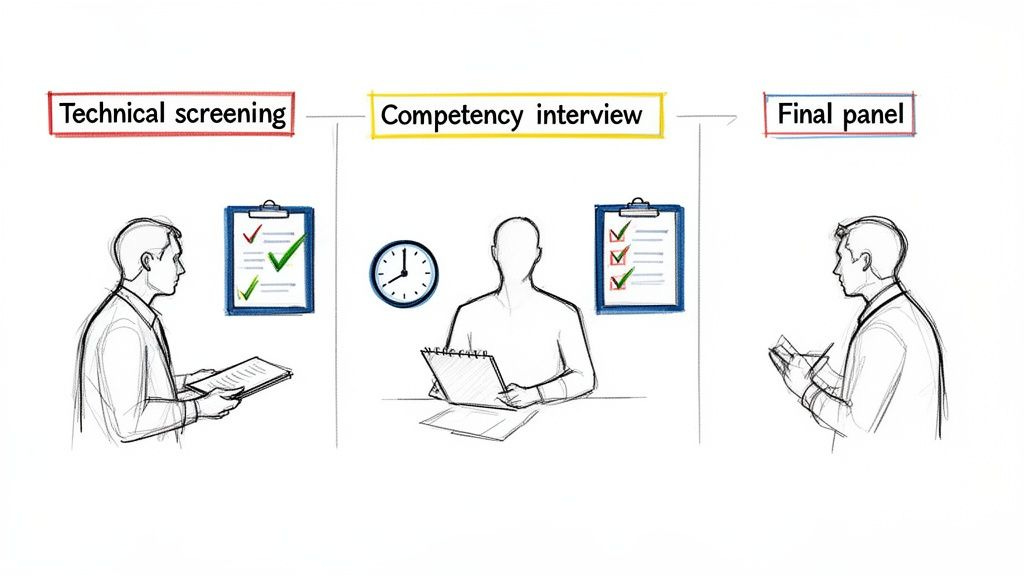
Think of it as a gauntlet. You’ll likely face a technical screening, a competency-based interview, and a final, high-stakes panel interview with senior leaders. Your job is to walk into each stage prepared and confident.
Cracking the Competency Based Interview
The competency-based interview is the heart of the process. They aren’t just asking “what did you do?” They want to know how you did it. They’re systematically testing you against the organization’s core competencies, the same ones listed in the job description.
Your only strategy is to prepare specific, evidence-backed stories that bring these competencies to life. For every answer, use the STAR method (Situation, Task, Action, Result).
Situation: What was the context? What was going on?
Task: What was your specific goal or responsibility?
Action: What exact steps did you personally take?
Result: What was the measurable outcome? What happened because of your actions?
Vague answers are the fastest way to get eliminated. The panel wants concrete proof you can deliver. You need to prepare at least two powerful STAR examples for each competency listed in the job description.
Navigating the Technical Screening and Panel Interview
The technical interview is a deep dive into your area of expertise. If you’re an economist, expect to be quizzed on macroeconomic theory. If you’re a project manager, they’ll probe your knowledge of procurement cycles or M&E frameworks. There’s no faking it here. You either know your stuff, or you don’t.
The final panel interview is often the most intimidating part. You’ll be sitting across from several senior staff members who will grill you on your technical skills and your judgment in politically sensitive situations. They’re assessing your fit, diplomatic instincts, and ability to handle intense pressure.
To get a better sense of what’s going through their minds, check out our interview with a former MDB panellist. It’s an invaluable insider perspective.
Handling Case Studies and Presentations
Many interviews for jobs with international organizations will throw a practical exercise at you, like a case study or a presentation. They might give you a dataset and ask you to draft a short policy memo, or they could lay out a project scenario and ask you to outline your approach.
The goal is to see how you think on your feet. They are testing your analytical skills, your ability to prioritize information, and your communication style, all under a tight deadline.
Here’s how to handle it:
Clarify the Objective: Before you start, make sure you understand exactly what they’re asking you to do. Ask clarifying questions if you need to.
Structure Your Response: Don’t just dive in. Take a few minutes to outline your thoughts. A well-structured, logical answer is far more impressive than a rushed, disorganized one.
Focus on the “Why”: Don’t just give them an answer. Explain the reasoning behind your recommendations. They want to see your thought process, not just a final conclusion.
Success in this process comes down to preparation and strategy for every single stage. They are looking for candidates who are technically brilliant, composed, articulate, and culturally astute.
Your Questions, Answered
Navigating the world of international organizations can feel opaque. Let’s tackle some of the most common questions with direct, straightforward answers to help you map out your next move.
Are All the Jobs Really in Washington D.C. or Geneva?
That’s a common myth. While headquarters are concentrated in hubs like Washington D.C., New York, and Geneva, a huge number of jobs are out in the field.
These are the “country office” roles that put you on the front lines of program implementation. If you’re in operations, project management, or a specialized technical field, you’ll often find yourself based in regional or country-specific offices across Africa, Asia, and Latin America. If you want to be close to the work on the ground, these are the roles to watch.
Do I Actually Need to Speak Multiple Languages?
It depends, but it’s a massive advantage. For most Multilateral Development Banks like the World Bank, English is the main working language. You can build a successful career with professional fluency in English alone, especially if you’re aiming for a headquarters role.
Once you step into roles that require direct engagement with local governments or communities, language skills become a game-changer. Fluency in another official UN language makes you a far more competitive candidate.
The six official languages of the United Nations are Arabic, Chinese, English, French, Russian, and Spanish. Proficiency in French or Spanish, in particular, unlocks a huge number of opportunities for field-based roles across Africa and Latin America. It’s often the key differentiator between two otherwise equally qualified people.
Being bilingual or multilingual signals that you can operate effectively in diverse cultural contexts, which is a core competency for anyone working in this space.
What’s the Real Deal with Salary and Benefits?
The compensation is a major draw. These institutions are designed to attract top global talent, and their packages reflect that. Salaries are highly competitive and, depending on your nationality and the organization’s charter, are often tax-free. This can significantly boost your net income compared to a similar job in the private sector.
The benefits packages are famously comprehensive. They almost always include:
Excellent health insurance: Often providing global coverage for you and your family.
Generous retirement plans: Including robust pension schemes that are almost unheard of in other sectors.
Relocation assistance: If you’re hired internationally, this usually covers moving expenses, shipping, and sometimes even a grant to help you get settled.
Education grants: Many organizations offer help with children’s education costs, a huge perk for staff posted outside their home country.
When you combine a competitive, often tax-free salary with a top-tier benefits package, these roles become incredibly attractive financially. It’s a key part of how these organizations recruit and retain the world-class experts they need.
At Multilateral Development Bank Jobs, we cut through the noise to bring you the opportunities that matter. We send curated lists of staff and consultant roles directly to your inbox three times a week, along with insider guides to help you navigate your career path. Subscribe today and start building your global career.