

When you hear “finance career,” your mind probably goes to Wall Street investment banks or a corporate treasury job. An international finance job is a completely different world.
This world operates at the crossroads of public policy, economic development, and high-stakes financial management. The goal is progress, not just profit.
These roles exist within a specific ecosystem of global organizations. The people in these jobs are the financial architects of international development. They’re the ones structuring massive loans for new power grids, advising governments on economic stability, and managing investment funds designed to pull people out of poverty.
Understanding The Landscape of International Finance
The Mission-Driven Difference
The single biggest thing that sets these roles apart is their mandate. A private bank finances a company to generate returns for its shareholders. A Multilateral Development Bank finances a country’s new port to boost trade and connect rural businesses to global markets.
This fundamental difference changes everything: the work, the culture, and the kind of person who thrives.
Your financial modeling skills are essential, but here they’re used to figure out the long-term economic ripple effect on a nation, not just a company’s next quarterly earnings report.
The real work is using financial tools to create sustainable, large-scale impact. You’re evaluating the risk of a sovereign loan or structuring a deal that can lift thousands out of poverty, not just analyzing a company’s P&L statement.
This intense focus on development outcomes demands a unique mix of hard technical skills and a genuine belief in the organization’s public service mission. If you want to dig deeper into how these institutions stack up, check out our guide comparing the World Bank, IMF, and other MDBs for career seekers.
Key Players In The Field
The landscape of international finance is dominated by a few key types of employers. Knowing who does what is the first step to aiming your job search in the right direction. These organizations aren’t interchangeable; each has a specific job.
You’ll find jobs in three main buckets:
Multilateral Development Banks (MDBs): These are the big ones like the World Bank, the African Development Bank (AfDB), and the Asian Development Bank (ADB). Their main gig is providing loans, grants, and technical advice to developing countries for projects and programs.
International Financial Institutions (IFIs): This group includes heavyweights like the International Monetary Fund (IMF) and the Bank for International Settlements (BIS). Their primary focus is maintaining the stability of the international monetary and financial system.
Specialized Global Funds and Agencies: Think of entities like the Green Climate Fund or specific agencies within the United Nations that have a financial or economic mandate.
Each of these players hires finance professionals, but the day-to-day work is wildly different. A job at the IMF might have you digging into a country’s macroeconomic data and advising on policy. A job at an MDB is more likely to involve project finance for a new dam, managing the bank’s own treasury operations, or overseeing investments. Getting these distinctions clear from the start is critical for a successful application.
Mapping The Key Players And Your Place Within Them
“International finance” isn’t some monolithic blob of development work. If you want to find your place in this world, you have to understand the major players and what they actually do. The World Bank, the IMF, and the various regional banks are fundamentally different organizations, each demanding its own brand of financial expertise.
A heart surgeon and a brain surgeon are both doctors, but you wouldn’t send a patient with a concussion to a cardiologist. The same principle applies here.
This diagram gives you a quick visual breakdown of the ecosystem. It shows how roles with a global mandate are organized across Multilateral Development Banks (MDBs), other key institutions, and the private sector.
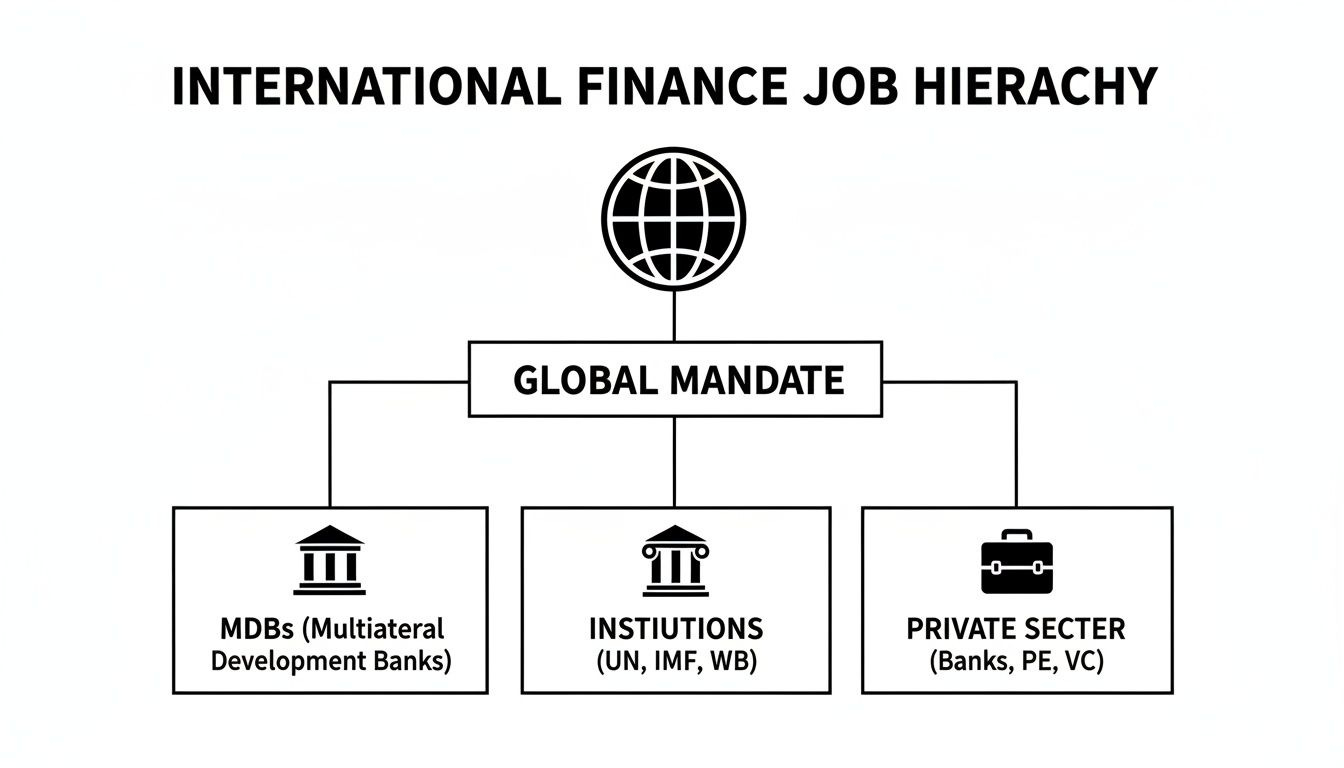
Use this to start figuring out where you fit. Are you a project finance specialist who belongs at an MDB? An economist who thinks in macroeconomic terms? Or a private-sector pro with a knack for emerging markets? Knowing the answer is the first step.
Major Employers In International Finance
To give you a clearer picture, let’s break down who does what. The table below outlines the key institutions, their primary focus in finance, and the kinds of professionals they’re constantly looking for.
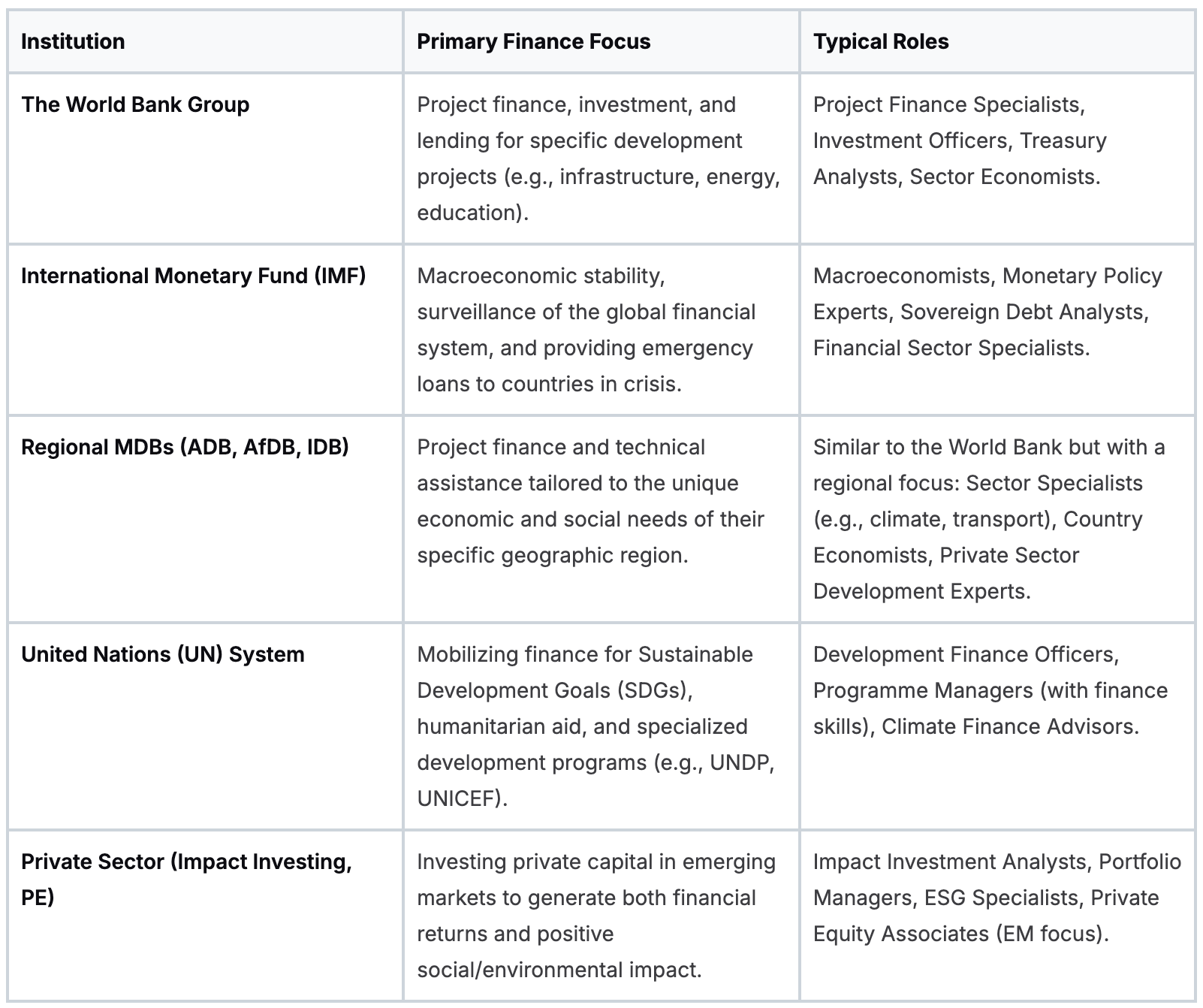
This isn’t an exhaustive list, but it covers the main buckets. The skills needed for the IMF are worlds apart from those required by an impact investing fund, even though both operate on the global stage.
The World Bank Group: The Project Financier
When most people think of development finance, they think of the World Bank Group. It’s the biggest player on the field. Its core mission is to provide financing and technical know-how to developing countries for specific, tangible projects. We’re talking about building roads, funding schools, and overhauling healthcare systems.
If your background is in project finance, investment analysis, or debt capital markets, this is your natural habitat. The Bank’s financial pros spend their days structuring loans for a new highway in Vietnam, analyzing the commercial viability of a solar plant in Kenya, or managing the Bank’s own massive multi-billion dollar treasury. The work is concrete and project-driven.
Your job is to ensure that a $200 million loan for a water sanitation project is financially sound, sustainable, and will actually deliver its intended development impact. There’s a direct line from your financial model to real-world outcomes.
This focus on tangible results pushed job creation to the forefront of the MDB agenda. For the first time, the World Bank Group made job creation a core objective of every project, recognizing that a good job is the surest path out of poverty. By 2035, the financial sector alone is expected to create around 91 million new roles, with a huge chunk of that growth happening in developing economies. You can dig into the World Bank’s evolving strategy on employment to get more context on this shift.
The International Monetary Fund: The Economic Stabilizer
The IMF is a different animal. It doesn’t fund projects. Its purpose is to keep the entire international monetary system from collapsing.
Think of the IMF as a global economic watchdog and the lender of last resort for countries spiraling into a balance-of-payments crisis. Because of this mission, the expertise they hunt for is heavily skewed towards macroeconomics, monetary policy, and sovereign debt analysis.
Finance professionals here are almost always economists by training. They analyze national budgets, advise central banks on interest rate policy, and negotiate the tough conditions tied to emergency loans. Your work doesn’t build a bridge; it directly influences a country’s entire economic policy.
Regional Development Banks: The Local Specialists
Regional MDBs, like the Asian Development Bank (ADB), African Development Bank (AfDB), and Inter-American Development Bank (IDB), operate a lot like the World Bank but with a laser-focus on a specific geography. This regional specialization is their secret weapon.
They have deep, on-the-ground knowledge of their member countries’ unique problems and opportunities. For a finance professional, this means your work is intensely contextual.
Asian Development Bank (ADB): Heavily focused on infrastructure, climate resilience, and fostering regional cooperation across Asia and the Pacific. Experience in these sectors gives you a step up.
African Development Bank (AfDB): Prioritizes industrialization, integrating regional economies, and improving quality of life across Africa. Expertise in private sector development and SME financing is gold here.
Inter-American Development Bank (IDB): Concentrates on tackling poverty and inequality in Latin America and the Caribbean, with a strong emphasis on social programs and digital transformation.
Targeting a regional bank is a smart move if you have specific language skills or professional experience in that part of the world. It proves you understand the local nuances, which is a massive advantage. Your ability to connect global finance principles to local realities is exactly what these banks want.
The Three Main Hiring Pathways
Forget corporate recruiting. Landing a finance job at an MDB or an institution like the IMF isn’t about schmoozing your way in or spamming your resume. These places have rigid, formal, and hyper-competitive hiring processes. If you don’t play by their rules, your application is dead on arrival.
Understanding these pathways is the single most important part of your strategy. It shapes how you frame your experience, when you apply, and what your career looks like for the first few years. There are three doors into this world. Let’s open them.
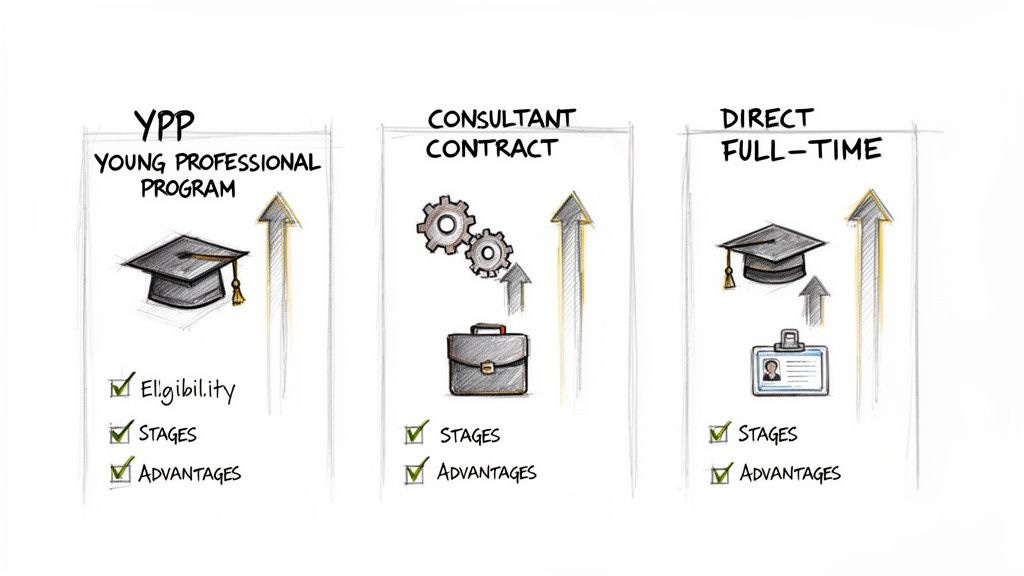
The Young Professional Programs (YPPs)
This is the gold-plated, front-door entrance. If you’re a high-achieving, early-career professional, this is the route you want. The World Bank YPP is the most famous, but nearly every major MDB has its own version. It’s a fast-track leadership program designed to groom the next generation of top brass.
Getting in is brutal. You’re fighting thousands of the best graduates from all over the world for just a handful of spots. The entry requirements are razor-sharp and non-negotiable.
Age Limit: Most programs have a hard cutoff, usually around 32 years old.
Education: A Master’s degree or PhD in a relevant field like finance, economics, or public policy is the bare minimum.
Experience: You’ll generally need at least three years of solid, relevant work experience.
The payoff is huge. YPPs offer rotational assignments that expose you to different parts of the institution, incredible training, and a clear path to a permanent staff position. It’s the most direct shot at a long-term, influential career inside one of these organizations.
The Consultant Contract
For many mid-career professionals, this is the most common way in. It’s the flexible side door that lets institutions bring in specific expertise for projects without the commitment of a permanent hire. These roles can be anything from a three-month gig to a contract that runs for several years.
This is a powerful way to get your foot in the door. You build a track record, develop an internal network, and prove your worth directly to the teams you want to join. A huge number of permanent staff members started out as consultants.
The consultant role is your extended interview. It gives managers a low-risk way to see your work ethic, technical skills, and cultural fit before they consider you for a staff position. A successful consultancy is the best reference you can get.
The catch is a lack of job security and fewer benefits compared to full-time staff. But the experience and connections you make are priceless. It’s a calculated risk that pays off for those who perform well and build strong relationships inside.
The Direct Full-Time Staff Position
This is the most straightforward path, but often the hardest to land from the outside. These are permanent, salaried jobs with full benefits, advertised for a specific role in a specific department. They’re aimed at seasoned professionals who have a particular skillset the institution needs immediately.
To have a chance here, your CV must perfectly mirror the job description. Recruiters aren’t looking for potential; they’re looking for a proven expert who can hit the ground running. This means you need deep, specialized experience in areas like project finance, treasury operations, or sovereign risk analysis.
Your application needs to scream “expert.” You have to show a clear history of delivering results in the exact functional area they’re hiring for. This is where private-sector veterans with a decade or more of specialized experience often find their opening.
Navigating Nationality And Eligibility Requirements
Let’s get straight to the point: in the world of international finance, your passport matters.
Unlike the private sector, Multilateral Development Banks and institutions like the IMF have strict rules about who they can hire based on nationality. Ignoring this is the fastest way to waste time on jobs you were never qualified for.
These rules are not just red tape. MDBs are funded and owned by their member countries, and a huge part of their mandate is to maintain a diverse staff that reflects this global ownership. This often means hiring quotas or strong preferences for citizens of under-represented member nations. Understanding this system gives you a massive strategic advantage.
Why Your Citizenship Is A Key Factor
Your nationality can be a major hurdle or a powerful asset.
If your country is “under-represented” on staff at a particular MDB, you instantly become a more attractive candidate, assuming you meet all other qualifications. If your country is “over-represented,” you’re facing a much steeper climb.
This system is a non-negotiable part of the MDB hiring game. It’s about institutional balance, not discrimination. A rookie mistake is thinking you can bypass it. Your job is to figure out the rules and use them to your advantage by targeting institutions where your citizenship gives you an edge.
For a detailed breakdown, check out our guide on how to determine which MDBs you are eligible to apply for.
Understanding The Exceptions
While most core staff positions are locked into these nationality rules, there are some important exceptions.
Certain roles, especially highly specialized technical positions or some consultant contracts, might be open to all nationalities. You’ll see these pop up when a bank needs a specific skillset that’s hard to find within its preferred pool of candidates.
It’s also worth remembering the broader context. The jobs crisis in Africa, the Middle East, and South Asia is a top priority, with millions of educated young people needing viable career paths. This demographic pressure has pushed MDBs to prioritize job creation in their strategies, which can influence hiring for specific field-based roles. Reading up on the strategic focus on employment in developing regions can give you a better sense of this landscape.
The bottom line: treat your nationality as a key data point in your job search strategy. Research which institutions favor your citizenship and focus your efforts there first. Don’t waste energy on applications where the odds are structurally stacked against you.
Crafting Your Application To Win
Your standard corporate finance resume is useless here. Sending an MDB a CV built for Wall Street is like showing up to a construction site in a tuxedo. It tells the hiring manager you fundamentally misunderstand the work.
These institutions, the World Bank, the IMF, regional development banks, operate on a different value system. They aren’t chasing quarterly profits. They need to see that you get their mission and can translate your skills into the language of economic development.
This section gives you direct, practical advice to reframe your experience. We’ll show you how to structure your CV and write a cover letter that proves you belong.
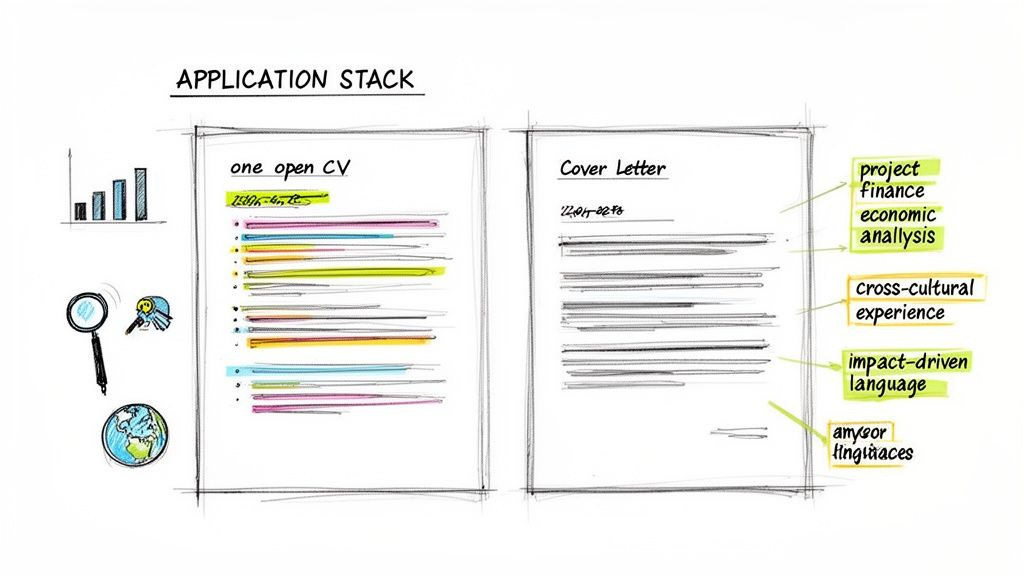
Reworking Your CV For Development Finance
Recruiters at these organizations spend seconds on each CV. Yours needs to immediately signal that you get it. This means ruthlessly prioritizing skills and achievements that align with their world, not the corporate one you’re coming from.
Your CV’s only job is to make it obvious that you have both the technical chops and the right mindset for development work. Drop the corporate jargon about “synergizing stakeholder value” and get straight to the point.
Start by restructuring your bullet points. Instead of focusing on revenue generated for a company, talk about the scale, complexity, and cross-border nature of your work.
Essential Skills For Your MDB Finance CV
Here is a checklist of the skills MDB recruiters are scanning for. Your CV needs to demonstrate these using concrete, quantifiable examples.
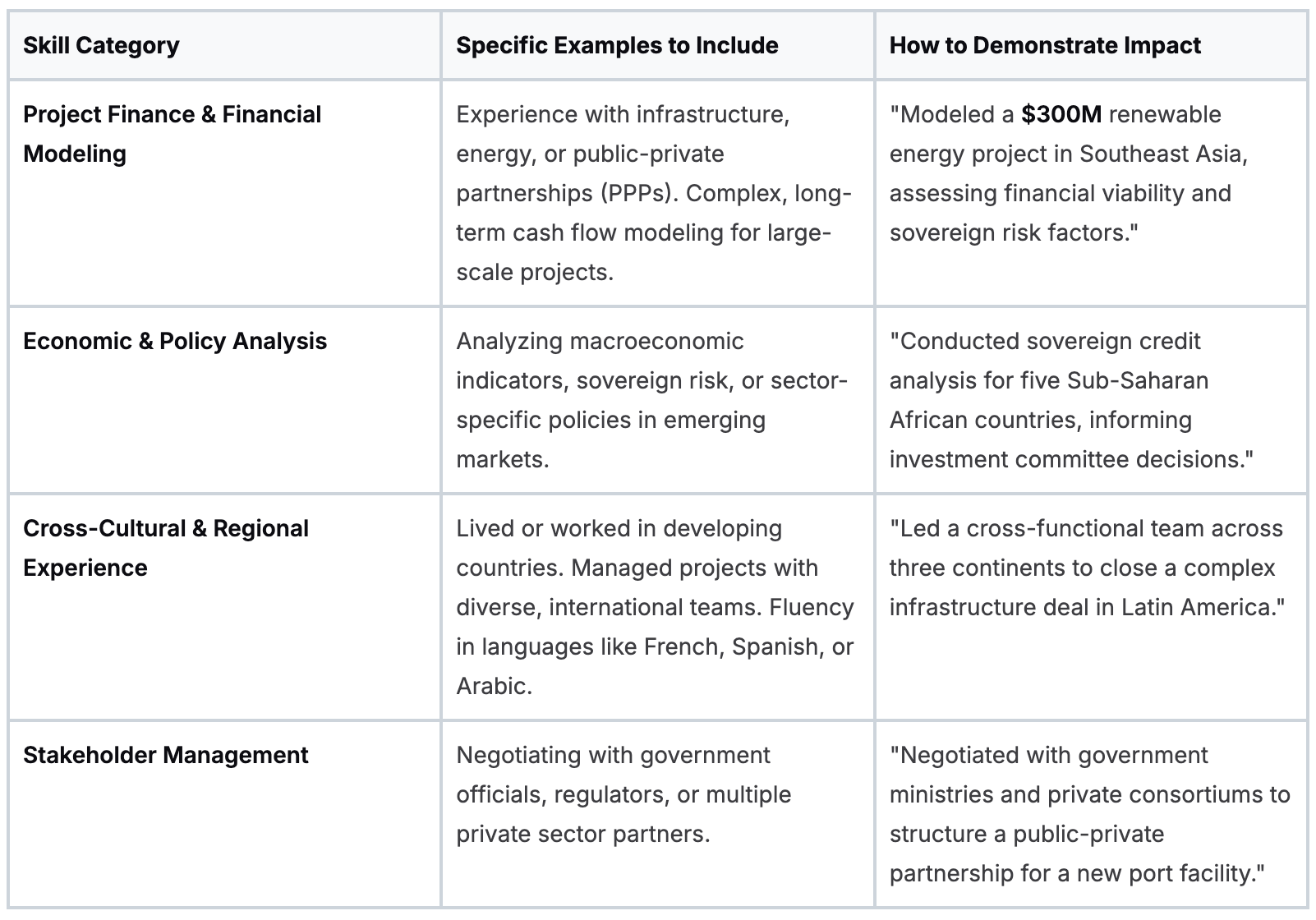
Think of it as translating every achievement. “Increased company profits by 15%“ becomes “Managed a $50M portfolio of investments in emerging market SMEs, leading to measurable job creation and economic growth.” It’s the same core skill, reframed for a mission-driven context.
Your private sector experience is valuable, but only if you connect it to the MDB’s mandate. Show them you can apply your financial acumen to solve development challenges, not just maximize shareholder returns.
Writing A Cover Letter That Shows You Care
The cover letter is where you prove you’re not just another finance professional looking for a well-paid, stable job. This is your chance to show a genuine, well-researched commitment to that specific institution’s mission.
A generic letter is a one-way ticket to the rejection pile. You have to show you’ve done your homework on the organization’s recent work, its strategic priorities, and how your unique skills can help them.
Here is a simple, effective structure:
Paragraph 1: State Your Purpose. Get straight to it. Name the position and immediately connect your core expertise to the institution’s mandate. Mentioning a specific project or report shows you’re paying attention.
Paragraph 2: Prove Your Technical Fit. Pick two or three key requirements from the job description and provide concrete evidence from your past work. The STAR method (Situation, Task, Action, Result) is your friend here.
Paragraph 3: Demonstrate Mission Alignment. This is the most critical part. Explain why you want this job at this organization. Connect your personal and professional motivations to their work in a specific region or sector you care about.
Paragraph 4: Conclude and Call to Action. Reiterate your enthusiasm and state your confidence that you can contribute to their team. Keep it professional, sharp, and concise.
Your cover letter isn’t a summary of your CV. It’s your argument for why you are the perfect candidate for a mission-driven role. This is where you bridge the gap between your technical skills and your understanding of the world they operate in.
Preparing For The Interview Process
The interview process for an international finance job is a marathon designed to test your substance. Expect a gauntlet of technical deep-dives, behavioral grilling, and high-pressure panel interviews.
It’s an intense process for a reason. These institutions are about to hand you immense financial responsibility, often in politically complex environments. They need to be sure you have the technical chops, the right temperament, and a commitment to the mission.
Master The Technical Interview
The first hurdle is almost always technical. They need to know you can do the work from day one, and the questions will be specific and practical.
For Project Finance roles: Be ready to walk them through a discounted cash flow (DCF) model for a new port in a developing country, debate risk mitigation strategies for a project in a fragile state, or pick apart the structure of a public-private partnership (PPP).
For Economist or Policy roles: You might be asked to discuss macroeconomic trends in Southeast Asia, argue the pros and cons of a specific monetary policy, or analyze the sovereign debt sustainability of a low-income country.
For Treasury or Investment roles: Prepare for detailed questions on portfolio management, asset allocation models, or how you’d hedge currency risk for a multi-billion dollar fund.
These aren’t abstract academic questions. They’re designed to test your ability to apply financial theory to the messy, real-world problems these institutions tackle.
Answering Behavioral Questions With STAR
Once you’ve proven you can do the math, they want to know how you get things done. This is where you’ll face competency-based questions. They’re digging for evidence of crucial soft skills like stakeholder management, cross-cultural communication, and resilience.
The only way to answer these is with the STAR method. It’s a simple framework that forces you to give concrete examples.
Situation: Briefly set the scene. Describe a specific challenge you faced. Task: Explain what you were responsible for. What was the goal? Action: Detail the specific steps you took to handle it. Result: Quantify the outcome. What was the impact?
Using this structure proves you’re a results-oriented person who can deliver under pressure. It’s how you show, not just tell, that you have the right mindset for a mission-driven organization.
Navigating The Panel Interview
The final stage is often a panel interview with senior staff, the people you’ll actually be working with. This is as much a test of your professional presence as it is of your expertise. Your job here is to articulate a clear, compelling vision for what you’ll bring to the team. For some pointed advice, check out our exclusive interview with a former MDB panellist, who reveals what goes on behind the curtain.
Mastering this kind of interview is becoming more important. The World Economic Forum projects that major structural changes will impact 22% of today’s jobs, creating 170 million new roles while making 92 million others obsolete. Securing a top-tier international finance job means proving you’re the kind of adaptable, specialized talent these institutions need for the future. You can get more details by reading the full report on the future of jobs. Your ability to navigate a tough interview is the first sign you can handle the job itself.
Answering Your Top Questions
We get a lot of the same questions from sharp candidates trying to break into this field. Here are some straight answers to the most common ones.
Do I Need a PhD for a Senior Finance Role?
Nope. This is a huge misconception, especially for giants like the World Bank or IMF.
A PhD is the standard for economist tracks, where deep academic research and heavy econometric modeling are the job. For most finance positions, it’s overkill. Sometimes, it’s less relevant than years of practical experience.
The real gold standard is a master’s degree in finance, business, or international relations, paired with significant, hands-on work experience. For specialized roles in treasury or risk management, professional certifications like the CFA or FRM carry more weight than a doctorate.
How Important Is Speaking a Second Language?
It’s a major advantage. While English is the working language at most of these institutions, being fluent in another UN official language, especially French, Spanish, or Arabic, can be a powerful tiebreaker.
Knowing another language signals that you can adapt and operate effectively in different cultural contexts, which is a core skill for any international finance job. If you’re aiming for field-based roles where you’re working directly with local governments, it’s practically a prerequisite. It shows you’ve put in the work to truly connect.
Can I Transition From the Private Sector Mid-Career?
Absolutely. This is one of the most common and successful pathways into these organizations. MDBs constantly hunt for seasoned professionals with 10+ years of private-sector experience in fields like investment banking, project finance, asset management, and corporate law.
They value the rigor, deal-making skills, and commercial mindset you bring. The key is learning to reframe your experience. You have to translate your track record of generating profit into a compelling narrative about managing complex transactions, navigating emerging markets, and delivering tangible results at scale. They want your skills applied to their mission.
What Is the Typical Salary and Benefits Package?
The compensation is designed to attract top global talent. Salaries are competitive with the private sector and are often tax-free, depending on your nationality and the institution’s headquarters agreement with its host country.
The real differentiator is the benefits package. It’s comprehensive and includes excellent global health insurance, generous retirement plans, full relocation assistance for you and your family, and education grants for your kids. The overall package is extremely strong and reflects the high caliber of professionals they’re trying to recruit and keep.
Finding the right opportunities and navigating the complex application process is the biggest challenge. At Multilateral Development Bank Jobs, we do the hard work for you, delivering curated job lists and insider guides directly to your inbox every week. Start your targeted job search today.