

So you’re aiming for a career at the Inter-American Development Bank. Good choice. But let’s get one thing straight: this isn’t another job hunt. Landing a role at the IADB means building a career with tangible impact across an entire continent. The key is understanding that the IADB is the single largest source of development financing for Latin America and the Caribbean.
Getting your foot in the door requires a specific strategy that goes beyond polishing a generic CV. You need to understand the institution’s DNA.
What a Career at the IADB Really Means
Working at the IADB puts you at the heart of major economic and social development projects. The Bank’s purpose is to improve lives across Latin America and the Caribbean. It does this by funneling financial resources, policy advice, and technical know-how to governments and the private sector. The scope is massive, covering everything from infrastructure builds and energy grids to overhauling education and health systems.
This isn’t your typical corporate gig. The entire place is driven by a deep commitment to regional progress, and the people who work there are specialists focused on that mission. To have a chance, you first need a real feel for what the IADB actually does and why it matters.
The Core Mission: What Drives the Bank
At its core, the Bank’s work is about tackling poverty and inequality. Every loan, every report, every technical mission is geared towards that goal. It achieves this by focusing on critical areas that kickstart sustainable growth.
Infrastructure and Energy: This is financing the massive road, port, and renewable energy projects that connect communities and power economies.
Social Sectors: This is about investing in people, funding better schools, hospitals, and social safety nets to build human capital and create opportunities.
Climate Change and Sustainability: A huge focus is on promoting green initiatives and helping countries build resilience against environmental shocks.
Institutional Capacity: This means strengthening public institutions to improve how they’re run, making them more transparent and effective.
Understanding these pillars is step one. Your ability to link your professional background to one of these areas is what will make your application stand out. For instance, if you’re a project manager from the tech sector, frame your experience in terms of delivering complex projects with measurable social outcomes, not just hitting profit targets.
The IADB and its private sector arm, IDB Invest, are obsessed with results. A recent analysis showed their projects created an average of 5.8 jobs per year for every $1 million invested. That’s a powerful, direct line between finance and putting food on the table.
This focus on measurable impact is everything. It’s central to the Bank’s identity. Every role, whether you’re a financial analyst, an economist, or a communications officer, ultimately serves this mission. Once you grasp this, you can start speaking the Bank’s language and weaving your personal story into its larger institutional goals.
This guide will walk you through exactly how to do that, starting with the different ways you can join the organization and the non-negotiable eligibility rules you have to meet.
Understanding IADB Employment Types and Eligibility
Before you hit “apply,” you need to understand the lay of the land. The Bank isn’t a monolith; it has several distinct career streams, each with its own rules, contract types, and strategic purpose. Applying blind is like showing up to a marathon in hiking boots—you’re setting yourself up for wasted effort.
The IADB is tackling massive challenges. In Latin America and the Caribbean, it’s facing down high labor informality, persistent gender gaps, and an 8% unemployment rate. The Bank’s entire mission is to build a more resilient workforce and create quality jobs, which means it needs a diverse mix of talent. This mission directly shapes how they hire and structure their teams. You can get a sense of how the IADB addresses these regional challenges directly on their site.
To make sense of it all, here’s a quick visual breakdown of the main pathways into the Bank.
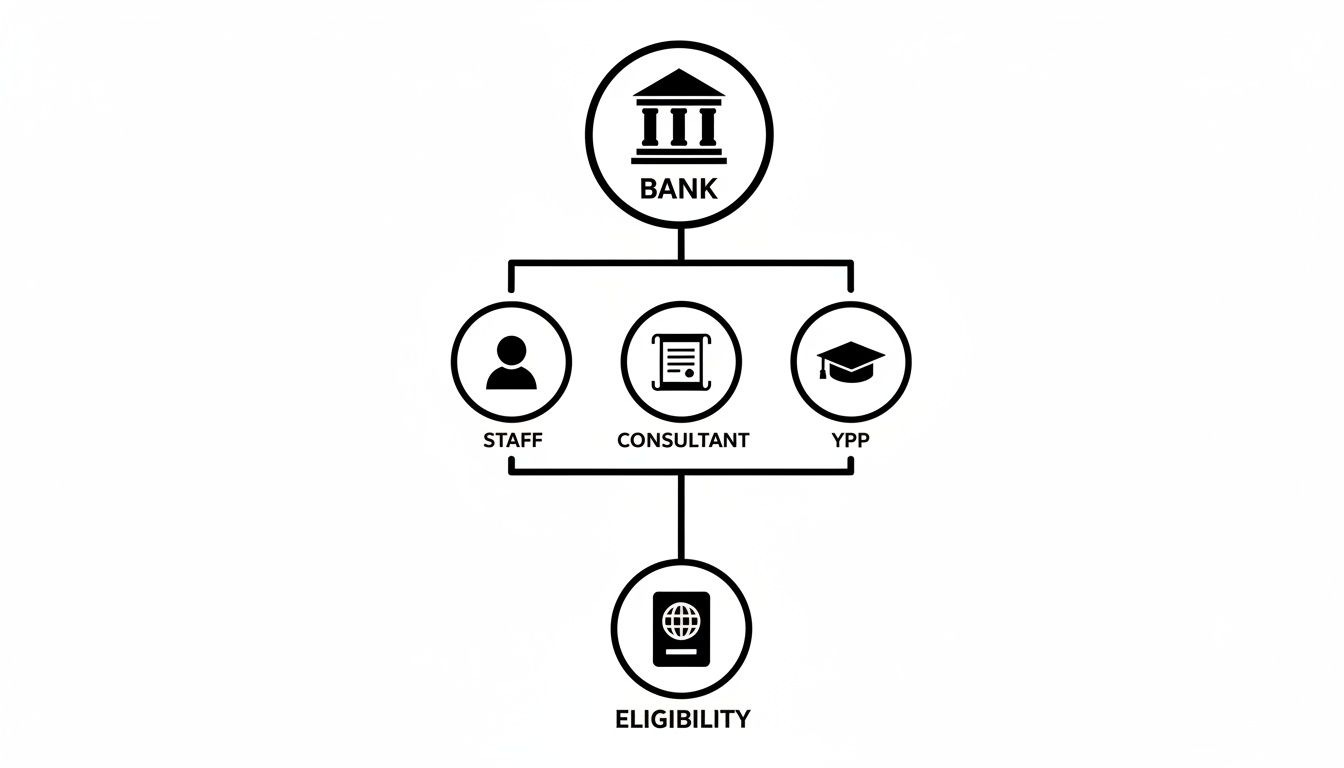
This flowchart shows the three main avenues: Staff, Consultant, and the Young Professionals Program (YPP). All are governed by strict eligibility rules. Let’s break down what each of these means for you.
Staff Appointments: The Core Team
Staff appointments are the backbone of the IADB. These are the long-term, permanent jobs with the full package: pensions, benefits, and a clear career ladder inside the institution.
Think of these roles as the Bank’s operational and intellectual core. They’re the economists, sector specialists, and operations officers who manage loan portfolios and provide the deep technical expertise that drives the IADB’s work. Getting a staff job is incredibly competitive and is reserved for seasoned professionals with a proven track record.
Consultant Contracts: The Flexible Force
Consultant contracts are project-based and make up a huge part of the Bank’s workforce. These roles are for specific, time-bound assignments that can range from a few months to a couple of years. Consultants are brought in for their specialized skills to support a particular project or fill a temporary gap.
For many, this is the most common way to get a foot in the door. Plenty of long-term staff members started their IADB journey as consultants. It’s a fantastic way to prove your value, build an internal network, and get priceless experience from the inside. We have a detailed guide that compares the pros and cons of being a consultant versus a full-time employee.
A key strategy for landing consultant gigs is getting your name on an official consultant roster. These are pre-vetted lists of experts the Bank can pull from when a need arises. Being on a roster doesn’t guarantee work, but it puts you on the shortlist.
The Young Professionals Program: The Future Leaders
The Young Professionals Program (YPP) is the IADB’s premier recruitment track for exceptional young talent. This is a fiercely competitive two-year program designed to mold the next generation of Bank leaders. YPPs get rotational assignments across different departments, intensive training, and top-tier mentorship.
This program is geared toward individuals under 32 who have a master’s degree and relevant professional experience. It’s a fast track to a staff position and is, without a doubt, the most prestigious entry point into the IADB.
Nationality and Eligibility: The Non-Negotiables
Let’s talk about the hard-and-fast rules. To be considered for most staff and YPP positions, you must be a citizen of one of the IADB’s 48 member countries. For consultant roles, the rules can sometimes be more flexible, but nationality is always a critical factor.
Always check the specific job description for the nationality requirements. This isn’t a guideline; it’s a rule with no way around it. Confirming your eligibility is the very first thing you do before spending a minute on an application.
IADB Employment Paths at a Glance
This table breaks down the key features of each employment type at the IADB. Use it to align your career goals and qualifications with the right opportunity.
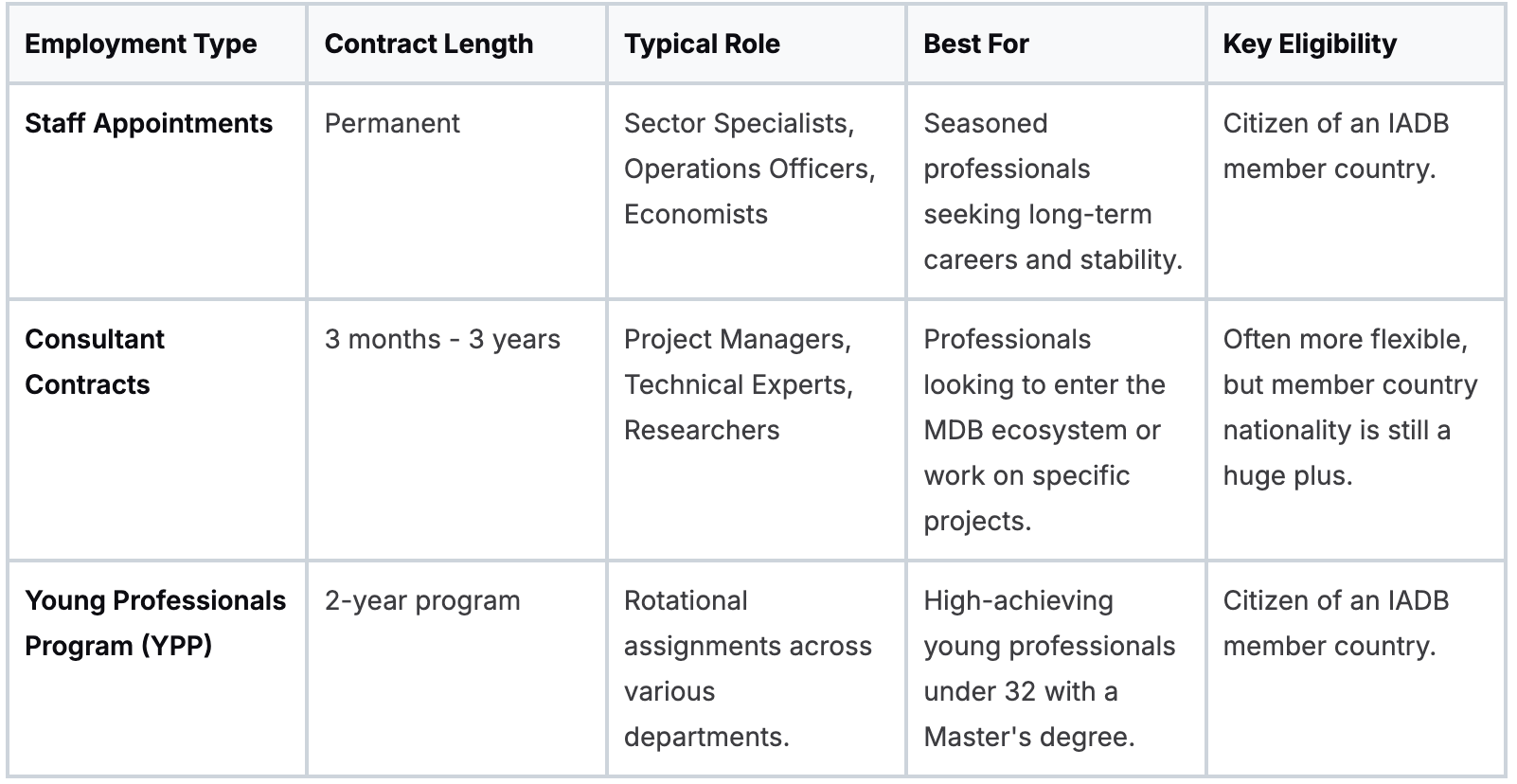
Whether you aim for a permanent staff role, a flexible consultancy, or the prestigious YPP, understanding these distinctions is your first step toward building a successful application strategy.
Your Step-By-Step Guide to the IADB Application Process
The application process for IADB jobs is methodical and can feel slow. Knowing what to expect at each stage is the best way to manage your expectations and prepare properly. Think of it as a marathon, not a sprint. If you know the roadmap, you won’t get discouraged.
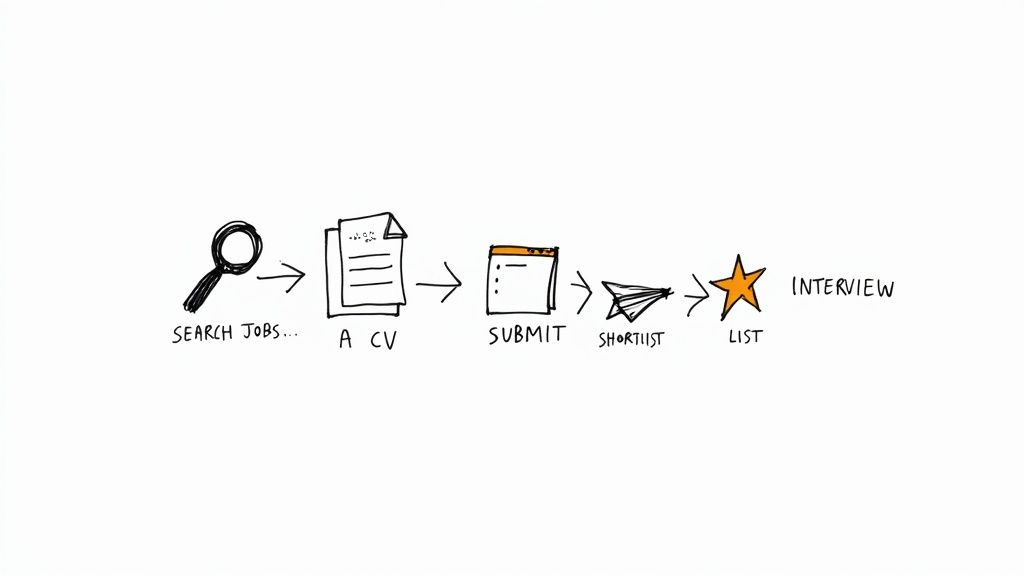
Success demands a proactive, smart approach from the first search to the final handshake. Let’s walk through the entire sequence so you’re never left wondering what comes next.
Stage 1: Finding the Right Opening
Your job search needs to be systematic. The official IADB careers portal is your starting point, but it shouldn’t be your only stop. The smartest candidates cast a wider net.
The Official IADB Portal: This is ground zero. Set up alerts for keywords that match your expertise. Get specific: use terms like “transport specialist,” “health economist,” or “procurement.”
MDB Jobs Newsletters: I recommend specialized services like the MDB Jobs newsletter. They pull together listings from dozens of development banks, saving you time and uncovering opportunities you might have missed.
Consultant Rosters: Keep a sharp eye out for “Calls for Expressions of Interest.” These are your ticket onto consultant rosters, which are pre-vetted pools of experts for upcoming projects. Getting on one is a huge strategic win.
Once you’ve found a promising role, your next task is to dissect the vacancy notice. This document is your blueprint. Print it, grab a highlighter, and mark up every key competency and required qualification. This is your guide.
Stage 2: The Application and the Long Wait
Submitting your application is the beginning of what can be a lengthy waiting game. After you hit “send,” your resume and cover letter drop into a system for an initial screening, which is often automated. A human recruiter won’t see it until it passes this first filter.
This is why tailoring your CV is so critical. Your application must explicitly mirror the language and requirements from the job description to get past the machine. A generic application is almost guaranteed to get screened out.
Get ready for radio silence. The time between the application deadline and hearing back can easily stretch from six weeks to three months. Sometimes, it’s even longer. This is completely normal for large MDBs. Patience is a requirement.
Think about it: the Bank’s recruitment teams are often sifting through hundreds, if not thousands, of applications for a single competitive role. The internal review and shortlisting process is thorough and goes through multiple people. You can find more details on typical MDB hiring timelines to get a realistic sense of what to expect.
Stage 3: Assessments and Interviews
If your application makes the shortlist, congratulations. Now the process gets intense. The next phase involves a series of evaluations designed to test your skills and your fit for the team.
The specific assessments will vary depending on the role, but they often follow a predictable sequence:
Written or Technical Test: For most technical roles, you’ll have to complete an assessment to prove you know your subject. This could be anything from a case study to a data analysis problem or a request to draft a short policy brief.
Competency-Based Interview: This is a classic panel interview. You’ll be asked to provide specific examples from your past experience that demonstrate key IADB competencies, like teamwork, leadership, and problem-solving.
Final Panel Interview: The last hurdle is usually a more in-depth conversation with senior managers and department heads. This interview digs into your strategic thinking and your vision for the role.
The IADB is obsessed with the tangible impact of its work, especially creating jobs. The Bank’s private sector arm, IDB Invest, even developed a pilot framework to measure how its projects generate direct and indirect employment across Latin America and the Caribbean. If you can show that you understand and share this commitment to measurable outcomes, you will stand out. You can discover more about their job creation measurement framework right on their site.
Crafting a Winning IADB CV and Cover Letter
Let’s be blunt: your application is the only first impression you get. For IADB jobs, a generic, one-size-fits-all CV is a guaranteed way to get overlooked. You have one chance to convince recruiters that you understand the Bank’s mission and that your skills are a direct match for its development goals in Latin America and the Caribbean.
This is about framing your entire professional story in a language that resonates with the IADB’s core purpose: driving measurable, life-changing impact.
Translate Your Experience into Development Impact
The IADB operates in a world of development outcomes, not corporate profits. Your CV has to speak that language. The trick is to translate your accomplishments, especially if you’re coming from the private sector, into the vocabulary of social and economic progress.
For instance, don’t just say you “increased sales by 15%.” That means nothing to a development economist. Instead, reframe it. Explain how you “managed a project that expanded access to financial services for 10,000 small business owners, leading to a 15% growth in their local market engagement.” The first statement is about profit; the second is about impact.
The IADB and its partners are obsessed with results that improve lives. A project with Danper, a leading Peruvian agribusiness, revealed that 28% of their workers’ households still face multidimensional poverty. This is the kind of data that fuels the Bank’s work, and your application needs to prove you think in these terms.
Your goal is to draw a straight line from your past work to the future challenges the IADB is trying to solve. It shows you’ve done your homework and aren’t just firing off another generic application.
Quantify Everything with Results-Based Language
Vague statements like “responsible for project management” are resume killers. They’re lazy and tell the recruiter nothing. Your CV must be built on a foundation of concrete, quantified achievements. This is non-negotiable.
For every bullet point under your work experience, use the “Challenge-Action-Result” model. State the problem you faced, the specific action you took, and the measurable result you delivered.
Weak: Managed a renewable energy portfolio.
Strong: Managed a $50 million renewable energy portfolio, leading the financing for three solar projects that now provide clean energy to over 200,000 rural households.
This approach gives recruiters hard data. It proves you deliver tangible outcomes.
The Cover Letter Tells Your Story
If your CV presents the facts, your cover letter tells the story. It’s your opportunity to connect the dots for the hiring manager and explain why you are the right person for this specific role at the IADB. Do not summarize your resume.
A powerful cover letter breaks down into three simple parts:
The Hook: Open by showing you get it. Mention a specific IADB project or strategic priority that excites you and connects directly to your background.
The Proof: Dedicate one or two paragraphs to your most compelling accomplishment. Tell a short story about a success that directly mirrors the requirements listed in the job description.
The Close: Reiterate your passion for the IADB’s work in Latin America and the Caribbean. End with a confident statement about your ability to contribute from day one.
Keep it sharp, professional, and focused. A one-page cover letter is the standard. Anything longer is a waste of everyone’s time. The goal is to make a compelling case that highlights your unique value and genuine motivation. It’s the human element that will make your application stand out.
How to Excel in IADB Interviews and Assessments
You’ve made it past the initial screening. Congratulations. Getting an interview for an IADB job is a real accomplishment. But now the serious work begins.
The Bank’s evaluation process is a methodical, rigorous test designed to see what you know, how you think, how you solve problems, and how you work with others. Your job is to prove you have the specific skills and technical depth to hit the ground running on complex development projects.
Deconstructing the IADB Interview Formats
The IADB uses a multi-stage approach, so you’ll likely face a few different interview styles. Each one has a specific purpose, and knowing what’s coming is the first step to feeling prepared.
Here are the most common formats you can expect:
Competency-Based Interviews: This is the core of the process. A panel will ask behavioral questions to understand how you’ve handled specific situations in the past. They’re looking for concrete proof of skills like teamwork, leadership, problem-solving, and innovation.
Technical Deep Dives: If you’re applying for a specialist role, get ready for an interview with a panel of experts from your field. They’ll test your technical knowledge, your grasp of the big challenges in Latin America and the Caribbean, and how you’d apply your skills to the Bank’s work.
Case Studies and Presentations: You might get a problem to solve, either on the spot or with a few days to prepare. This could be analyzing a dataset, outlining a project proposal, or critiquing a policy. It’s all about seeing your analytical process and communication skills in action.
Mastering the Competency-Based Interview
Success here comes down to structured, evidence-based answers. Vague claims like “I’m a great team player” will fall flat. You need to use the STAR method: Situation, Task, Action, and Result.
For every question, frame your story this way:
Situation: Briefly set the scene. What was the professional challenge you were facing?
Task: What was your specific responsibility in that scenario?
Action: Detail the exact steps you took. This is your moment to highlight your skills.
Result: Quantify the outcome. Use numbers, data, and metrics to prove your impact.
Insider Tip: Come prepared with at least two powerful STAR examples for each core IADB competency. Having a small arsenal of well-rehearsed, impactful stories is far more effective than trying to invent answers on the fly. You’ll find great insights on what panelists look for in our guide on acing a multilateral development bank interview.
Proving Your Regional and Technical Expertise
The IADB needs to see that you get the unique context of their work. The Bank is focused on solving the real-world problems facing Latin America and the Caribbean. You have to show you’ve done your homework.
For instance, a striking feature of the region’s job market is the dominance of tiny firms: 95% have fewer than five workers and account for 57% of all employment. Meanwhile, only 1% of firms with over 50 employees handle 20% of jobs. This fragmentation is a huge drag on productivity. Being able to discuss specific challenges like this shows you think like a real development professional. You can learn more from this IDB report on competition and growth.
Be ready to talk about:
The Bank’s Strategic Priorities: Know Vision 2025 inside and out. Be prepared to connect your skills directly to its pillars, like climate action, regional integration, and digitalization.
Current Projects: Research a few recent IADB projects in your sector. Have an intelligent conversation about their goals, their progress, and the challenges they face.
Your Vision for the Role: Formulate a clear idea of how you would contribute to the team’s goals in your first six months.
Acing the IADB interview process is a mix of meticulous preparation, strategic storytelling, and a genuine passion for the Bank’s mission. Nail these elements, and you’ll confidently show the panel that you’re the right person to help drive development in the region.
Common Questions About IADB Careers
We’ve seen the same questions pop up time and again from people navigating the IADB hiring process. Here are straight answers to the most common ones we get.
How Important Is Speaking Spanish or Portuguese?
It’s critical. While English is a primary working language, you can’t get by without the others for most roles. Professional fluency in either Spanish or Portuguese is a massive advantage and, for many IADB jobs, it’s a non-negotiable requirement.
Operational roles, especially those based in Latin America and the Caribbean, involve constant engagement with government clients and local partners. These conversations happen in Spanish or Portuguese. Always check the specific language requirements in the job description before applying.
Can I Apply for Multiple Positions at Once?
Yes, you can. But you must tailor every application to the specific role.
Blasting out a generic CV and cover letter to a dozen openings is a surefire way to get your application tossed. Recruiters are looking for a genuine, demonstrated interest in a specific position, not a vague desire to work at the Bank.
Focus your energy on a few roles where you are a perfect fit. A handful of high-quality, targeted applications will always outperform a scattergun approach. It shows you’re serious and that you respect the recruiter’s time.
What Is the Work Culture Like at the IADB?
The IADB is a multicultural, mission-driven, and highly professional place to work. The culture is built around collaboration and achieving real, measurable development impact in Latin America and the Caribbean.
It combines the structured, analytical nature of a large financial institution with the genuine passion of a development organization. The best part is working alongside incredibly qualified experts from every national and professional background imaginable.
How Do Consultant Rosters Work?
Consultant rosters are the Bank’s go-to list of pre-vetted experts for short-term projects. Getting on one is a smart, strategic move if you’re looking for consulting work.
You respond to a specific “Call for Expressions of Interest” on the IADB careers portal. If your profile makes the cut, you’re added to the pool and become eligible for consideration when relevant projects pop up. Being on a roster doesn’t guarantee you work, but it’s one of the main pathways for securing contracts and building a solid track record with the Bank.
Ready to find your next opportunity at a Multilateral Development Bank? The Multilateral Development Bank Jobs newsletter delivers curated lists of full-time and consultant roles from over 30 MDBs directly to your inbox. Stop searching and start applying. Subscribe at MDB Jobs.