
MDB jobs disappear fast. Are you tracking the latest openings?
Subscribe to the Premium Plan and never miss an opportunity:
Get Staff roles on Mondays
Get Consultant roles on Fridays
Grab a free trial here to see what you’ve been missing (no payment required).
In 1991, a diplomat from Vanuatu stood before an intergovernmental negotiating committee in Geneva and made a proposal. Robert Van Lierop, representing the Alliance of Small Island States, asked the assembled delegations to create an insurance mechanism funded by wealthy nations to compensate developing countries for the damage caused by climate change. The mechanism would be financed according to a formula: half based on a country’s gross national product, half based on its carbon emissions. The polluter pays principle, applied to the atmosphere.
The proposal was struck from the text. American negotiators, led by Robert Reinstein, held firm to a position that could be distilled into five words: no on targets, no on money. The following year, at the Earth Summit in Rio de Janeiro, world leaders signed the UN Framework Convention on Climate Change. It contained no mention of a fund for climate-related loss and damage. Van Lierop’s proposal disappeared into the footnotes of negotiating history, where it would remain, in various forms and under various names, for the next three decades.
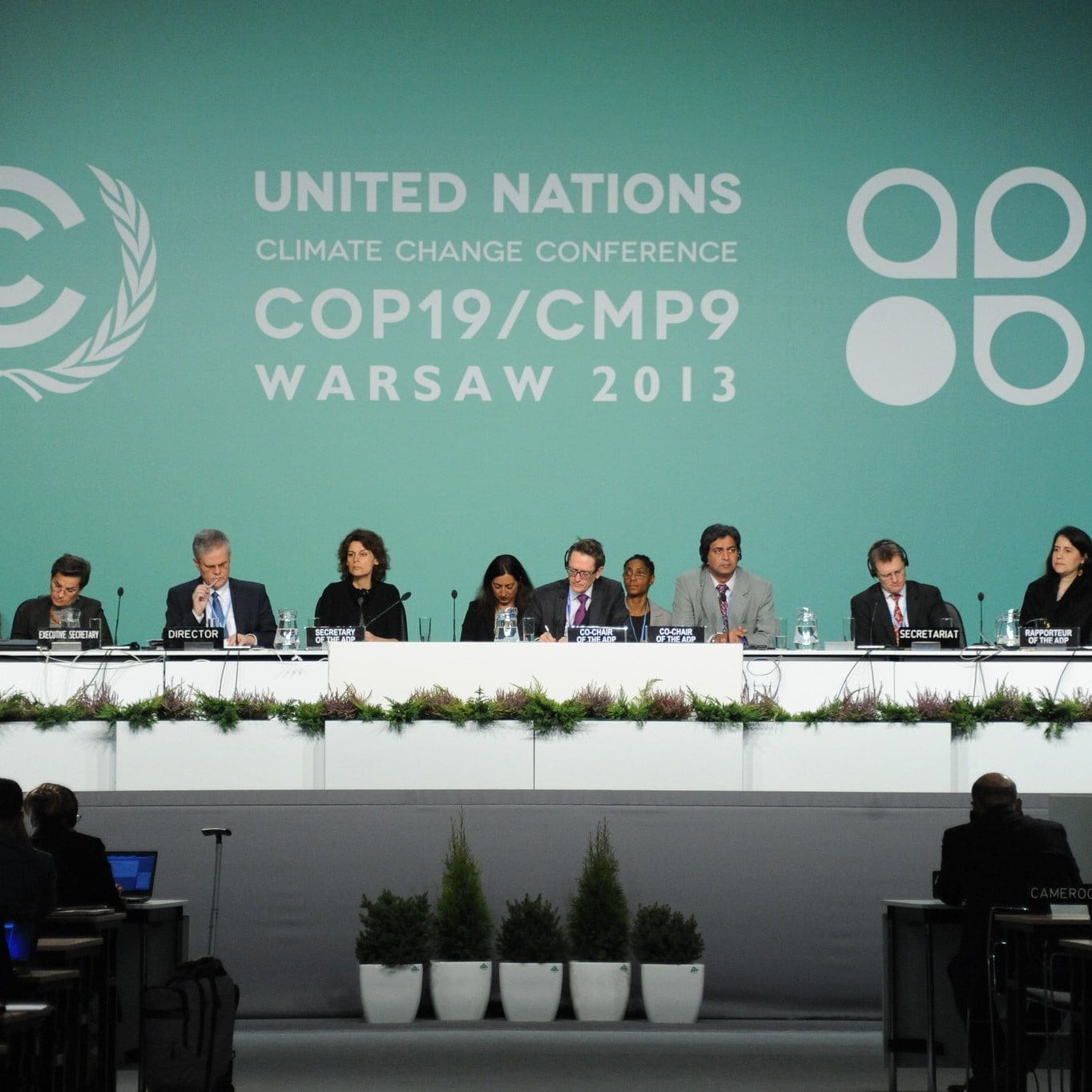
It resurfaced in 2013, when negotiators at COP19 in Warsaw established the Warsaw International Mechanism for Loss and Damage, a body tasked with studying the problem. It had no money and no mandate to distribute any. It resurfaced again at COP25 in Madrid in 2019, where the Santiago Network was created to connect vulnerable countries with technical assistance. Still no fund. Each time developing countries raised the question of who would pay for the damage already being inflicted by a warming planet, wealthier nations deflected. The language shifted from insurance to compensation to “addressing” loss and damage, each iteration more euphemistic than the last.
Then came the summer of 2022. In June, catastrophic flooding struck Nigeria. In August, monsoon rains inundated one-third of Pakistan. Thirty-three million people were affected. The World Bank’s post-disaster assessment put total damages and economic losses above $30 billion. Pakistan contributes less than one per cent of global greenhouse gas emissions. Its people face a fifteen-fold higher risk of death from climate-related disasters than the global average. The images from Sindh province, of entire districts submerged for months, became the backdrop against which COP27 opened in Sharm el-Sheikh that November.
For the first time, loss and damage finance appeared on the official COP agenda. After negotiations that ran deep into the early hours of Saturday, 19 November 2022, delegates agreed to establish a fund. The decision was historic. It was also, at that point, entirely abstract. There was no structure, no governance, no money, and no agreement on who would contribute or who would receive.
A 24-member Transitional Committee was formed, drawn from both developed and developing nations, and given a year to turn the concept into something operational. Their deadline was COP28 in Dubai, December 2023.
They met it. On the opening day of COP28, the fund was formally operationalised. The UAE and Germany each pledged $100 million. The United Kingdom committed £60 million. France and Italy followed at $100 million each. The European Union and its member states collectively accounted for over €400 million. The United States, whose negotiators had blocked the concept for three decades, pledged $17.5 million, subject to Congressional approval. By the close of COP28, approximately $700 million had been committed.
Seven hundred million dollars is a large number in most contexts. In the context of climate-related loss and damage, which runs to hundreds of billions of dollars annually across the developing world, it is a gesture. Pakistan’s 2022 floods alone cost more than forty times the entire initial capitalisation of the fund. Climate advocates pointed this out immediately and loudly. But the fund existed, which was more than anyone could have said two years earlier.
The governance architecture that emerged reflected hard compromises. The World Bank was designated as interim host and trustee for a four-year period, subject to an evaluation at COP33 in 2028 against eleven conditions designed to ensure the fund’s independence. The fund would be governed by a 26-member board with a developing-country majority: 14 seats for developing nations, including dedicated seats for least developed countries and small island developing states. Critically, the World Bank would hold the money and manage the trust arrangements, but would play no role in selecting projects, allocating resources, or directing the board’s decisions. The board would be independent. This was a red line for developing nations, many of whom viewed World Bank governance with suspicion rooted in decades of experience with conditionality-heavy lending.
In January 2026, the board elected its co-chairs: Camila Minerva Rodriguez Tavarez from the Dominican Republic and Georg Børsting from Norway. They inherited a fund that was operational in name but still finding its feet. At COP30 in Belém the previous November, negotiators had confirmed the fund’s start-up phase and linked it to the broader New Collective Quantified Goal on Climate Finance. The fund’s coffers held $431.52 million, less than two-thirds of what had been initially pledged. Wealthy nations were accused of delaying payments. Some pledges remained unfulfilled more than a year after they were made.
The start-up phase operates under what the board calls the Barbados Implementation Modalities, a framework adopted in 2025 that sets the terms for the fund’s initial $250 million disbursement window. Projects can range from $5 million to $20 million, with at least half the funding reserved for small island developing states and least developed countries. The call for proposals opened on 15 December 2025, with a six-month submission window. The board is expected to begin approving projects at its ninth meeting, likely in mid-2026.
For small island states, the design of the fund carries particular weight. These are countries where loss and damage is not an abstraction. Rising seas are eroding coastlines. Saltwater intrusion is contaminating freshwater supplies. Cyclones of increasing intensity are destroying infrastructure that took decades to build. The Lowy Institute’s Melanie Pill, writing on the fund’s design, noted that for these nations, the lack of direct access to funding, requiring intermediaries rather than allowing governments to apply directly, is “a particularly unacceptable scenario when it comes to finance for addressing loss and damage because much of what we need to do is direct support to the individuals and communities that bear the burden.”
The fund’s supporters argue that the start-up phase is necessarily cautious. A new institution handling climate finance for the most vulnerable countries in the world cannot afford to disburse recklessly. The $250 million pilot will fund a limited number of national-scale interventions, generate operational data, and inform the long-term replenishment strategy set to begin in 2027. The board has been tasked with designing rapid-disbursement and small-grants windows alongside the main project funding stream.
Critics counter that caution is a luxury the climate does not afford. The fund took 35 years to create and still holds less than half a billion dollars. The annual cost of climate-related loss and damage in developing countries is estimated in the hundreds of billions. At its current scale, the fund can address a fraction of a fraction of the need. And the countries most affected, those with the least institutional capacity, face the highest barriers to accessing even this modest pool.
For professionals in the development and climate finance sectors, the fund’s operationalisation creates a new and growing category of work. The FRLD secretariat, hosted at the World Bank, is hiring. The board’s 2026 workplan includes developing accreditation standards, designing monitoring and evaluation frameworks, and building out the institutional infrastructure that a permanent climate fund requires. At the country level, governments eligible for funding need proposal writers, project designers, and fiduciary management specialists to navigate the application process. Implementing agencies, whether national entities or international organisations, need climate adaptation experts, loss assessment specialists, and programme managers.
The Adaptation Fund, the Green Climate Fund, and now the FRLD each operate with distinct governance structures, funding windows, and accreditation requirements. For consultants and organisations working in climate finance, the proliferation of funds means more opportunities but also more complexity. Understanding which fund covers what, how to structure a proposal for each, and how to meet their respective fiduciary standards is becoming a specialisation in itself.
The deeper question is whether the fund can break free from the patterns that have constrained other climate finance mechanisms. The Green Climate Fund, established in 2010 with a target of mobilising $100 billion annually, took years to become operational and has been criticised for slow disbursement and cumbersome processes. The Adaptation Fund, older and smaller, has earned a reputation for more accessible procedures but lacks the scale to match the need. The FRLD enters a crowded field with a modest endowment, high expectations, and the weight of a 35-year political struggle behind it.
Van Lierop, the Vanuatu diplomat who first raised the idea in 1991, has watched this process unfold across his entire career. In 2022, on the eve of COP27, CNN asked him to reflect on the three decades since his proposal was rejected. He did not express bitterness. He expressed impatience.
The fund now exists. The money, such as it is, is beginning to move. For the 33 million Pakistanis who lost their homes in 2022, for the Tuvaluan families watching their islands shrink, for the Mozambican farmers rebuilding after their fifth cyclone in a decade, the question is no longer whether the world will acknowledge the debt. The question is whether $250 million, disbursed in $5-20 million increments through a process that took 35 years to create, can arrive fast enough to matter.
Make sure you subscribe to MDB Jobs to get the latest vacancies delivered straight to your inbox each Monday, and consultant positions each Friday.