
Hi everyone,
For those hunting MDB jobs (which I’m guessing might be you), subscribe to the paid plan to get fresh job listings every Monday. Apply early and track positions before they disappear.
Wondering what’s included? Job listings from September 22, 2025 and earlier are now free to access. Check out the most recent unlocked post here.
Want to get your foot in the door? Landing a consultant role is the best first step. Consultancy opportunities are published every Friday for paid subscribers.
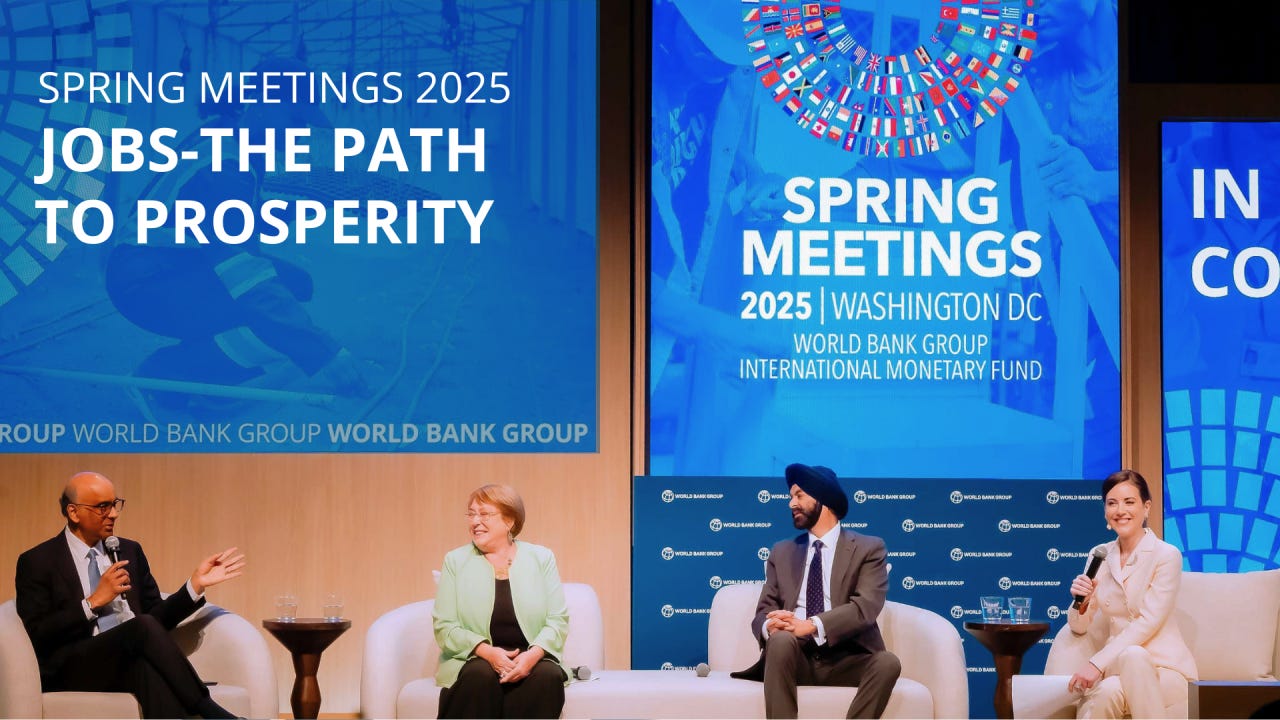
The World Bank Group (WBG) and International Monetary Fund (IMF) held their 2025 Annual “Fall” Meetings from 13–18 October 2025 in Washington, D.C. amidst a pretty uncertain global economic climate.
Leaders grappled with slowing growth, widespread debt distress, climate pressures, and digital transformation, all under the shadow of geopolitical conflicts.
“Buckle up: Uncertainty is the new normal, and it is here to stay”
- IMF Managing Director, Kristalina Georgieva
The World Bank’s President Ajay Banga echoed some of the long-term challenges, highlighting a historic demographic wave: by 2050, 85% of the world’s people will live in today’s developing countries, with “1.2 billion young people…enter[ing] the workforce—vying for roughly 400 million jobs” in the next 10–15 years .
Against this backdrop, delegates emphasised the need to boost economic resilience and create opportunities to avert instability.
Anyway, the meetings’ outcomes can be grouped into a few thematic areas:
economic growth,
debt relief,
climate finance,
digital development,
global poverty, and
private sector investment.
So today, I want to discuss how these relate to recruitment and future careers in the multilateral development bank (MDB) space.
1. Global Economic Growth: Outlook and Stability
The latest (IMF) forecast for 2025 expects world economic growth to slow to about 3.2%, down from 3.3% in 2024, and taper to 3.1% in 2026. Advanced economies will likely grow around 1.5% next year, while emerging and developing economies may exceed 4%.
The IMF Managing Director acknowledged there is a “sense of relief that the world economy is holding… better than we feared,” but added that there is “also still a sense of anxiety” because growth remains “less than we need it to be”. The risk picture is clearly tilted to the downside, with geopolitical conflicts, trade frictions and financial market instability posing threats.
She identified three priorities for all members:
Strengthen fundamentals: rebuild fiscal buffers, reduce debt and reinforce institutions.
Boost lasting growth: carry out regulatory reforms and unlock the private sector’s potential.
Address global imbalances: lift demand in surplus countries and use fiscal consolidation in deficit countries.
Policymakers were essentially urged to “restore confidence through credible, transparent and sustainable policies”. There was broad consensus that the IMF should remain an anchor of global stability: “members expressed support for the role of the Fund as an anchor of stability”. In short, while the world economy is showing resilience, it remains fragile. Georgieva summed it up: “roll [up] our sleeves; we need to navigate through this fog of uncertainty.”
2. Debt Relief and Fiscal Sustainability
Debt is a major drag on development. The IMF warned global public debt could top 100 % of GDP by 2029, which will be the highest since the post-war era.
Relief and restructuring are top priorities. The IMF and World Bank Group urged governments and creditors to speed up orderly workouts. Georgieva stated the work on debt is “both very important and urgent”.
The Bank is also trying new tools: President Ajay Banga revealed they’ve begun “debt-for-development” swaps (starting with Côte d’Ivoire) to free up fiscal space.
Lastly, the IMF’s funding capacity is being strengthened. Member countries backed raising quotas by around 50 %, which should make the Fund more capable of helping countries in trouble.
3. Climate Finance and Climate Resilience
As always, there’s a bit of a mixed message around climate change and development. Banga announced that 48 % of the Bank’s financing in FY2025 qualified as having climate co-benefits. In addition, 43 % of its public-sector portfolio is now focused on resilience (up from ~33 % two years ago).
So I’m guessing climate may be back on the agenda now!?
Anyway, several innovations are underway:
debt-for-climate swaps,
blended-finance tools, and
increased collaboration among MDBs.
The agenda also reflects a strong expectation that multilateral funds must do more, and faster, to match climate needs.
4. Digital Development and Innovation
Digital infrastructure and governance got a big boost in the meetings. The World Bank emphasised that development is not just about roads and power, but also about connectivity and digital systems. Banga described digitisation as “the human and physical infrastructure that underpins opportunity”.
Governments are being helped to use tech for transparency and inclusion. This includes, for example, digital IDs, AI for tax/property/asset linking, and fraud detection. The Bank works with over 120 governments already, and 26 more countries are in the pipeline for digital-governance support.
Fintech and financial inclusion are also pretty important. In developing economies, adult financial-account ownership has risen from 42 % to 76% over ten years, and in South Asia women’s account ownership climbed from 27 % to 83%. The new Gender Strategy links digital inclusion with economic empowerment.
In short: digital skills, infrastructure and governance are now core to development, not just nice extras.
5. Global Poverty and Inequality
Despite progress, poverty remains stubborn. In 2024 some 10.3% of the world’s population (≈ 839 million people) were still in extreme poverty. Sub-Saharan Africa has the heaviest burden (≈ 46 %), and the Middle East & North Africa are next.
Banga emphasised a pivot. Jobs and income are now the “North Star” of the Bank’s strategy. He said:
“a job is more than a paycheck. It’s purpose. It’s dignity. The straightest line to stability”.
Anyway, the point is that education, skills training, gender equality, and social protection all serve the goal of helping people earn decent living and escape poverty.
6. Mobilising Private Sector Investment for Development
A strong theme from the meetings was that public money alone isn’t enough. The Bank and IMF stressed that real scale requires private investment.
Banga noted: “Most jobs – nearly 90% – ultimately come from the private sector, but they don’t all begin there.”
In FY2025 the Bank mobilised US$69.9 billion of private investment alongside its own funds.
To attract investors the Bank is becoming faster and more agile. Average project approval time has come down from 19 months to around 12. Co-financing platforms and guarantee tools are scaling up; for example the Bank aims to triple its guarantee business by 2030.
The private-sector arm (IFC) is focusing on five job-rich sectors: infrastructure & energy, agribusiness, healthcare, tourism and value-added manufacturing. The goal is to use public finance as a lever to unlock private capital and turn development ambition into jobs and growth.
Implications for World Bank Recruitment and Skills Needs
Right about now, I can hear you saying, “Rob, I’m here for the jobs. What does all this mean about the job market?”
Well here you go…
The strategic outcomes from the 2025 Annual Meetings carry a bunch of implications for the World Bank Group’s own job market. It’s specifically related to the types of talent and expertise the Bank will be seeking, as well as for hiring trends in the wider international development sector. The WBG is in the midst of institutional change and growth to meet ambitious goals, and this is expected to be reflected in its recruitment:
Expansion in Climate and Sustainability Roles: With climate co-benefits now approaching half of the Bank’s portfolio, the demand for climate experts will continue to rise. The Bank will need more climate change specialists, renewable energy engineers, and adaptation/resilience experts to design projects that both reduce emissions and protect communities.
The meetings also discussed new areas like support for nuclear energy (the Bank is partnering with the IAEA to advise countries on nuclear power for the first time in decades) , which will likely necessitate hiring or contracting niche expertise in nuclear energy policy and safety.
Digital Development and Data Skills: The emphasis on digitization and anti-corruption tech solutions points to increased recruitment of digital development specialists. My guess is the Bank will hire more ICT policy analysts, digital infrastructure engineers, and gov-tech advisors to help client countries build digital ID systems, e-government platforms, and cyber-secure databases.
Data science and artificial intelligence skills are also in demand. The Bank is already using AI for stuff like fraud detection and analyzing tax data, so data analysts, machine learning specialists and developers who can deploy these tools in development projects will be valuable.
The WBG’s new Gender Strategy explicitly links digital access to women’s empowerment. So my guess is that those with experience in gender-focused digital initiatives (like closing the digital gender gap) could be sought after.
Private Sector and Financial Engineering Expertise: As the Bank pivots to mobilising private capital, it’ll likely staff up in finance and investor-facing roles. There will be greater need for professionals who understand project finance, risk guarantees, capital markets, and blended finance. For instance, the success of the Bank’s first loan securitization deal points to more work in structuring such transactions (e.g. financial engineers, securitization lawyers, and credit analysts).
MIGA’s plan to triple its guarantee business by 2030 implies hiring more underwriters and risk management specialists who can structure political risk insurance and credit enhancement products.
Economists and Policy Specialists for Jobs and Reforms: Banga’s “Jobs” agenda means the Bank will probablyt intensify work on improving business climates, labor markets, and skills development in client countries. We can expect continued hiring of economists, public policy experts, and sector specialists who can advise on reforms.
The Bank’s creation of a single Country Partnership Framework for each country that pulls together all arms (IBRD, IDA, IFC, etc.) will require multi-disciplinary teams and leaders who can oversee integrated strategies. Indeed, the Bank has been consolidating its country office leadership. By June 2026 every country office will have a dedicated country director as the single point of contact, replacing previous cluster-management approaches. This restructuring implies new country director posts and expanded country teams, especially in nations that used to share directors. For mid-career professionals in developing regions, this could translate into more openings for country-level economists, operations officers and programme managers, as the Bank boosts its on-the-ground presence.
Regional Recruitment Focus: Africa and Fragile States. The meetings suggested that future development success hinges on Africa (with its booming youth population) and on addressing Fragility, Conflict and Violence (FCV) situations. The World Bank is likely to increase hiring in Africa and other developing regions, both to staff country offices and to bring in local knowledge. African professionals (e.g. energy engineers for Mission 300, agronomists for AgriConnect) will be in high demand. Likewise, implementing the forthcoming WBG Strategy for Fragility, Conflict and Violence will require specialists in conflict resolution, refugee/displacement issues, and rebuilding institutions in fragile states. Governors specifically called for continued focus on low-income countries, FCV states, and small island states. These are areas that often need field-based staff willing to work in challenging environments.
Alright, that was a lot, I know.
But in summary, a career at the World Bank going forward will likely require expertise in one of the high-priority domains (climate, digital, infrastructure, finance, or human capital) together with a strong adaptability to work across sectors.
Make sure you subscribe to MDB Jobs to get the latest vacancies delivered straight to your inbox each Monday.