

Hi everyone,
For those hunting MDB jobs (which I’m guessing might be you), subscribe to the paid plan to get fresh job listings every Monday. Apply early and track positions before they disappear.
Wondering what’s included? Job listings from November 24, 2025 and earlier are now free to access. Check out the most recent unlocked post here.
Want to get your foot in the door? Landing a consultant role is the best first step. Consultancy opportunities are published every Friday for paid subscribers.
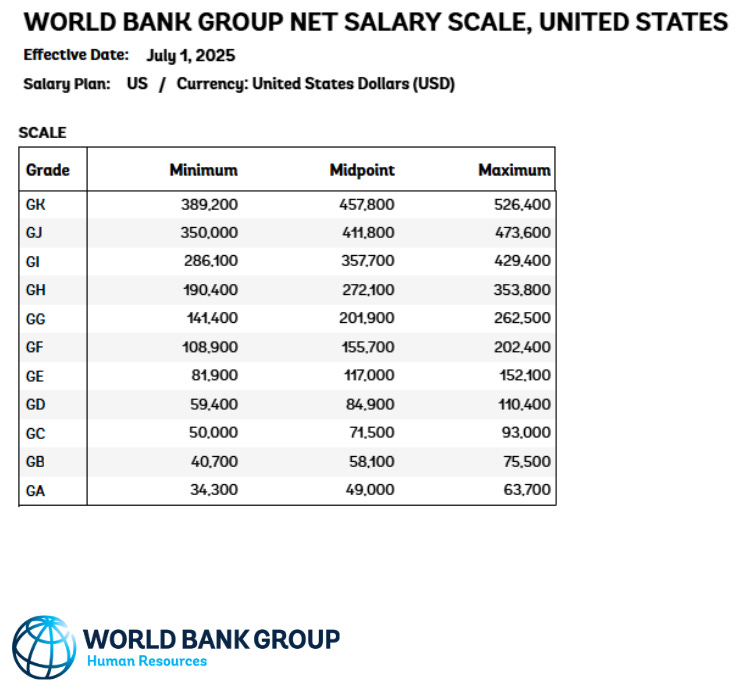
This is the unwritten manual on how the World Bank salary system actually works.
If you’re looking at a World Bank job description, you’re likely staring at a code like “GF” or “GG” and a number that looks suspiciously low for Washington, D.C. You’re probably also wondering if you count as “International” or “Local” staff—and why the difference could cost you $50,000 a year.
Official documents are written by HR lawyers. This guide is for you. The practitioner who wants to know what the offer really means.
The “Net of Tax” Concept: Read This First
Before we look at the numbers, you have to understand the single most important concept in multilateral compensation: Net of Tax.
If you aren’t a US citizen, the World Bank salary figure you see on the scale is (effectively) what hits your bank account. There are no deductions for federal or state income tax.
If the scale says $100,000: You get ~$8,333 a month deposited.
In the private sector: To take home $100,000 in D.C., you’d need a gross salary of roughly $145,000+.
For US Citizens: You do have to pay taxes (Uncle Sam never sleeps). However, the Bank pays you a “tax allowance” on top of your salary to cover the estimated tax liability. Theoretically, this makes you whole, bringing you to the same “net” position as your international colleagues.
The Insider Warning for US Staff: The tax allowance is paid to you quarterly. Don’t blow it on booze and caviar. You need to make estimated tax payments to the IRS yourself. If you treat that quarterly bump as a bonus, April 15th will be a disaster.
The World Bank Salary Grade Hierarchy (GA to GK)
The Bank uses a letter system ranging from GA (entry-level admin) to GK (Vice Presidents). Here’s the breakdown of what those letters mean in the real world.
The Administrative Grades (GA – GD)
Who they are: The backbone of the institution. Executive Assistants, Program Assistants, and Team Assistants.
The Titles:
GA/GB: Office Assistant / Team Assistant.
GC: Program Assistant.
GD: Senior Program Assistant.
The Vibe: These roles are pretty important. A good Senior Program Assistant (GD) runs the unit and knows where all the skeletons are buried.
The Professional Grades (GE – GG)
This is where 80% of the “technical” work happens. If you have a Master’s degree and 5-10 years of experience, you’re pretty much landing here.
GE (Analyst):
The Role: Often for younger staff or those with less than 5 years of experience. You’re doing the grunt work: data crunching, research, and drafting.
Salary Range (Net): ~$70k – $130k.
GF (Specialist / Young Professional):
The Role: The entry point for the “Young Professionals Program” (YPP) or mid-career hires. You are a full-fledged team member but not leading the show just yet.
The Titles: “Urban Specialist,” “Energy Specialist,” “Economist.”
Salary Range (Net): ~$95k – $170k.
GG (Senior Specialist):
The Role: The workhorse of the Bank. You lead projects (Task Team Leader or “TTL”), negotiate with government ministers, and sign off on technical reports. Most career staff retire at this grade.
The Titles: “Senior Education Specialist,” “Senior Economist.”
Salary Range (Net): ~$130k – $220k.
The Managerial & Technical Lead Grades (GH – GK)
GH (Lead Specialist / Program Manager):
The Role: You‘re either a deep technical expert (Lead Specialist) or you’ve moved into management (Practice Manager). A Practice Manager (PM) is a powerful role. They control the budget and hiring for a specific sector, so everyone wants to be their friend.
Salary Range (Net): ~$170k – $280k.
GI (Director / Senior Advisor):
The Role: You run a whole department. High stakes, high politics.
Salary Range (Net): ~$250k – $380k.
GK (Vice President / Managing Director):
The Role: Political appointees and top-tier career climbers. You report to the President.
Salary Range (Net): ~$330k – $450k+.
The “Caste System”: International vs. Local Staff
This is the part recruiters gloss over, but it affects your bank account and lifestyle more than your World Bank salary grade.
International Staff (The “Expat” Package)
Who: Recruited globally to work at HQ (DC) or rotated to country offices.
The Perks:
Relocation: Full move paid for, plus a “settling-in” grant.
Mobility Premium: If you are posted abroad (outside your home country), you get an extra cash bump. The Secret Formula: It’s roughly 11% of the Grade GG midpoint for you, plus 5% for a spouse and 4% per child. This can add $20k–$40k tax-free to your income.
Education Grant: The Golden Handcuff. The Bank pays roughly 75% of tuition for your kids’ private school or university (up to age 23). In DC, where private school costs $50k/year, this is worth tens of thousands post-tax.
Home Leave: Every two years, the Bank pays for you and your family to fly back to your home country to “maintain cultural ties.”
Local Staff (Country Office / “IRS” Staff)
Who: Recruited in-country (e.g., a Kenyan national hired in the Nairobi office).
The Deal: You’re paid a competitive salary for the local market.
The Difference: You generally do not get the education grant or home leave. You’re considered “local,” even if you have the same PhD from Harvard as the International staff member sitting next to you.
Note: If you’re a “Local” staff member in a high-cost location, your salary is good, but you miss out on the expat arbitrage.
The “Foot in the Door”: Consultants (STC / ETC)
You will see many jobs listed as STC (Short Term Consultant) or ETC (Extended Term Consultant).
STC: Max 150 days of work per year. No benefits. Hourly rate. Pure hustle.
ETC: One-year contract, renewable for up to two years. Benefits included (medical, leave), but no pension.
The Strategy: Many full-time staff (GF/GG) started as STCs. It is the best way to prove you can do the work before they commit a permanent “slot” to you.
However, it looks likely that STCs will be phased out in next fiscal year. So stay tuned to learn about what these consultancy opportunities will evolve into.
Make sure you subscribe to MDB Jobs to get the latest vacancies delivered straight to your inbox each Monday.