MDB jobs disappear fast. Are you tracking the latest openings?
Subscribe to the Premium Plan and never miss an opportunity:
Get Staff roles on Mondays
Get Consultant roles on Fridays
Grab a free trial here to see what you’ve been missing (risk-free).
In the high-altitude air of Davos, a new conglomerate absorbs the business of global security, turning the messy art of diplomacy into a clean balance sheet asset.
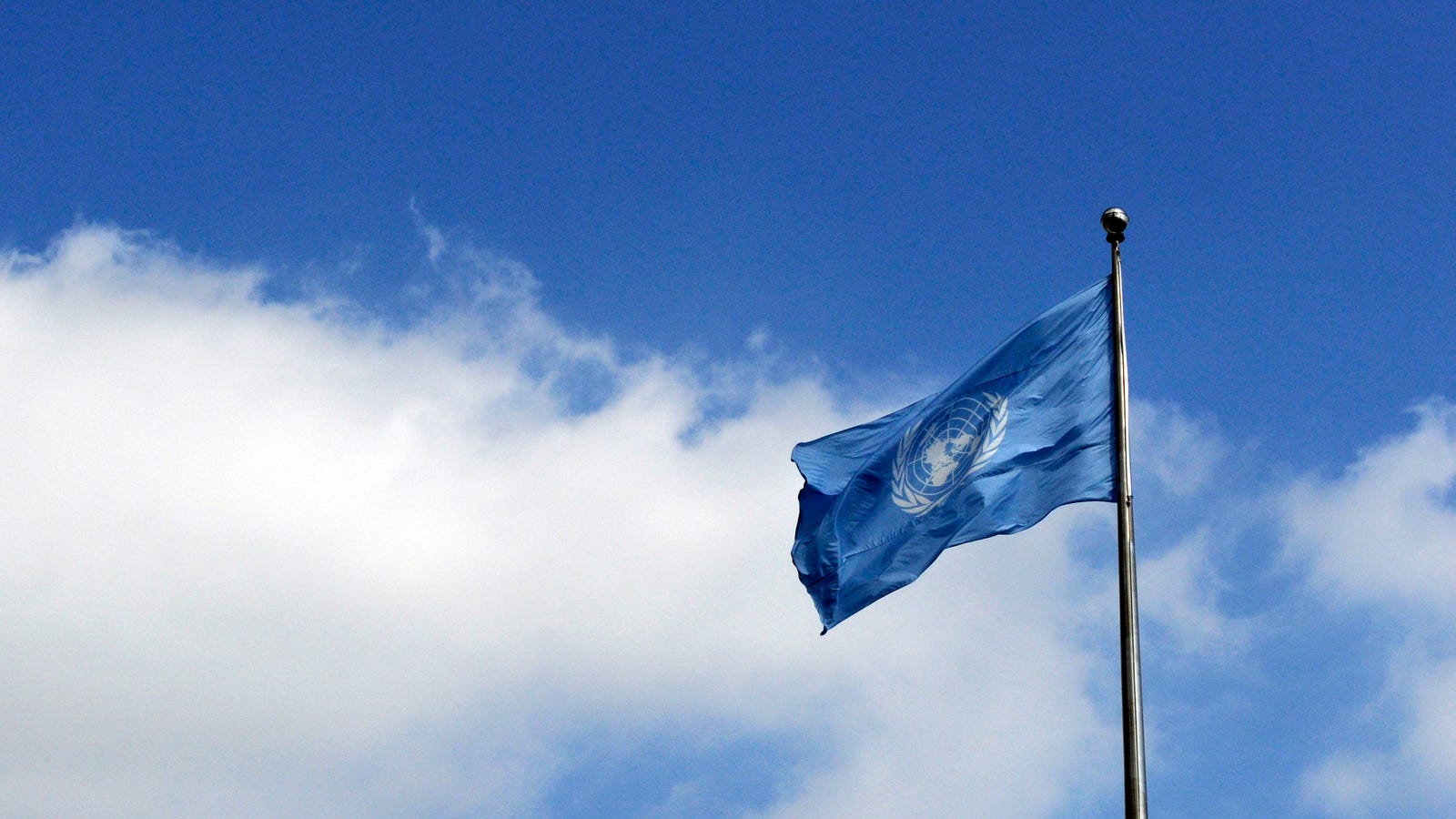
The air in Davos is always thin, but on the morning of January 26, 2026, it felt entirely devoid of oxygen for the traditionalists of the global order. For eighty years, the color of international peace had been a specific, bureaucratic shade of pantone blue. It was the blue of helmets, the blue of flags flying outside the East River headquarters, the blue of a postwar dream that promised equality among nations. But as the limousines idled outside the Kongresszentrum and the heavy glass doors swung open for the signing ceremony, the color palette had shifted. The branding for the newly ratified Board of Peace was not blue. It was gold.
Inside the hall, the atmosphere did not resemble a diplomatic summit. There were no circular seating arrangements designed to imply peerage, nor were there headsets for simultaneous translation of long-winded speeches. The room was set up like a deal closing. At the center of the dais sat Donald J. Trump, flanked not by ambassadors, but by the architects of a new financial instrument. To his right sat Jared Kushner, the chief product officer of this geopolitical startup. To his left sat Marc Rowan of Apollo Global Management, representing the capital stack.
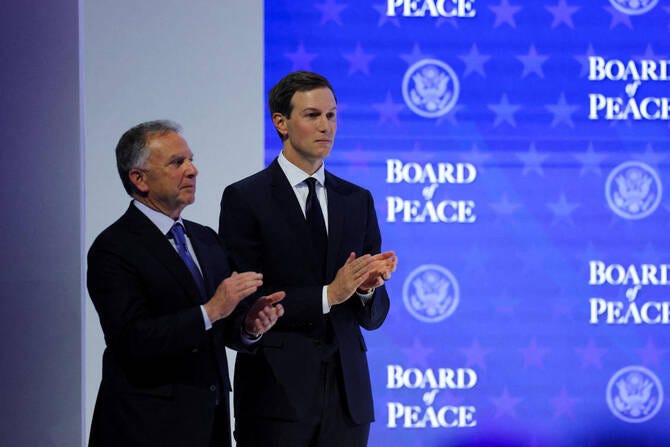
The entity they were bringing public was the Board of Peace, or BoP. In the eyes of its founders, this was not a new United Nations. It was the hostile takeover of the United Nations. The BoP was a sui generis executive organization designed to bypass the gridlock of the Security Council with the ruthless efficiency of a leveraged buyout.
To understand how the world arrived at this moment, one has to look back to the previous autumn, to a moment of supreme irony in the chambers of the UN Security Council. On November 17, 2025, the Council passed Resolution 2803. In doing so, the United Nations essentially voted for its own obsolescence. The resolution authorized the creation of a “transitional administration” to handle the post-war reality of the Gaza Strip. It was a vacuum that the UN, paralyzed by funding cuts and vetoes, could not fill.
Into this vacuum stepped a plan that viewed the Gaza Strip not as a humanitarian disaster, but as a distressed asset. This is a concept familiar to private equity investors. A distressed asset is a company, or in this case, a territory, that is broken financially and operationally but possesses underlying value if management can be replaced and debt restructured. The “Comprehensive Plan to End the Gaza Conflict” was the prospectus.
The structure of the Board of Peace revealed a profound shift in the mechanics of power. The organization rejected the one-country-one-vote idealism that had defined the post-1945 era. Instead, it adopted a corporate governance model. The Board was divided into tiers. At the top were the Permanent Members, a status achieved not by winning a world war, but by writing a check. The entry fee was $1 billion.
This “pay-to-play” model terrified the old guard of the diplomatic corps, yet it was brutally effective. In a single morning, the BoP raised more discretionary capital than the United Nations’ entire regular operating budget. For nations like Saudi Arabia, this was an opportunity to buy a seat on the board of global security without the tedious lectures on human rights.
The genius of the structure lay in its honesty about how the world actually worked. As Ben Gilbert might observe, this was a classic disruption play: the incumbent was burdened by legacy costs and a slow decision-making cycle, while the challenger was lean, well-capitalized, and centralized. The Chairman held a single veto. There were no committee meetings to water down the strategy.
The management team reflected this pivot. The Executive Board was a fusion of state authority and private capital. You had Marco Rubio providing the diplomatic cover of the State Department. You had Ajay Banga, the President of the World Bank, signaling that the financial plumbing of the globe was being re-routed to support this new venture. And then there were the builders. Steve Witkoff and Yakir Gabay, real estate moguls who looked at a map of the Levant and saw zoning opportunities rather than sectarian divides.
The product launch for this new venture was the “New Gaza” paradigm. Jared Kushner took the stage in Davos to present the vision. The presentation skipped the granular details of rubble removal and unexploded ordnance. Instead, it featured high-resolution AI renderings of glass skyscrapers, data centers, and a beachfront promenade that looked like a mixture of Miami and Singapore.
Kushner’s pitch was simple and audacious. The problem with Gaza, the argument went, was not political but economic. It was a failure of real estate development. By creating a “Singapore of the Middle East,” the Board of Peace argued they could make conflict too expensive to sustain. They were betting that prosperity, enforced by a technocratic administration, would dissolve ideology. It was the ultimate test of the “Peace to Prosperity” thesis, scaled up and backed by the full weight of American executive power.
However, a real estate development in a war zone requires security. This brings us to the most significant operational shift of the BoP era: the privatization of the peacekeeper.
For decades, the “Blue Helmet” was the symbol of international intervention. These were troops loaned by nations, operating under strict rules of engagement, often hamstrung by a mandate to observe rather than enforce. The Board of Peace had no patience for observation. They needed site security.
The resolution authorized an International Stabilization Force, but the boots on the ground did not belong to the armies of Iowa or Lancashire. They belonged to the payrolls of private contractors. Firms like UG Solutions began recruiting a new class of worker. They were not looking for “peacekeepers.” They were hiring “Advanced Protection Operators” and “International Humanitarian Security Officers.”
This distinction is important to keep in mind. A peacekeeper answers to a chain of command that ends in a democratic government. A security contractor answers to the terms of a contract held by a board of directors. The mission of the ISF was not to win hearts and minds, but to secure the “Yellow Line”. I.e. the perimeter within which the new economy could function. It was the mercenarization of stability.
The labor market for international development convulsed in response. In New York, Geneva, and London, the traditional “aid industrial complex” began to collapse. The grant writers, the policy advisors, and the rights-based advocates found their funding lines severed. The United Nations was liquidating positions, unable to pay its electric bills, while the BoP was hiring.
A new archetype of professional emerged. The resume of 2026 did not list experience in “community dialogue” or “capacity building.” It highlighted skills in risk analysis, blended finance, and secure logistics. The “humanitarian” was replaced by the “fixer.” These were professionals who could navigate the grey zones between a sovereign wealth fund’s investment committee and a private military contractor’s rules of engagement.
As the signing ceremony in Davos concluded, the implications rippled far beyond the Alps. In the halls of the State Department and the corridors of power in Beijing and Moscow, the message was received. The United Nations had been bypassed. The era of seeking consensus was over; the era of purchasing outcomes had begun.
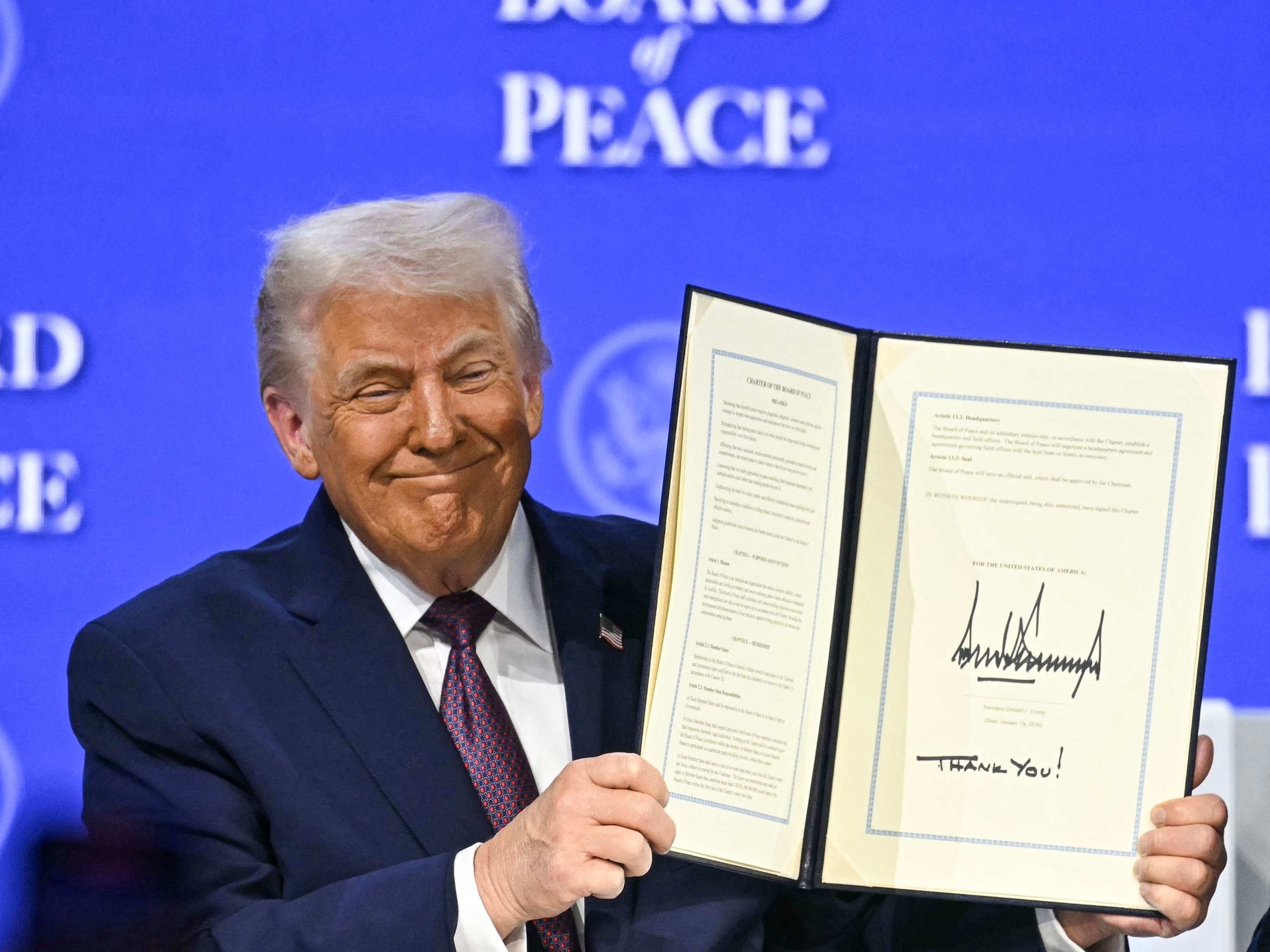
Donald Trump, holding the folder containing the Charter, looked out at the assembly of investors and ministers. He had often spoken of the world as a series of deals to be made, of nations as competitors in a zero-sum game. Now, he had built the arena where that game would be played.
The Board of Peace symbolized the privatization of the global order. It was the moment when the world stopped pretending that all nations were equal and accepted the logic of the marketplace. Peace was no longer a right to be protected. It was a service to be subscribed to, a luxury product available to those with the capital to pay the entry fee. As the applause filled the hall, the silence of the old institutions was deafening. The hostile takeover was in session. And so was the Board.
Make sure you subscribe to MDB Jobs to get the latest vacancies delivered straight to your inbox each Monday, and consultant positions each Friday.