MDB jobs disappear fast. Are you tracking the latest openings?
Subscribe to the Premium Plan and never miss an opportunity:
Get Staff roles on Mondays
Get Consultant roles on Fridays
Grab a free trial here to see what you’ve been missing (no payment required).
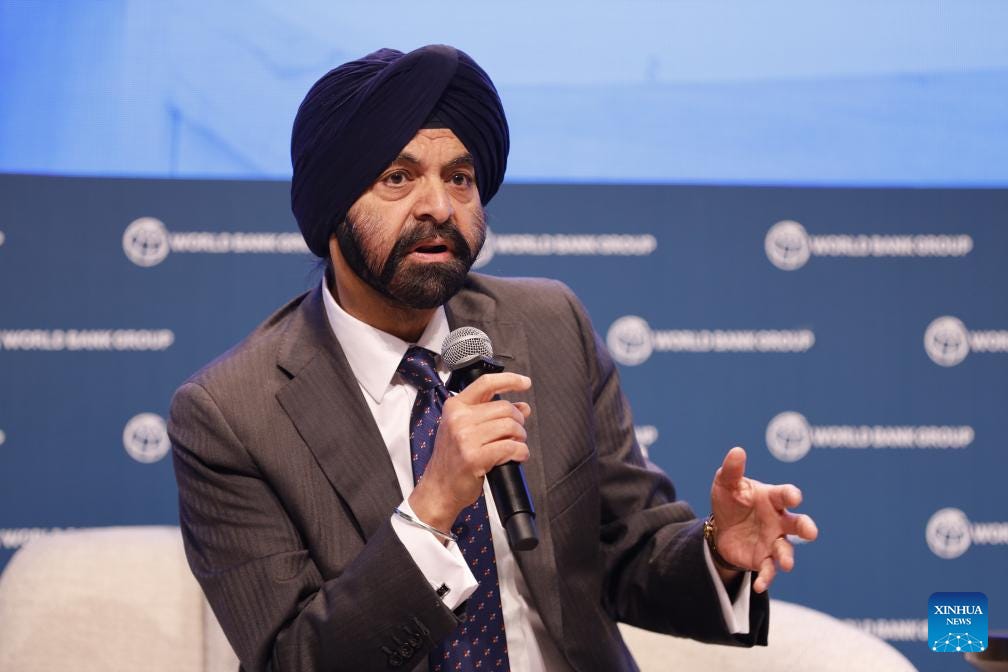
The math was unyielding, and it painted a picture of either unprecedented global prosperity or catastrophic instability. When World Bank Group President Ajay Banga stepped to the podium in Rome on March 4, 2026, he delivered a stark calculation to the assembled world leaders. Over the next fifteen years, 1.2 billion young people in developing nations would reach working age. Based on current economic trajectories, the global economy was on pace to produce only 400 million jobs for them. “That gap,” Banga told the room, “is not a statistic. It is the defining economic and strategic challenge of our time.”
Banga had come to Italy to address a coalition of global power brokers, including Italian Prime Minister Giorgia Meloni and Singaporean President Tharman Shanmugaratnam. Tharman, the head of the High-Level Advisory Council on Jobs, had spent his career untangling complex economic knots. Meloni had convened the summit in a grand Roman building to fuse Italy’s strategic ambitions with the World Bank’s global mandate. They all understood the tectonic plates of global demographics were shifting. By 2050, more than 80 percent of the human race would reside in what are currently developing nations. One in four people on the planet would be African.
Banga looked at the audience and laid out the reality of the situation. If these young people failed to find work, the resulting pressures on migration, fragile states, and political systems would shatter international borders. If they succeeded in finding meaningful employment, this demographic wave would become the most powerful engine of global growth the world had ever witnessed. He urged the leaders to view this as a shared destiny. “It is not a zero-sum game,” Banga reminded them. When developing countries grow, advanced economies reap the rewards through new consumers, diversified supply chains, and hardened global stability.
To defuse the demographic time bomb, Banga anchored the World Bank’s entire strategy around job creation. He specifically targeted the entrepreneurs and small businesses responsible for 90 percent of global employment. Executing this required a specific, three-tiered architecture. First, a nation must build foundational infrastructure. This means pouring concrete for roads and laying power lines, alongside heavy investments in human capital like education and healthcare. Second, governments must engineer predictable regulatory environments. Capital is easily spooked, and investors demand clear, consistent rules before committing funds. Third, public institutions must help the private sector scale. By using public funds to guarantee loans and absorb early risks, institutions like the World Bank can coax massive volumes of private investment into emerging markets.
This blueprint dovetailed perfectly with Meloni’s Mattei Plan, Italy’s strategic initiative to partner with African nations. Together, they were already laying physical groundwork, funding electricity connections in Mozambique, Côte d’Ivoire, Tanzania, and the Democratic Republic of Congo, along with vital water systems in Angola. They were actively connecting European labor demands with job creation in North Africa, starting in Tunisia and pushing southward into Egypt and Ethiopia. To stretch public resources further, they mobilized private capital through concessional finance, successfully moving nearly one billion euros in co-financing alongside the World Bank Group.
Banga knew that high-level summits meant nothing if the theories failed on the ground. Just days before arriving in Rome, he had traveled to Egypt to inspect this exact strategy in motion. He wanted to see how large-scale, local job creation functioned across core sectors like manufacturing, agriculture, and tourism. Walking the floor of a bus manufacturing facility, he saw how targeted policy reforms and strategic financing led directly to expanded local production and new industrial jobs. He toured a massive housing program, noting how it built resilient homes while simultaneously feeding employment through vast construction supply chains.
The Egyptian tour continued through the agricultural sector, where Banga met with agritech entrepreneurs. These founders were fundamentally rewiring the agricultural value chain, helping small farmers improve crop yields, secure better storage, and navigate complex logistics to reach broader markets. Later, standing inside the newly constructed Grand Egyptian Museum, Banga observed how a single massive infrastructure project could pull tourism dollars into the region and generate thousands of ancillary jobs far beyond the museum walls.
Infrastructure and financing were the visible engines of progress in Egypt. Yet Banga realized the true linchpin of sustainable growth was invisible. A country could build factories and museums, but without a reliable business environment, the momentum would inevitably stall. He brought this critical lesson back to the leaders in Rome.
“Confidence is built on clarity,” Banga told the summit, emphasizing the need for rules that are transparent, consistent, and reliable. Sustained economic growth rarely comes from isolated megaprojects. It emerges from the grueling, unglamorous work of steady regulatory reform. When countries sequence, implement, and maintain business-friendly policies over time, entrepreneurs finally gain the confidence to start companies, hire workers, and expand their operations.
The path forward was remarkably straightforward in theory, yet incredibly difficult to execute. If the global community could successfully align infrastructure, regulatory certainty, and access to capital, they could create jobs exactly where these young people lived. In doing so, they would avert a crisis of migration and instability, forging a new era of shared prosperity that would bind the economies of the developed and developing worlds together for the rest of the century.
Make sure you subscribe to MDB Jobs to get the latest vacancies delivered straight to your inbox each Monday, and consultant positions each Friday.