
MDB jobs disappear fast. Are you tracking the latest openings?
Subscribe to the Premium Plan and never miss an opportunity:
Get Staff roles on Mondays
Get Consultant roles on Fridays
Grab a free trial here to see what you’ve been missing (no payment required).
On the morning of March 4, 2026, the Strait of Hormuz closed. Iranian naval mines and military interdiction shut down the waterway through which one-fifth of the world’s oil and gas had, until that moment, reliably flowed. Brent crude vaulted past $120 a barrel within days. Tankers idled. LNG cargoes meant for power stations in Bangladesh, Pakistan, and the Philippines sat stranded in the Persian Gulf.
For the finance ministries of Asia’s developing economies, the arithmetic was brutal. Bangladesh imports roughly 95 per cent of its energy. Sri Lanka, still recovering from its 2022 sovereign default, watched its fragile tourism sector shed 18 per cent of arrivals in a single month. Across the Pacific, small island states that depend on diesel generators for electricity faced the prospect of rationing within weeks. The Asian Development Bank’s own research team modelled the damage: if disruptions persisted beyond a year, developing Asia could lose 1.3 percentage points of growth and absorb a 3.2-point spike in inflation. This was not a theoretical exercise. It was already happening.
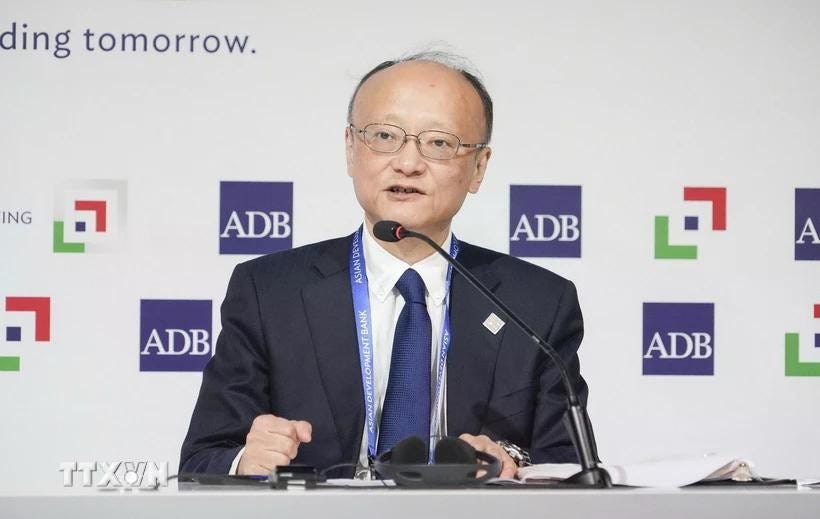
Into this crisis stepped Masato Kanda, the ADB’s president since February 2025. Kanda is a former Japanese Vice-Minister of Finance for International Affairs, a career diplomat whose previous job involved coordinating Japan’s foreign exchange interventions with the Bank of Japan and representing Tokyo at G7 and G20 tables. He had spent decades inside the machinery of international finance. He understood, better than most, how slowly that machinery could move.
The traditional way a multilateral development bank responds to a crisis goes something like this: a disaster strikes; the affected government contacts the bank; the bank assembles a team; the team designs a new loan or grant; the loan goes through internal review, board consideration, and negotiation with the borrower; money eventually arrives. The process can take months. Sometimes it takes the better part of a year. By then, the acute phase of the crisis has passed, damage has compounded, and the financing serves reconstruction rather than rescue. For decades, this was simply how things worked. Speed was not in the institutional vocabulary.
Kanda wanted to change the vocabulary.
On April 1, 2026, barely four weeks after the Strait closed, the ADB board approved a mechanism with the unwieldy name of the Rapid Resource Reprogramming and Deployment Option, or 3RDO. The concept behind it was pretty simple. Every ADB borrowing country has a portfolio of existing loans, many with funds that have been approved but not yet spent. These undisbursed balances sit on the bank’s books, earmarked for specific projects: a highway in Cambodia, a water treatment plant in Fiji, a school construction programme in Mongolia. Under 3RDO, a country hit by a crisis can redirect up to 10 per cent of those undisbursed funds toward emergency relief and early recovery, with no need to negotiate a new loan. For small island developing states, the ceiling rises to 25 per cent.
The critical detail is speed. Because the eligible expenditures, trigger conditions, and implementation arrangements are all agreed in advance, the actual activation can happen within 24 hours of a government’s request. No new appraisal missions. No fresh board papers. A phone call, a formal request, and the money moves.
“Speed is crucial to protect the economy and the most vulnerable during a crisis,” Kanda said at the announcement, “and this new tool gives our developing members the means to act in days, not weeks or months, when their people need support the most.”
This matters because the first hours and days of a crisis determine whether disruption becomes catastrophe. When fuel prices spike overnight, governments need to subsidise essential imports immediately or watch power grids fail. When food supply chains seize up, social safety nets need cash before hunger triggers unrest. In Bangladesh, the energy shock had already led to robberies at petrol stations. The window between “manageable stress” and “social breakdown” can be measured in weeks, not quarters.
The ADB had been inching toward this kind of speed for years. Its Pacific Disaster Resilience Programme, launched in 2017 for Samoa, Tonga, and Tuvalu, tested the principle of pre-arranged financing. When Tropical Cyclone Gita struck Tonga in 2018, the bank released $6 million within 24 hours because all the preparatory work had been done before the storm arrived. The 3RDO takes that logic and applies it across the ADB’s entire membership of developing countries, and to a far wider range of crises than natural disasters alone.
The mechanism also arrived alongside a broader financial support package. In late March, the ADB had reactivated oil-import support under its Trade and Supply Chain Finance Programme and offered fast-disbursing budget support through its Countercyclical Support Facility. For Sri Lanka specifically, Kanda announced $100 million in additional budget support. The 3RDO was the capstone of this response: not a new pool of money, but a new way of unlocking money that already existed.
There is something worth pausing over in that distinction. Development finance has long been constrained less by the total volume of available capital than by the speed and flexibility with which it can be deployed. The World Bank’s IDA window just completed a record $100 billion replenishment. The ADB’s own balance sheet is substantial. The problem has never been that the money does not exist. The problem is that it sits in pipelines, bound by project-specific conditions, while crises unfold at a pace that project cycles were never designed to match.
The 3RDO does not solve all of this. It does not create new resources. A country that repurposes 10 per cent of its undisbursed portfolio for crisis relief will have 10 per cent less for the highway or the water plant those funds were originally meant to build. There are trade-offs. But the mechanism reflects a recognition, forced by a succession of overlapping shocks (the pandemic, the food price crisis, the current energy shock), that the old model of development finance, in which banks design bespoke solutions to foreseen problems on orderly timelines, cannot survive contact with a world where crises arrive faster than institutions can deliberate.
For professionals working in or seeking to enter the MDB world, the implications are concrete. Crisis-response work is no longer a niche function buried inside a humanitarian affairs division. It is becoming a core operational capability. The ADB now needs staff who can design pre-agreed trigger frameworks, manage rapid portfolio restructuring, and coordinate across sovereign lending teams under pressure. Procurement specialists, financial management experts, and disaster risk analysts are in demand not because the bank is growing (though it is), but because the nature of the work is shifting. The bank that once prized meticulous long-term project design now also needs people who can execute in 24 hours.
The Countercyclical Support Facility, the Trade and Supply Chain Finance Programme, the 3RDO: each of these instruments requires its own cadre of specialists. And as other MDBs watch the ADB’s experiment, pressure will build to develop similar mechanisms. The World Bank’s joint statement with the IMF and the International Energy Agency on April 1, forming a coordination group on the energy and economic impacts of the Middle East conflict, suggests that the system-wide response is still in its early stages. More instruments will follow. More people will be needed to design and operate them.
The deeper lesson here may be institutional rather than financial. For seventy years, multilateral development banks have been built around the assumption that development is a long game: patient capital, careful planning, decade-long investment horizons. That assumption is not wrong. But the world in which these institutions operate has developed a habit of delivering shocks that do not respect planning cycles. The ADB’s answer, pragmatic and mechanical rather than grand, is to build speed into the existing architecture. Not a new institution. Not a new fund. A new option on the menu, pre-wired and ready to fire.
Whether 3RDO works in practice remains to be seen. The mechanism is weeks old. The real test will come when a Pacific island state faces a cyclone while simultaneously absorbing $130-a-barrel fuel costs, and the ADB has to prove that the 24-hour promise holds under pressure. But the direction of travel is clear. The age of the slow, deliberate development bank is giving way to something faster and less tidy. For those building careers in this sector, the ability to operate at crisis speed, to think in days rather than fiscal years, is becoming the most valuable skill on the market.
Make sure you subscribe to MDB Jobs to get the latest vacancies delivered straight to your inbox each Monday, and consultant positions each Friday.