MDB jobs disappear fast. Are you tracking the latest openings?
Subscribe to the Premium Plan and never miss an opportunity:
Get Staff roles on Mondays
Get Consultant roles on Fridays
Grab a free trial here to see what you’ve been missing (no payment required).
When global conflict forced the British government to slash its international aid budget to historic lows in the spring of 2026, Foreign Secretary Yvette Cooper faced an impossible mandate. She needed to achieve greater global impact with a fraction of the historical capital. This is the story of how the UK abandoned decades of traditional foreign charity in favor of a ruthless, private-sector-inspired investment model, fundamentally rewriting the rules of modern geopolitical soft power and demanding a return on every pound spent abroad.
March 2026 brought a fractured and volatile world to the doorstep of the United Kingdom. British jets were actively flying defensive operations in the skies over the Middle East. The Royal Navy’s Carrier Strike group was preparing to deploy to the freezing waters of the High North. National security demanded immediate, massive capital. The money had to come from somewhere, and the resulting financial calculus required an agonizing sacrifice.
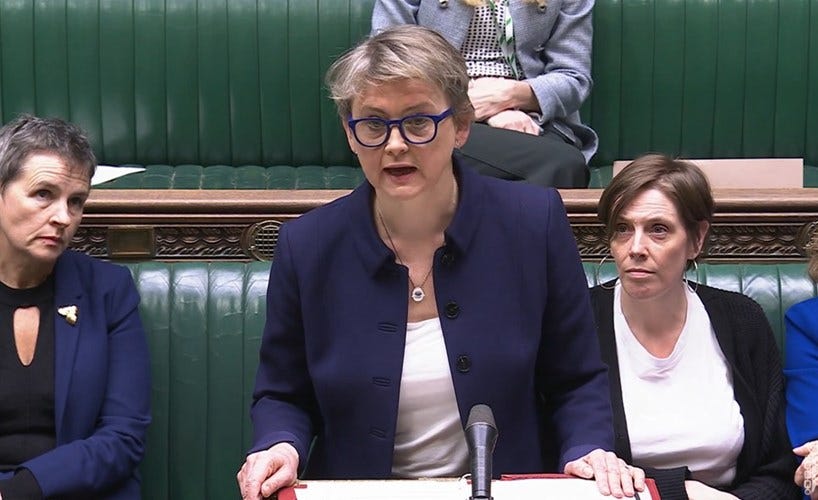
Foreign Secretary Yvette Cooper stepped to the dispatch box in the House of Commons on the nineteenth of March with a heavy reality to deliver. The Official Development Assistance budget, the global standard metric used to measure government aid designed to promote the economic development of poorer nations, was being severely reduced. The new hard target was 0.3 percent of Gross National Income, which represents the total wealth generated by the nation’s people and businesses. It was a staggering reduction for a country that had long prided itself as a philanthropic superpower.
Cooper refused to frame the decision as an ideological retreat. It was a brutal necessity in a hostile era. The geopolitical board had shifted beneath their feet. Allies were making the exact same defensive calculations, a reality reflected across the channel where Friedrich Merz’s administration in Germany, alongside leaders in France and Sweden, faced identical budgetary constraints.
With less capital to deploy, the entire machinery of British soft power required a tear-down. The old model of writing unilateral checks to developing nations was dead. Setting out how the budget would be spent over the next three years, Cooper outlined a fundamental change in how the UK would approach international development. The mandate was clear and uncompromising. The government would shift its identity from a passive donor to an active investor.
The new strategy began with severe triage. Seventy percent of all geographic support would be ruthlessly allocated to the most fragile and conflict-affected states by the end of the decade. Cooper ringfenced funding for the bleeding edges of the globe. She guaranteed capital for Ukraine, where civilians were surviving a freezing winter under bombardment. She protected funds for Palestine, enduring immense suffering in Gaza, and for Sudan, the site of the twenty-first century’s worst humanitarian crisis. Lebanon was added to the protected list in a real-time response to the deteriorating security situation in the Middle East.
Protecting the vulnerable meant abandoning the comfortable. Direct bilateral aid to the relatively wealthy G20 nations was eliminated entirely, with the sole exception of Turkey to assist with their immense refugee burden. Countries like Pakistan and Mozambique were stripped of their traditional grant funding. Instead, they were transitioned into rigorous investment partnerships designed to build infrastructure rather than subsidize daily operations.
Enter Minister for International Development Jenny Chapman. Chapman served as the pragmatic architect of the operational pivot. She understood intimately that emerging markets resented the old, paternalistic dynamics of foreign aid. Our partners in the Global South tell us they want partnership, Chapman observed to the press. They demand investment, rejecting dependency. They want to trade and to build their own systems so they are able to thrive without aid, and our job is to help them do that.
To execute this vision, the UK leaned heavily on British International Investment. This state-owned development finance institution injects capital into private sector growth in developing nations to generate both social impact and concrete financial returns. Through this vehicle, Cooper signed a joint agreement in Ethiopia for energy transmission projects worth 300 million pounds. This modern arrangement helped Ethiopians find work at home, directly addressing the economic drivers that pushed people toward dangerous, illegal migration routes.
The strategy demanded financial alchemy. Every pound spent needed to generate exponential value. The UK dramatically increased its contribution to the World Bank’s International Development Association. This was a calculated play within the broader ecosystem of Multilateral Development Banks, which are international financial institutions backed by multiple countries that pool risk to provide affordable loans for global development projects. Cooper noted the mathematics of this leverage, explaining that every single pound the UK invested in these structures unlocked four pounds of additional global finance.
The new currency of British influence was expertise. Rather than funding foreign schools directly, the UK deployed specialists from its own universities to design local curriculums. Through agencies like the Met Office and HMRC, Britain exported its institutional knowledge. In Ghana, British tax experts helped the local government generate an additional 100 million pounds in domestic revenue. This was the ultimate return on investment, enabling a sovereign nation to fund its own schools and hospitals indefinitely.
Even with a constrained budget, Cooper anchored the ruthless new strategy in core values. She designated the protection of women and girls as a central, non-negotiable priority across the entire Foreign Office. By 2030, at least ninety percent of all bilateral programs would integrate gender equality, championing their political participation and keeping children learning through the chaos of war. Simultaneously, the UK mobilized the City of London, leveraging its status as a global financial hub to drive nearly seven billion pounds in climate and nature-positive investments.
The era of paternalism had ended. In its place stood a leaner, more demanding model of global engagement. As Cooper stepped away from the dispatch box, the message to the world was unequivocal. International development was no longer an act of charity. It was a strategic investment in global stability, designed to protect the British homeland while forcing developing nations to finally stand on their own.
Make sure you subscribe to MDB Jobs to get the latest vacancies delivered straight to your inbox each Monday, and consultant positions each Friday.