MDB jobs disappear fast. Are you tracking the latest openings?
Subscribe to the Premium Plan and never miss an opportunity:
Get Staff roles on Mondays
Get Consultant roles on Fridays
Grab a free trial here to see what you’ve been missing (no payment required).
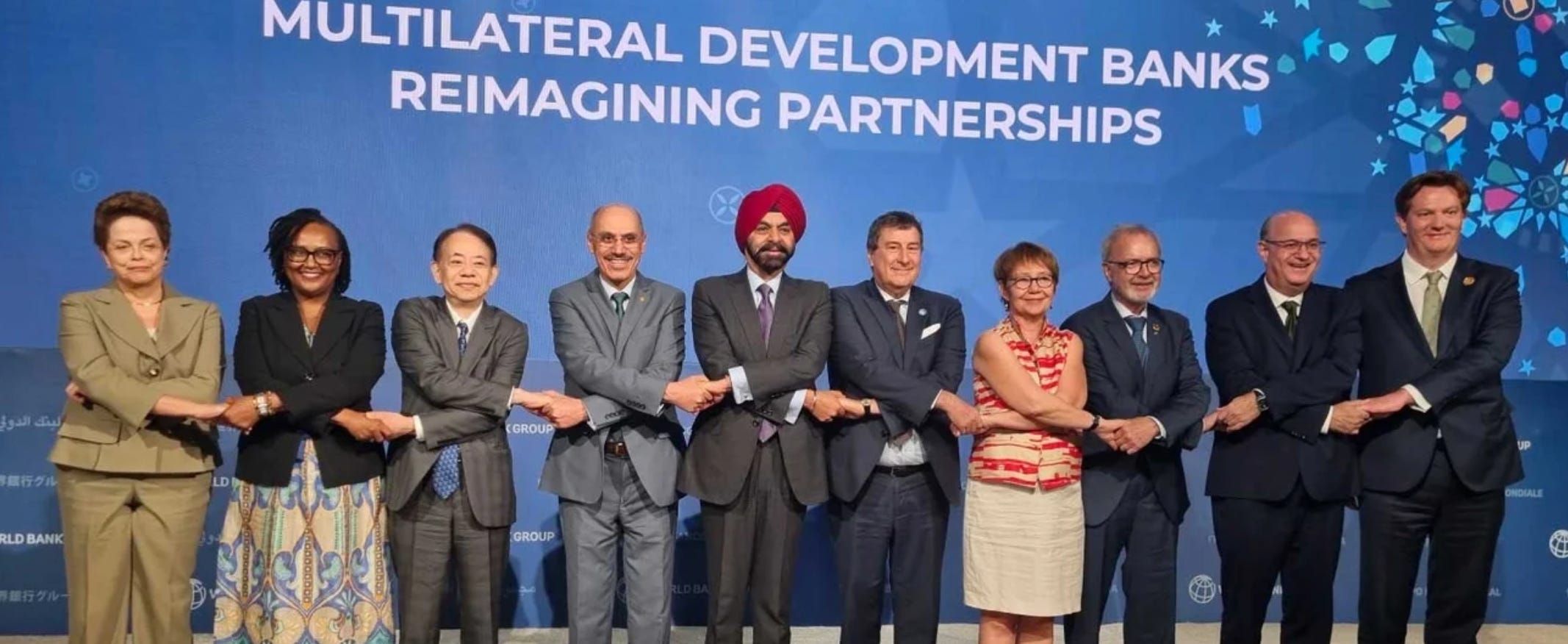
When seven multilateral development banks issued a single joint statement on a Monday afternoon in May, they were doing something the development finance world has spent the better part of a decade insisting it could never do quickly. The reason they did it tells you what the next generation of MDB jobs will look like.
On 18 May 2026, a coordinated press release went out from seven institutions simultaneously, in seven different time zones and in five different languages. The World Bank in Washington, the Asian Development Bank in Manila, the European Bank for Reconstruction and Development in London, the European Investment Bank in Luxembourg, the African Development Bank in Abidjan, the Inter-American Development Bank in Washington and the Council of Europe Development Bank in Paris. The statement was three paragraphs long. It pledged coordinated support for countries hit by the Middle East conflict, listed the channels of impact in clinical language, energy and fertiliser markets, trade routes, inflation, food security, jobs, fiscal and external balances, financing conditions, and committed the seven banks to combine financing, policy support, private sector instruments and technical expertise at scale.
The press release was unremarkable in its prose. It was extraordinary in its existence. Multilateral development banks are not built to act in chorus. They have different boards, different shareholders, different mandates, different country lists, different currencies of account, different procurement rules. Getting any one of them to move quickly is hard. Getting seven of them to issue a coordinated statement, with each board having signed off, within weeks of a crisis, is the kind of institutional choreography that usually takes years. In 2026 it took weeks. The reason was that the crisis had become a permanent operating condition, and the institutions were finally beginning to admit it.
The trigger had been the Iran-Israel-United States war, which broke out in late spring and disrupted the Strait of Hormuz, the fertiliser flows out of the Persian Gulf, the wheat routes through the Red Sea, the energy contracts that underpinned half of South Asia’s electricity grid. Twenty-seven countries had moved within a fortnight to activate emergency financial instruments at the World Bank Group, drawing on contingency facilities that had been built but rarely used. From Sri Lanka to Tunisia to Pakistan, finance ministers were on the phone to country directors, asking the question that every country director in every MDB had heard fifty times in the previous five years. How fast can you move?
The answer used to be a slow institutional shrug. The answer in May 2026 was different.
Masato Kanda was sixty-one years old and four months into the presidency of the Asian Development Bank. He had taken office on 24 February 2025, after almost forty years at Japan’s Ministry of Finance, including a stint as Vice-Minister for International Affairs that had earned him the nickname “Mr. Yen” in the foreign exchange press for his heavy interventions to prop up a weakening currency. Kanda was a graduate of Nada High School in Kobe, the University of Tokyo and Oxford, a career civil servant who had spent decades inside the engine room of Japanese economic statecraft. He understood crisis management in the way that someone who has personally executed sixty billion dollars of currency intervention understands crisis management. It was not theoretical.

In the second week of May, the Philippine President Ferdinand Marcos Jr. met Kanda in Manila. The Philippines was facing a triple shock from the conflict: rising fuel imports, rice supply uncertainty and remittance pressure from the half million Filipino workers in the Gulf. Kanda offered up to $1.75 billion in additional financing, pulled together from existing pipelines and contingency facilities. The number was unusual not for its size but for its speed. Inside the ADB, country teams were being told to compress disbursement timelines, to use policy-based lending instruments that could move money in weeks rather than years, to coordinate with the IMF on shared programmes.
Across the Mediterranean, the European Bank for Reconstruction and Development was preparing a similar pivot. The EBRD’s mandate runs across emerging Europe, Central Asia and the southern and eastern Mediterranean. Almost every country on its book was exposed to the war in some way. On the same week as the joint MDB statement, the EBRD announced a plan to deploy €5 billion in economies affected by the Middle East conflict during 2026. The deployment package would lean heavily on private sector tools, working capital lines for exporters facing logistics shocks, trade finance guarantees, and direct equity into food security and energy resilience projects. Days before, the Bank had also launched its first significant risk transfer transaction, a €1 billion synthetic securitisation called Mosaic that bundled existing EBRD loans, retained a senior tranche on its own books and placed mezzanine and junior tranches with PGGM, AXA XL, AXIS Capital and Liberty Mutual. The point of Mosaic was capital. By insuring part of its existing portfolio against loss, the EBRD could free up balance sheet headroom to lend more without raising new shareholder capital. In a year of crisis, freeing balance sheet was the same thing as creating crisis capacity.

The Bank for International Settlements veteran Nadia Calviño, who chaired the EIB, had been pushing a similar message from Luxembourg. The World Bank, under Ajay Banga, had spent the spring quietly testing the contingency facilities that had been built into IDA and IBRD in the wake of the COVID-19 shock. These had been designed in 2021 and 2022, in the abstract, for a crisis that no one could quite name. The Middle East war had named it.
For the MDB workforce, the implications of this pivot are substantial and underappreciated. Crisis response is becoming a permanent line of work inside these institutions. It is not a periodic surge that empties out the offices for a few months before everything returns to normal. The pattern of the last six years, COVID-19, Ukraine, the global food crisis, the East African drought, the Pakistan floods, the Middle East war, has burned a new operating model into the institutions. The contingency facilities, the policy-based lending windows, the crisis economics teams, the fragility and conflict units, the social protection rapid response groups, are now permanent fixtures, and they are hiring.
The Asian Development Bank’s restructuring under Kanda has been instructive on this point. In his first year, Kanda has elevated the fragility and conflict-affected situations function, expanded the energy security team and built out a dedicated crisis economics unit reporting directly to the chief economist. The World Bank Group’s Crisis Preparedness and Response Toolkit, launched in 2024 and stress-tested for the first time on a continental scale in 2026, has its own programme management office with growing headcount. The EBRD’s resilience and crisis response operations have absorbed staff from across the Bank.
The skills these units recruit for are not the standard project officer skills that dominated MDB job descriptions in the 2010s. They are crisis economics, sovereign debt sustainability under shock, energy security analysis, food systems resilience, contingent financing instrument design, social protection programme management, conflict sensitivity, geopolitical risk assessment. They favour candidates who have worked at the IMF’s Fiscal Affairs or Strategy, Policy and Review departments, at the World Food Programme, at OCHA, at private sector commodity desks, at major energy utilities, at regional central banks during stress periods. They favour, in other words, candidates who have lived inside a crisis at the operational level and learned to make decisions under uncertainty.
For aspiring MDB professionals, the practical implication is clear. The traditional path into the development finance workforce, country economist to project task manager to sector lead, is no longer the only path. The crisis response path is opening, and it is where headcount is moving. Applicants who can credibly write a paragraph about how they helped a country, a company or an institution navigate a real economic shock, with named instruments and dated decisions, are now in a different competitive bracket from applicants who can only describe project supervision experience.
There is something more profound underway as well. The seven-bank joint statement on 18 May was, in institutional terms, an admission. For decades the MDBs had defended their separateness, their distinct mandates, their independent boards, their distinctive cultures, as features of a healthy ecosystem. The crisis decade has eroded that defence. The instruments are converging. The reporting frameworks are converging. The joint statements are becoming more frequent and more substantive. There is now serious discussion in the G20 architecture of common policy frameworks for crisis response, common contingency facility design, common procurement protocols. The MDBs are still seven separate banks. They are starting to behave, in a crisis, like one institution operating across seven balance sheets.
For the workforce, the convergence creates mobility. Staff who have built skills in crisis response at one MDB are increasingly portable to another. The institutional firewalls that used to make a move from the ADB to the EBRD a years-long credentialling exercise are coming down. The hiring panels are looking for the same competencies. The instruments are increasingly shared.
The last paragraph of the 18 May joint statement contained a sentence that almost no one quoted, but it deserves quoting now. The seven banks committed to “preserve development gains, and strengthen long-term resilience.” Preserve. The verb is telling. Multilateral development finance was designed in the 1940s and 1960s for an era of building. The 2020s have made it an era of holding the line. The institutions that do that work, and the people who do it inside them, are the development workforce of the decade ahead.
Make sure you subscribe to MDB Jobs to get the latest vacancies delivered straight to your inbox each Monday, and consultant positions each Friday.