
MDB jobs disappear fast. Are you tracking the latest openings?
Subscribe to the Premium Plan and never miss an opportunity:
Get Staff roles on Mondays
Get Consultant roles on Fridays
Grab a free trial here to see what you’ve been missing (no payment required).
In April 2026, eleven multilateral development banks agreed on something that sounds deceptively simple: how to count jobs. Behind that announcement sat years of institutional tension, political pressure, and a growing fear that the development finance system was losing its organising purpose. What emerged was more than a measurement framework. It was an attempt to redefine what the world’s most powerful development institutions exist to do.
On a spring morning in Washington, the heads of eleven multilateral development banks did something these institutions rarely do quickly: they agreed.
The statement itself was dry. Almost aggressively so. A few paragraphs. Diplomatic language. References to “closer collaboration” and “common approaches”. The sort of communiqué that usually disappears into the machinery of international development within hours.
But buried inside the announcement was a bureaucratic event so improbable that people inside the MDB system immediately recognised its significance.
The World Bank. The Asian Development Bank. The African Development Bank. The Inter-American Development Bank. The European Bank for Reconstruction and Development. The European Investment Bank. The Asian Infrastructure Investment Bank. The Islamic Development Bank. The New Development Bank. The Caribbean Development Bank. The Council of Europe Development Bank.
Eleven institutions. Eleven boards. Eleven governance structures. Eleven sets of economists, statisticians, operational departments, sovereign shareholders, private-sector arms, and reporting systems.
All agreeing to measure one thing the same way: jobs.
Inside the MDB world, this was close to a miracle.
Because counting jobs sounds simple until you actually try to do it.
Does a road construction project count only the workers who physically build the road? What about the suppliers who manufacture the cement? The truck drivers? The restaurants that open along the highway two years later? What about temporary jobs versus permanent jobs? Formal employment versus informal labour? Higher wages versus simply more workers? Does a solar plant that replaces coal jobs create employment or destroy it?
Development finance had spent decades avoiding these questions by focusing on something easier to count: money.
Billions disbursed. Kilometres built. Megawatts installed. Schools financed. Loans approved.
Jobs were usually treated as a secondary effect. Important rhetorically, but operationally fuzzy.
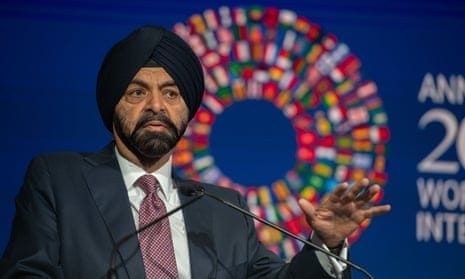
Then Ajay Banga arrived at the World Bank.
Banga, the former Mastercard CEO who took over the World Bank in 2023, inherited an institution facing a quiet identity crisis. Climate finance had become the dominant language of development banking. Every project needed a climate angle. Every annual meeting revolved around adaptation, mitigation, resilience, and blended finance.
But outside the conference halls, something else was happening.
Developing countries were staring at a demographic wave unlike anything in modern history.
Over the next decade to fifteen years, roughly 1.2 billion young people in developing economies would reach working age. The projected number of new jobs: around 400 million. The gap was staggering. Nearly 800 million people without a clear economic future.
Banga repeated the number constantly.
At the Atlantic Council in Washington, he framed it with the urgency of a systems failure rather than a labour market statistic. “That gap,” he said, “is not a statistic. It is the defining economic and strategic challenge of our time.”
The line landed because it reframed the entire purpose of development finance.
For years, MDBs had increasingly organised themselves around global public goods. Climate. Biodiversity. Pandemic preparedness. Resilience. Important priorities, all of them. But Banga’s argument was more politically visceral: if hundreds of millions of young people could not find work, every other development objective would become harder.
Migration pressures would intensify. Fragility would spread. Political systems would destabilise.
Jobs, in his framing, were not a downstream outcome of development. They were the central organising principle.
Inside the World Bank, people began referring to it simply as the “jobs-first” agenda.
That shift carried enormous implications.
Development banks are, at their core, bureaucracies of incentives. What gets measured influences what gets financed. What gets financed determines who gets promoted. And eventually, entire institutions begin hiring differently.
A transport economist who once focused primarily on vehicle operating costs and travel time savings might now need to quantify labour market effects. Infrastructure specialists increasingly found themselves discussing supply chains, SME ecosystems, and workforce participation. Private-sector operations teams suddenly gained institutional prominence because private firms, unlike sovereign ministries, directly hire people.
One senior MDB staff member described the change bluntly: “If climate was the last decade’s universal language, jobs is becoming the next one.”
But there was an immediate problem.
No one agreed on how to measure them.
This was partly technical and partly political.
MDBs had evolved separately over decades, almost like rival city-states sharing a profession. The World Bank operated differently from the ADB. The ADB operated differently from the EBRD. The EIB had European institutional logic. The AIIB had Chinese governance influences. The IDB reflected Latin American priorities. Each institution had built its own systems, templates, evaluation frameworks, and reporting cultures.
Even basic concepts varied.
Some institutions focused on “jobs supported”. Others used “jobs created”. Some counted temporary construction employment. Others prioritised long-term wage effects. Some emphasised direct employment. Others modelled indirect and induced effects through economic multipliers.
A multiplier, in simple terms, is the economic ripple effect of spending. Build a factory, and you do not only employ factory workers. You also create demand for suppliers, transport companies, maintenance contractors, nearby shops, and local services. Economists attempt to estimate these secondary effects using statistical models.
The problem is that different models produce very different numbers.
A billion-dollar infrastructure project can generate wildly different job estimates depending on the methodology used.
Which created a credibility issue.
If every MDB used different assumptions, shareholders and governments could not compare outcomes across institutions. Worse, the numbers increasingly looked political rather than analytical.
The irony was that MDBs had already solved this problem elsewhere.
Over the previous decade, they had painstakingly harmonised methodologies for climate finance reporting. The process had taken years of negotiations, technical workshops, arguments over definitions, and endless drafting sessions. But eventually, the institutions converged around shared frameworks because shareholders demanded comparability.
Jobs were becoming the next frontier.
The pressure came from multiple directions at once.
Shareholders wanted MDBs to demonstrate tangible economic outcomes rather than abstract development language. Borrowing countries wanted financing linked to visible employment gains. Political leaders increasingly needed domestic narratives around livelihoods and growth. And internally, MDB leadership needed a way to operationalise the jobs agenda into actual project design.
Without common metrics, “jobs-first” risked becoming a slogan.
The April 2026 agreement was the first serious attempt to build a shared architecture underneath it.
The wording of the statement reflected the delicate politics involved. The process would be “iterative”. It would respect “individual mandates”. It would incorporate dialogue with the International Labour Organization to account for job quality, not merely quantity.
That language mattered.
Because every institution was protecting something.
Some MDBs worried that simplistic job metrics would bias lending toward labour-intensive sectors at the expense of long-term productivity. Others worried about being judged against indicators outside their operational control. Infrastructure teams feared their projects would appear weaker than SME finance operations if metrics were poorly designed. Climate specialists worried that decarbonisation projects could be penalised if they displaced existing employment.
Then there was the question everyone understood but rarely stated openly: rankings.
Once institutions use common metrics, comparisons become unavoidable.
Which MDB creates more jobs per dollar invested?
Which sectors generate the strongest employment outcomes?
Which regional strategies work best?
Who is underperforming?
In development finance, metrics are power.
That was why the agreement mattered so much to younger professionals entering the MDB system.
For decades, the archetypal MDB economist was a public finance specialist, macroeconomist, or infrastructure planner. The emerging system increasingly favoured labour economists, private-sector specialists, firm-level analysts, investment officers, and operational staff capable of tracing employment impacts through complex economic systems.
Job descriptions were already beginning to shift.
Terms like “jobs outcomes”, “labour market effects”, and “private sector mobilisation” appeared more frequently in recruitment notices and operational frameworks. Internal discussions that once revolved around lending volumes increasingly focused on outcome attribution.
Attribution is another deceptively complicated concept. In development finance, it refers to determining whether an institution genuinely caused an outcome or merely participated in a broader process. If employment rises after an MDB-funded project, how much of that change can actually be credited to the bank?
The question sounds academic until careers and billion-dollar strategies depend on the answer.
The Centre for Global Development had been warning for years that MDBs were far better at tracking outputs than outcomes. It was easier to count roads built than productivity gains. Easier to count loans approved than jobs sustained five years later.
The jobs framework was an attempt to move the system further downstream into real economic effects.
And yet the deeper story behind the April agreement was not technical. It was institutional.
MDBs are often described externally as a coherent ecosystem. In practice, they are a collection of partially aligned bureaucracies competing for relevance, capital, influence, and strategic territory.
The World Bank is the largest and politically dominant. Regional banks guard their autonomy fiercely. Newer institutions like the AIIB and NDB emerged partly because rising powers wanted alternatives to Western-led development finance. European institutions operate with their own political constraints and mandates.
Getting eleven MDBs to agree on anything substantive usually requires either crisis or overwhelming shareholder pressure.
This agreement contained elements of both.
The post-pandemic world had sharpened concerns about growth, inequality, migration, and geopolitical instability. Simultaneously, shareholders were demanding MDB reform at unprecedented scale. Capital efficiency. Private finance mobilisation. Faster approvals. Greater coordination. Clearer results.
Jobs became the rare theme broad enough to unite everyone.
Climate could divide institutions by mandate. Geopolitics could fracture coalitions instantly. Jobs were politically universal.
Every finance minister understands employment. Every head of government needs growth. Every electorate notices livelihoods.
Which made the symbolism of the April agreement unusually powerful.
For perhaps the first time in years, the MDB system was converging around a common organising idea.
Not climate alone. Not poverty alone. Not infrastructure alone.
Work.
The statement itself ended quietly, almost modestly. The collaboration, it said, would help “support better policy dialogue and stronger project design, to deliver more and better jobs.”
Classic MDB language. Careful. Technocratic. Restrained.
But inside those institutions, people understood what had really happened.
A metric had become a mandate.
And once bureaucracies start measuring something together, they rarely stop there.
Make sure you subscribe to MDB Jobs to get the latest vacancies delivered straight to your inbox each Monday, and consultant positions each Friday.