
MDB jobs disappear fast. Are you tracking the latest openings?
Subscribe to the Premium Plan and never miss an opportunity:
Get Staff roles on Mondays
Get Consultant roles on Fridays
Grab a free trial here to see what you’ve been missing (no payment required).
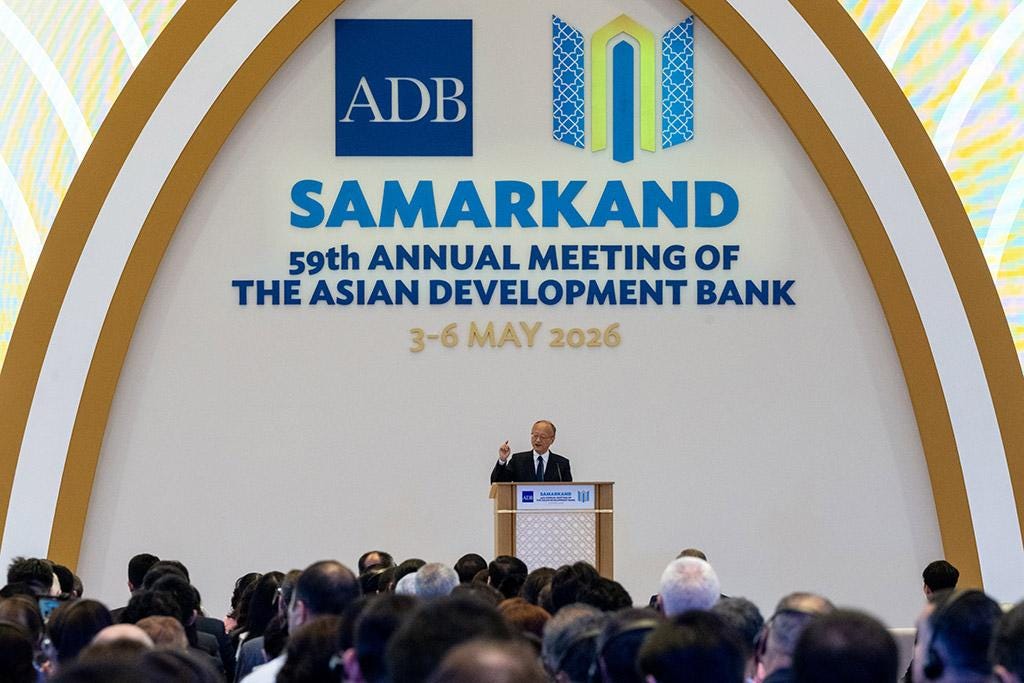
In May 2026, the Asian Development Bank arrived in Samarkand with a simple question hanging over its Annual Meetings: could Asia remain connected in a world that was fragmenting? Trade routes were under pressure, energy systems were straining under rising demand, and geopolitical tensions were beginning to shape everything from food prices to electricity grids. Over four days in one of the oldest cities on the Silk Road, finance ministers, development bankers, private investors, and political leaders gathered to debate what regional cooperation would look like in the next decade. Beneath the diplomatic speeches and carefully staged ceremonies sat a more urgent reality. The model of growth that had powered Asia for decades was entering a more unstable era.
The city itself carried a certain symbolism. Samarkand had spent centuries as a meeting point between empires, traders, and civilisations. Caravans once moved through its markets carrying silk, spices, metals, and ideas between China, Persia, India, and Europe. In 2026, the traffic was digital infrastructure plans, cross-border electricity grids, climate finance packages, and debates over supply chains.
The Asian Development Bank leaned heavily into that symbolism. The theme of the 59th Annual Meeting was “Crossroads of Progress: Advancing the Region’s Connected Future”.
For Uzbekistan’s president, Shavkat Mirziyoyev, the meeting represented something larger than a development conference. Since taking office in 2016, Mirziyoyev had tried to reposition Uzbekistan from an inward-looking post-Soviet state into a regional commercial hub. Hosting the Annual Meeting became part of that narrative. According to Uzbek government statements, the country had attracted massive inflows of investment and was attempting to expand its economy towards innovation-driven growth.
For ADB itself, the stakes were equally high. The institution was approaching its 60th anniversary, and the development environment around it had changed dramatically since its founding in 1966. Growth across Asia had lifted hundreds of millions out of poverty, but the easy gains were becoming harder to find. Infrastructure deficits remained enormous. Climate shocks were becoming more frequent. Supply chains that once appeared stable now looked fragile. Even the underlying logic of globalisation had become politically contested.
Inside the conference halls, there was a growing recognition that the next phase of Asian development would depend less on building isolated national systems and more on stitching economies together.
That idea surfaced repeatedly during the meeting’s major announcements. The most significant was a broad regional infrastructure initiative reportedly valued at around $70 billion. According to coverage of the meeting, the proposal centred on two pillars: a Pan-Asia Power Grid Initiative designed to expand cross-border electricity connectivity, and a major digital infrastructure push aimed at broadband and data systems across the region.
To outsiders, a cross-border power grid can sound abstract. In practice, it works much like a regional transportation network. Countries with excess electricity at one moment can supply neighbours facing shortages. Renewable energy generated in one geography can move across borders instead of being wasted locally. The larger and more connected the grid becomes, the more resilient the overall system tends to be.
ADB President Masato Kanda framed the issue in stark terms. “To survive and thrive in this new era, we must build deeply connected and resilient systems,” he said during the meeting.
The statement reflected a broader shift taking place across development finance. For decades, infrastructure lending often focused on national projects: one country, one highway, one dam, one power station. By Samarkand, the conversation had moved toward networks. Electricity interconnections. Regional rail systems. Shared digital corridors. Coordinated supply chains.
Part of that shift was economic. Part of it was geopolitical.
The world arriving in Samarkand looked considerably more unstable than the one that existed even five years earlier. Discussions around food security became unusually prominent during the meeting. Officials warned that disruptions around the Strait of Hormuz were already increasing the cost of fuel, fertiliser, insurance, and freight.
Those effects travelled quickly through agricultural systems. Higher energy prices raised fertiliser costs. Higher transport costs affected food distribution. Farmers adjusted planting decisions. Inflation spread outward. What began as a geopolitical shock in one region eventually appeared in supermarket prices thousands of kilometres away.
Qingfeng Zhang, ADB’s Senior Director for Agriculture, Food, Nature, and Rural Development, described the pressure building across regional food systems. The comments carried an implicit warning. Asia’s economic integration had generated extraordinary gains during decades of relative stability. The same interconnectedness could now transmit shocks at remarkable speed.
Outside the main plenary halls, another conversation unfolded more quietly.
Civil society groups arrived in Samarkand with their own agenda. Organisations focused on environmental protection, indigenous rights, and accountability used the meeting to challenge the Bank’s evolving energy strategy. Some criticised ADB’s support for critical mineral extraction, large hydropower projects, geothermal developments, and waste-to-energy investments.
These tensions exposed one of the defining contradictions of modern development finance. The clean energy transition requires enormous quantities of copper, lithium, nickel, transmission infrastructure, and renewable power generation. Yet many of the projects designed to accelerate decarbonisation create environmental disruption, displacement, and political conflict on the ground.
Development banks increasingly found themselves balancing competing pressures. Governments wanted faster infrastructure delivery. Investors demanded bankable projects. Communities demanded consultation and protections. Climate targets demanded speed.
The Annual Meeting became a stage where all of those forces collided.
Several controversial projects hovered in the background of discussions. The Rogun hydropower project in Tajikistan, major mining investments in Pakistan’s Balochistan region, geothermal expansion in Indonesia, and large hydroelectric projects in Nepal all drew criticism from advocacy organisations attending the meeting.
For ADB, this scrutiny reflected a larger institutional challenge. The traditional model of development lending, where economic growth itself was often treated as sufficient justification, no longer carried the same legitimacy it once did. Questions around environmental safeguards, indigenous rights, civic participation, and accountability had become central to project finance.
That evolution was visible in the discussions around ADB’s Environmental and Social Framework and its accountability mechanisms. Civil society organisations openly questioned whether commitments made in policy documents would translate into meaningful protections during implementation.
The contrast between the polished optimism inside the formal sessions and the sharper criticism outside them gave the meeting a certain tension. Samarkand was simultaneously a celebration of regional ambition and a reminder of how contested development had become.
Yet the dominant mood remained forward-looking.
Much of that optimism centred on connectivity itself. The idea carried historical resonance in Central Asia, where geography had always shaped destiny. Countries across the region had spent decades constrained by fragmented transport systems, limited energy integration, and weak trade corridors following the collapse of the Soviet Union.
Mirziyoyev’s government had tried to reverse that fragmentation. Regional diplomacy improved. Border restrictions eased. Investment flows increased. Infrastructure partnerships expanded.
The ADB meeting amplified that narrative. Samarkand presented itself as both symbol and strategy: an ancient crossroads attempting to become a modern one.
For many delegates, the deeper question was whether multilateral institutions like ADB could still play a coordinating role in an increasingly fragmented geopolitical environment. The post-Cold War assumption that global economic integration would steadily deepen no longer looked guaranteed. Strategic competition between major powers had returned. Trade policy was becoming more politicised. Industrial policy was back. Supply chains were being redesigned around security concerns as much as efficiency.
Against that backdrop, regional development banks occupied an unusual position. They were financiers, conveners, technical advisers, and political intermediaries all at once.
The Annual Meeting’s schedule reflected that breadth. Finance ministers met alongside private investors, infrastructure firms, civil society groups, academics, and central bankers. Sessions ranged from food systems to digital infrastructure to energy transition financing.
The sheer variety sometimes made the event feel diffuse. But beneath the sprawling agenda sat a coherent theme. Asia’s next stage of growth would require coordination across borders at a scale the region had never previously attempted.
That challenge was particularly visible in energy.
Renewable energy systems create a different infrastructure problem from fossil fuel systems. Coal plants can often operate relatively independently within national grids. Renewable generation is more variable. Solar and wind output fluctuate by time, season, and geography. Larger interconnected systems help smooth those fluctuations.
That technical reality partly explains the appeal of cross-border power grids. A windy region in one country can support electricity demand elsewhere. Hydropower in one geography can stabilise solar-heavy systems in another. Connectivity becomes a resilience strategy.
The Pan-Asia Power Grid Initiative reflected this thinking directly. According to reporting around the meeting, the programme aimed to support regional electricity integration while expanding access to cleaner energy sources.
The proposal also carried geopolitical implications. Infrastructure creates interdependence. Interdependence can reduce costs and increase resilience, but it can also create vulnerabilities. Countries connected through power systems, trade corridors, or data infrastructure become economically tied to one another’s stability.
That balance between cooperation and vulnerability lingered over many conversations in Samarkand.
By the meeting’s closing sessions, the official tone remained optimistic. Regional cooperation was framed as both economic necessity and strategic opportunity. Infrastructure was presented as the backbone of resilience. Connectivity became the organising principle tying energy, transport, trade, and digital systems together.
Yet the subtext of the gathering was harder to ignore.
The world that created Asia’s extraordinary growth story over the past four decades was changing. Climate volatility was increasing. Geopolitical tensions were hardening. The economics of globalisation were shifting. Development institutions were being asked to move faster while satisfying more demands from governments, investors, activists, and affected communities simultaneously.
Samarkand captured that transition almost perfectly.
An ancient Silk Road city hosted a modern argument about what integration would mean in the twenty-first century. The caravans had become transmission lines, fibre optic cables, trade corridors, and renewable energy projects. But the underlying question remained remarkably similar to the one merchants and rulers faced centuries earlier: how do you build prosperity across borders when the world around you is becoming more uncertain?
The answer, at least in Samarkand, was that Asia would try to stay connected anyway
Make sure you subscribe to MDB Jobs to get the latest vacancies delivered straight to your inbox each Monday, and consultant positions each Friday.